


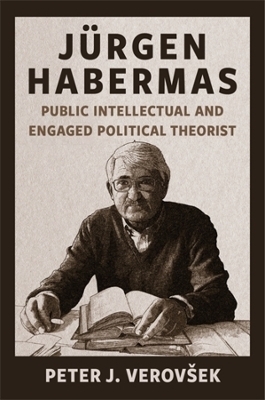
Jürgen Habermas
Public Intellectual and Engaged Critical Theorist
Seiten
2026
Columbia University Press (Verlag)
978-0-231-21302-8 (ISBN)
Columbia University Press (Verlag)
978-0-231-21302-8 (ISBN)
- Noch nicht erschienen (ca. März 2026)
- Versandkostenfrei
- Auch auf Rechnung
- Artikel merken
This book provides a new understanding of Jürgen Habermas by focusing on his work as a public intellectual, showing how he has shaped debates far beyond the ivory tower.
Jürgen Habermas is Germany’s most important postwar philosopher, the leading figure of the Frankfurt School in this period. He is best known for the concept of the public sphere, which forms the basis of his communicative understanding of democratic politics. Habermas has not only theorized the public sphere—he has also taken part in it through frequent commentary on current social, political, and cultural issues. Yet since Habermas’s extensive public-facing writings have been overlooked, his philosophy has often been criticized as apolitical.
This book transforms our understanding of Habermas by focusing on his work as a public intellectual, showing how he has shaped debates far beyond the ivory tower. Peter J. Verovšek argues that while Habermas maintains a strict separation between his academic and his public-facing writings, he has also ensured that these two aspects of his work are part of a consistent whole. The book highlights the development of Habermas’s views over time and the changing nature of his public interventions. His early political writings focused on questions tied to the particular situation of postwar West Germany, but since 1989 he has increasingly turned his attention to the future of Europe and global politics more broadly. Verovšek sheds light on the interrelationship between Habermas’s participation in the public sphere and his theoretical work, demonstrating that his political engagement is crucial to understanding his philosophy. In a moment when public debate is under threat, this book offers timely new insight into Habermas’s lifelong project of defending the public sphere—both in theory and in practice.
Jürgen Habermas is Germany’s most important postwar philosopher, the leading figure of the Frankfurt School in this period. He is best known for the concept of the public sphere, which forms the basis of his communicative understanding of democratic politics. Habermas has not only theorized the public sphere—he has also taken part in it through frequent commentary on current social, political, and cultural issues. Yet since Habermas’s extensive public-facing writings have been overlooked, his philosophy has often been criticized as apolitical.
This book transforms our understanding of Habermas by focusing on his work as a public intellectual, showing how he has shaped debates far beyond the ivory tower. Peter J. Verovšek argues that while Habermas maintains a strict separation between his academic and his public-facing writings, he has also ensured that these two aspects of his work are part of a consistent whole. The book highlights the development of Habermas’s views over time and the changing nature of his public interventions. His early political writings focused on questions tied to the particular situation of postwar West Germany, but since 1989 he has increasingly turned his attention to the future of Europe and global politics more broadly. Verovšek sheds light on the interrelationship between Habermas’s participation in the public sphere and his theoretical work, demonstrating that his political engagement is crucial to understanding his philosophy. In a moment when public debate is under threat, this book offers timely new insight into Habermas’s lifelong project of defending the public sphere—both in theory and in practice.
Peter J. Verovšek is senior assistant professor in history and theory of European integration at the University of Groningen. He is the author of Memory and the Future of Europe: Rupture and Integration in the Wake of Total War (2020).
Preface
Introduction: Habermas the Public Intellectual
1. Mediating Theory and Practice
2. The Journalistic Years, 1951–1955
3. At the Institute for Social Research, 1956–1959
4. A Partisan Professor in the Student Movement, 1960–1971
5. Retreat to Starnberg, 1971–1982
6. Return to the Public Sphere, 1983–1992
7. A Turn From Germany to Europe, 1993–2009
8. The Colonization of Politics by Economics, 2010–2020
Conclusion: The Last Public Intellectual?, 2021–2025
Notes
Bibliography
Index
| Erscheint lt. Verlag | 24.3.2026 |
|---|---|
| Reihe/Serie | New Directions in Critical Theory ; 91 |
| Verlagsort | New York |
| Sprache | englisch |
| Maße | 156 x 235 mm |
| Themenwelt | Literatur ► Biografien / Erfahrungsberichte |
| Sachbuch/Ratgeber ► Geschichte / Politik | |
| Geisteswissenschaften ► Philosophie | |
| Sozialwissenschaften ► Politik / Verwaltung ► Politische Theorie | |
| ISBN-10 | 0-231-21302-6 / 0231213026 |
| ISBN-13 | 978-0-231-21302-8 / 9780231213028 |
| Zustand | Neuware |
| Informationen gemäß Produktsicherheitsverordnung (GPSR) | |
| Haben Sie eine Frage zum Produkt? |
Mehr entdecken
aus dem Bereich


aus dem Bereich
Leben und letzte Reise eines Revolutionärs
Buch | Hardcover (2025)
C.H.Beck (Verlag)
CHF 36,40
Weltherrschaft und Menschheitsethos
Buch | Hardcover (2025)
Suhrkamp (Verlag)
CHF 67,20
Buch | Softcover (2025)
Matthes & Seitz Berlin (Verlag)
CHF 16,80


