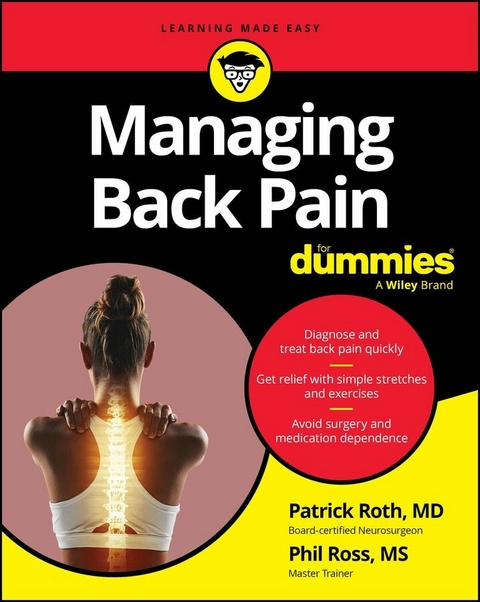
Managing Back Pain For Dummies (eBook)
568 Seiten
For Dummies (Verlag)
9781394295296 (ISBN)
Discover countless options for rest and relief when you have chronic back pain
You're probably not thrilled that you need a book called Managing Back Pain For Dummies, but you'll be thrilled that you bought it. Written by a neurosurgeon and a master personal trainer, this book contains expert advice that will help you feel better. You'll get step-by-step guidance on how to lessen your pain and reduce reliance on medication, using self-treatments and exercises that really work. You'll also learn about the clinical treatments that are available to treat back pain-and when it's time to seek a doctor's help. Back pain is different for everyone. You might benefit from simple posture fixes and at-home exercises, or you might be ready to pursue injections, nerve blocks, and other medical treatments. Wherever you are on the back pain spectrum, this helpful Dummies guide will help move the needle toward relief.
- Prevent and reduce back pain by improving your posture and technique during daily activities like yard work
- Understand the latest professional treatments and self-treatments, and know when to see an MD
- Reduce your reliance on medication by exploring our methods of stimulating self-healing and permit the body to heal itself.
Follow clear, concise, illustrated exercise routines designed to strengthen your core and support muscles of the spine. This book is for the millions of people who are struggling with back pain and looking for non-surgical options to improve their quality of life.
Patrick Roth, MD, MHA founded New Jersey Brain and Spine, the premier neurosurgical group in New Jersey. He serves as both chairman of the department of neurosurgery at Hackensack University Medical Center and chair of the department of neurosurgery at Hackensack Meridian School of Medicine. His interest in spine includes using technology to decipher pain generators and utilizing minimal access solutions when appropriate.
Phil Ross, MS is an ACE certified personal trainer and developer of The Get Off Your Back Method and The BodyBell Method®, providing hands on methods to prevent, alleviate, treat, and manage back pain. He is Board member of the Industry Advisory Council at APUS. Pat and Phil are big advocates in a holistic approach to pain, involving mind and body therapy, is always the most essential component of care.
Introduction
Your back hurts, and you have two questions: “What’s causing it?” and “What can I do about it?” Chances are good that you’ve already tried to get answers to those questions. Maybe you asked your doctor about it, searched the Internet, had your back cracked by a local chiropractor, tried hanging upside down on an inversion table, bought an expensive new mattress, or even had spinal surgery. Despite your best efforts, your back still hurts, and you have no idea what to do about it. Chances are good that your doctor doesn’t know either.
So, now, here you are, book in hand, hoping it can answer those two questions. We hate to break it to you, but you may never get a clear, definitive answer to that first question. You may never know what’s causing your back pain. Its cause can be elusive. It doesn’t always show up clearly on medical imaging or a lab test, and it can be the result of several factors, some of which modern medicine has no way of determining for sure. The good news is that knowing what’s causing your back pain often doesn’t matter. You can do a lot on your own to manage it effectively, maybe even make it go away, without having any idea what’s causing it.
The fact is that almost regardless of what’s making your back hurt, being healthier and stronger and having the right mindset make your back feel better. And it feels better because it is better — it’s stronger, more mobile, more flexible, and more resilient.
About This Book
In this book, we offer a unique patient-centered approach to managing back pain that puts you at the head of your treatment team. Here, you discover how to build a powerful mind-body synergy that makes your back healthier, more mobile, and more resilient. You do most of the heavy lifting by educating yourself and building a healthier, stronger mind and body, and you consult providers when you need professional assistance — physical therapy, pain meds, surgery, chiropractic adjustment, fitness training, and so on.
The way we structured the information and guidance presented in this book reinforces our patient-centered philosophy. Had we followed a traditional approach, we would have covered diagnosis and medical treatments first and then discussed what you, as a patient, could do to enhance your recovery. Instead, we focus first on education and self-help and then discuss diagnoses, treatments, and therapies that healthcare professionals can provide to augment your efforts.
Admittedly, such an approach may seem counterintuitive. Logically, diagnosis comes first, followed by treatment. Sometimes, that is the best course of action. If your back pain is so severe that you can’t move, or it’s accompanied by weakness in a limb (arm or leg), diagnosis and medical treatment may be the first steps. However, diagnosis can, and often does, lead patients down a path of unnecessary surgeries and other treatments that can do more harm than good and burden them with a hefty and avoidable expense. In addition, diagnosis often makes people mistakenly believe that fixing back pain is simply a matter of identifying and treating physical injury or damage (a pain generator), and that’s often not the case. The fact is that most people with back pain would be better off not seeking a diagnosis first. More often than not, the pain will subside in a few days to a couple of weeks. If the exercise, stretching, and other do-it-yourself remedies do not provide relief or if the condition worsens, seek medical attention.
We are not suggesting that you “self-diagnose,” but realize that many strains and pains may go away on their own or by employing tactics other than an immediate visit to the doctor. In Chapter 5, we provide guidance to help you decide the right approach for you — seeing a doctor first or starting with a do-it-yourself approach.
This book has two authors with vastly different backgrounds — one a neurosurgeon and the other a personal trainer — a Master Trainer. You get the benefits of both perspectives, along with comprehensive coverage of all aspects of managing back pain. Together, we bring you up to speed on the anatomy and physiology of back pain and equip you with the knowledge, insight, and tools you need to manage it effectively. We don’t expect you to do everything we recommend all at once, all the time, or in the order we present it. Feel free to skip around and try different things. Everybody’s different, and everybody is different. Additionally, you may need to focus on different aspects of back pain at different points in time as your needs change. Incorporating a broad range of exercises and activities is also great for keeping things interesting and stimulating adaptation (your mind and body’s natural ability to adapt to stress).
Foolish Assumptions
As you’ll soon discover when you start reading this book, we discourage people from making assumptions about anything related to their health, such as assuming that the doctor is always right or that your back pain is due to an injury. However, to better serve your needs, we make the following foolish assumptions about you:
- Your back hurts, and you want to know how to make the pain go away.
- You’re tired of having your back pain prevent you from living a full and active life. You have things to do, places to go, and people to love!
- You’re not looking for a quick fix that merely masks the pain or makes it go away for a few days or weeks. You want a more permanent solution — and a better back.
- You’re willing to take responsibility for your own health and invest time and effort into becoming healthier, stronger, and more resilient.
Icons Used in This Book
Throughout this book, icons in the margins highlight certain types of valuable information that call out for some special attention. Here are the icons we use and a brief description of each.
Of course, we’d love for you to remember everything you read in this book, but if you can’t quite do that, then remember the important points we flag with this icon.
Tips are tidbits of information and insight that we’ve gathered from our many years of education, training, and experience that are distilled to save you time and effort.
“Pump the brakes!” Before you take another step, read these warnings. We provide this cautionary content to help you avoid the common pitfalls that are otherwise likely to slow your progress or set you back on your road to recovery.
Beyond the Book
As if we didn’t already pack this book with a ton of great information on managing back pain, you can access the book’s Cheat Sheet at Dummies.com. This Cheat Sheet provides quick and handy info and tips you can use on the go. It includes guidance on when to see a doctor, reasons to avoid a diagnosis, a common-sense approach to back pain diagnosis, six essential exercises for mobilizing the back, and a list of professionals who can help manage back pain. To access this Cheat Sheet, simply go to https://www.dummies.com/ and search for “back pain cheat sheet.”
You can also find videos for several of the exercises we cover in Chapters 8 and 9 by visiting Phil’s YouTube channel @TheMasterPhil.
Where to Go from Here
As with all For Dummies guides, you can read this book from cover to cover or skip around to the topics you find most interesting or applicable to your situation. If you choose to skip around, use the table of contents at the front of the book or the extensive index at the back of the book as your guide.
To make our book easier to navigate, we divided the content into the following four parts:
- Part 1: Getting Started with Back Pain Management brings you up to speed on the basics, introduces you to common anatomical injuries and anomalies that can trigger back pain, explains the powerful role the mind can play in both creating and relieving back pain, and provides guidance on where to start — whether you should see a doctor first or try to resolve your back problem on your own.
- Part 2: Taking a Do-It-Yourself Approach to Back Pain presents a host of self-care therapies for building a stronger, healthier back. Here, we cover everything from improving diet and making lifestyle changes to doing exercises focused specifically on strengthening the back to home remedies and healthy breathing. If you do half of what we encourage you to do in Part 2, you may not need to see a doctor.
- Part 3: Exploring Professional Back Pain Treatment Options explains how different healthcare professionals who specialize in treating various aspects of back pain can help you get back on your feet and enable you to engage in the self-care therapies we recommend in Part 2. Here, we cover topics including medical imaging, pain management, physical therapy, chiropractic care, spinal surgery, and psychological therapies. These pockets of professional care can do wonders to jump-start and accelerate your self-healing. You may not need them but they’re great to have if you do.
- Part 4: The Part of Tens presents ten tips to help you stick with your personalized pain management program and ten hard-to-believe facts about back pain.
Browse through the...
| Erscheint lt. Verlag | 15.9.2025 |
|---|---|
| Sprache | englisch |
| Themenwelt | Sachbuch/Ratgeber ► Gesundheit / Leben / Psychologie |
| Schlagworte | Back Care • back exercises • Back injury • Back pain • back pain management • back pain relief • back support • chiropractor • chronic back pain • Healthy back • physical therapy back • pillows for back pain • posture book • posture exercise • spine stretch |
| ISBN-13 | 9781394295296 / 9781394295296 |
| Informationen gemäß Produktsicherheitsverordnung (GPSR) | |
| Haben Sie eine Frage zum Produkt? |
 EPUB (Adobe DRM)
Kopierschutz: Adobe-DRM
Adobe-DRM ist ein Kopierschutz, der das eBook vor Mißbrauch schützen soll. Dabei wird das eBook bereits beim Download auf Ihre persönliche Adobe-ID autorisiert. Lesen können Sie das eBook dann nur auf den Geräten, welche ebenfalls auf Ihre Adobe-ID registriert sind.
Details zum Adobe-DRM
Dateiformat: EPUB (Electronic Publication)
EPUB ist ein offener Standard für eBooks und eignet sich besonders zur Darstellung von Belletristik und Sachbüchern. Der Fließtext wird dynamisch an die Display- und Schriftgröße angepasst. Auch für mobile Lesegeräte ist EPUB daher gut geeignet.
Systemvoraussetzungen:
PC/Mac: Mit einem PC oder Mac können Sie dieses eBook lesen. Sie benötigen eine
eReader: Dieses eBook kann mit (fast) allen eBook-Readern gelesen werden. Mit dem amazon-Kindle ist es aber nicht kompatibel.
Smartphone/Tablet: Egal ob Apple oder Android, dieses eBook können Sie lesen. Sie benötigen eine
Geräteliste und zusätzliche Hinweise
Buying eBooks from abroad
For tax law reasons we can sell eBooks just within Germany and Switzerland. Regrettably we cannot fulfill eBook-orders from other countries.
aus dem Bereich