Magic For Dummies (eBook)
402 Seiten
For Dummies (Verlag)
978-1-394-34325-6 (ISBN)
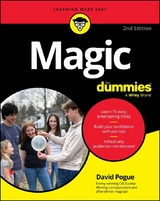
Develop the knowledge, skill, and showmanship you need to thrill audiences of all ages
Magic For Dummies is your introduction to mystifying friends, family, and the world at large with the art of the magic. Emmy award-winning author David Pogue teaches you dozens of fun, inexpensive tricks that you can do with everyday objects like office supplies, clothing, food, and even your phone. Card tricks, sleight of hand, disappearing tricks-it's all in here. You'll also learn how to practice and improve your skills, so you can take your magical performances to the next level. Plus, this book includes tips on how to refine your techniques, so you can dazzle any live or virtual audience. This entertaining introduction to the world of illusion is a must for aspiring magicians.
- Get easy instructions on how to perform and perfect basic magic tricks
- Become a more entertaining magician, with tips on connecting with your audience
- Discover the fun of performing magic tricks for friends and strangers, in person and online
- Wow people of all ages with card tricks, optical illusions, and beyond
This book is for readers of all ages who want to learn the art of magic, including beginners and those who have already tried a trick or two.
David Pogue is a seven-time Emmy-winning correspondent for 'CBS Sunday Morning,' a New York Times bestselling author, five-time TED speaker, the writer or co-writer of more than 120 books, and a 20-time host of NOVA on PBS. He's done magic since he was five.
Develop the knowledge, skill, and showmanship you need to thrill audiences of all ages Magic For Dummies is your introduction to mystifying friends, family, and the world at large with the art of the magic. Emmy award-winning author David Pogue teaches you dozens of fun, inexpensive tricks that you can do with everyday objects like office supplies, clothing, food, and even your phone. Card tricks, sleight of hand, disappearing tricks it's all in here. You'll also learn how to practice and improve your skills, so you can take your magical performances to the next level. Plus, this book includes tips on how to refine your techniques, so you can dazzle any live or virtual audience. This entertaining introduction to the world of illusion is a must for aspiring magicians. Get easy instructions on how to perform and perfect basic magic tricks Become a more entertaining magician, with tips on connecting with your audience Discover the fun of performing magic tricks for friends and strangers, in person and online Wow people of all ages with card tricks, optical illusions, and beyond This book is for readers of all ages who want to learn the art of magic, including beginners and those who have already tried a trick or two.
Chapter 1
All Form, No Content
IN THIS CHAPTER
How to get comfortable in the spotlight
The importance of patter
A few goofy, funny tricks to warm you up
If you’ve read this book’s Introduction, you know that only a tiny percentage of a magic trick is what you do. The rest is how you do it: your sense of humor, timing, and conversation. Hate to break it to you, but behind the scenes, some of the world’s greatest magic tricks actually look pretty dumb. Out front, they look spectacular — but you may have to overcome a certain self-consciousness when doing them.
How can I possibly stress the importance of personality in magic? How can I cure you of worrying that you might get caught doing something silly? How can I hook you on the rush of entertaining people, even if you’ve never been a show-off before?
Hey, I’ve got it: I’ll begin the book with tricks that are nothing but showmanship. These tricks aren’t even tricks. They’re optical illusions, hilarious visual jokes, laugh-out-loud quickies. These tricks aren’t about fooling people; they’re about entertaining people — which, after all, is the goal of magic. Because there’s nothing for the audience to figure out, you won’t suffer that kind of performance anxiety.
These tricks will, however, get you into the habit of performing. Try them out. Get a sense of how people react to you. Practice being onstage. See how it feels to talk as you go. After you do a few of these, you’ll be ready for the added excitement of astonishing and entertaining people; that’s what the rest of the book is about.
THE IMPORTANCE OF PATTER
Patter is magicians’ terminology for “what you say while you’re doing the trick.”
Not every magician talks while performing; some stage magicians, for example, hit Play on a playlist before doing their stuff. You, however, may find it a tad inconvenient to whip out a Bluetooth speaker as you sit down at the restaurant table or stand in line for a movie.
No magician performs in absolute silence; it’s just too uncomfortable. Because the music thing isn’t ideal for close-up, impromptu performances, you have to talk while you do your tricks.
Patter can take various forms. If you can’t think of anything clever, just describe what you’re doing. (“Now I’m going to insert this steak knife, which you’ve previously examined, into the melon …”) Sometimes you may be able to create a storyline that goes with your trick. (“Centuries ago, there was a magical steak knife from India who fell in love with a forbidden cantaloupe …”)
If you’re going to perform a trick before your speech at a business function, for example, it’s usually easy to make up patter that ties in with your pitch. (“Now, most consultants are like steak knives plunging into a melon. They only tackle problems they already know they can solve …”) The point is to say something as you go. Make it funny, make it serious and mysterious, make it New Age and life-affirming — just say something.
Because patter is a huge part of any good magic trick, I’m going to suggest patter for every trick in this book. If you use it, great. If you don’t, replace it with your own homemade patter. Just don’t perform in silence.
The Anti-gravity Pencil
You don’t necessarily need a pencil for this trick. You could also call this trick the Anti-gravity Butter Knife, Letter Opener, Straw, Ruler, Magic Wand, or Other Long Skinny Doodad.
The effect: You clench a long pencil (or other long skinny doodad) in your fist. You hold it high above your head — and open your fingers one by one. But the pencil doesn’t fall! It hangs there against your palm, defying gravity.
The secret: The only thing defying gravity is the index finger of your other hand. Like I said, this one isn’t really designed to fool anyone older than about nine years old (although you may be surprised). But it sure looks good, and it’s great practice for overcoming the “The-secret-is-so-stupid-I-can’t-believe-I’m-doing-this” syndrome.
-
Rub the pencil (or other doodad) up and down against your clothing, as though you’re building up a static charge.
“Did you ever fool around with static electricity when you were a kid?” you might say. “We used to rub balloons against the carpet, and then they’d stick against the wall.”
-
Lay the pencil across your open left palm (photo A in Figure 1-1).
For added effect, you might pull it away from your skin a couple of times, as though you’re testing the static charge.
FIGURE 1-1: At the outset, the setup looks innocent enough (A), here featuring a magic wand. After you’ve closed your left hand (B), your right hand (seen in C from behind) is missing a finger, although nobody will notice. And voilà … anti gravity (D)!
-
Close your hand into a fist. Grab your own wrist with the other hand, as shown in photo A. Turn your fist so the back faces the audience. As you do so, straighten your right index finger (which is out of sight) so that it pins the pencil against your palm (photos B and C).
You’ll have to open a couple of your fist fingers briefly to let your index finger in.
I know, I know — you’re worried that people will see this move. They won’t. First, your turning wrist blocks your index finger’s movement. Second, your audience isn’t even tuned in yet — as far as they’re concerned, you haven’t even started the trick yet! If you act as though nothing important has happened yet, so will the audience.
After you’re in position, however, your attitude should change. Now get slow, deliberate, and highly mystical. Start acting.
“The funny thing is — when the humidity is just right …” (It’s okay to not finish your sentences here. You’re much too busy concentrating.) “I’ve found that even heavier objects can sometimes — here, I’ll just …”
-
Raise your hands to the level of your head. Look at your hands. With a great display of difficulty and danger, open your fingers one by one (photo D).
Leave the thumb last; to the last moment, you want your audience to think, “Oh, big deal. The thumb is still holding the pencil.” Then, when you finally do open your thumb (and the pencil doesn’t fall), there’s a moment of genuine shock or hilarity, depending on how seriously your audience is taking you.
At this point, spread your open fingers wide. You might decide to move your hand slowly around, maybe even shaking it. You might even roll the pencil mysteriously up and down your palm (with your index finger), although doing so immediately gives away the secret. (Which is fine if you’re doing this for comedic effect or for children.)
-
Finally, close up your fingers again and bring your hands down. Deliberately turn your left fist knuckles up — which perfectly conceals your right index finger sneaking back out of your fist and joining the other fingers on your wrist.
You’ve just reversed the move you made at the outset. There’s nothing left for the audience to see but your left fingers opening, revealing an ordinary pencil that, by now, has lost its static charge.
If anyone actually looks mystified, you can now hand over the pencil: “You wanna try? It feels really neat!”
Otherwise, if everyone’s smiling and thoroughly entertained, you might decide to (a) get back to work, (b) break your pencil with a dollar bill (see Chapter 3), or (c) push the pencil up your nose (see “Pencil Up the Nose,” later in this chapter).
TRUTHS OF MAGIC, PART 1: NOBODY QUESTIONS THE PROCEDURE
At one point in the Anti-gravity Pencil trick that opens this chapter, you’re supposed to grab your wrist with the other hand. In 1,000 performances, nobody will ever ask why it’s necessary for you to grab your own wrist! Deep down, they’ll assume you’re trying to stabilize your fist, help lift it into the air, guard against germs, or whatever.
But the more important lesson here is useful in overcoming your shyness about doing magic: When it comes to how you do something, the advantage is definitely the magician’s. For some reason, audiences simply don’t question the way you do something; they just assume that the rules of the trick are a given.
Look: If a stage magician were really magic, he’d just stand there in the middle of Times Square with his assistant and slice her in half with a power saw. But he doesn’t. He puts her in a box. On a table, on a stage. With the audience seated out front, limiting their view of his assistant before cutting her in half.
But not a single person complains about all that setup. To them, a woman still got bisected, and it’s a darned-tootin’ miracle.
Pencil Up the Nose
Amazing isn’t the...
| Erscheint lt. Verlag | 8.9.2025 |
|---|---|
| Sprache | englisch |
| Themenwelt | Sachbuch/Ratgeber ► Freizeit / Hobby |
| Schlagworte | become a magician • book on magic tricks • card magic • card tricks • coin trick book • deception magic • magic books for adults • magician book • magic show book • magic trick book • Magic tricks • simple magic tricks • sleight of hand • stage magic |
| ISBN-10 | 1-394-34325-6 / 1394343256 |
| ISBN-13 | 978-1-394-34325-6 / 9781394343256 |
| Informationen gemäß Produktsicherheitsverordnung (GPSR) | |
| Haben Sie eine Frage zum Produkt? |
 EPUB (Adobe DRM)
Kopierschutz: Adobe-DRM
Adobe-DRM ist ein Kopierschutz, der das eBook vor Mißbrauch schützen soll. Dabei wird das eBook bereits beim Download auf Ihre persönliche Adobe-ID autorisiert. Lesen können Sie das eBook dann nur auf den Geräten, welche ebenfalls auf Ihre Adobe-ID registriert sind.
Details zum Adobe-DRM
Dateiformat: EPUB (Electronic Publication)
EPUB ist ein offener Standard für eBooks und eignet sich besonders zur Darstellung von Belletristik und Sachbüchern. Der Fließtext wird dynamisch an die Display- und Schriftgröße angepasst. Auch für mobile Lesegeräte ist EPUB daher gut geeignet.
Systemvoraussetzungen:
PC/Mac: Mit einem PC oder Mac können Sie dieses eBook lesen. Sie benötigen eine
eReader: Dieses eBook kann mit (fast) allen eBook-Readern gelesen werden. Mit dem amazon-Kindle ist es aber nicht kompatibel.
Smartphone/Tablet: Egal ob Apple oder Android, dieses eBook können Sie lesen. Sie benötigen eine
Geräteliste und zusätzliche Hinweise
Buying eBooks from abroad
For tax law reasons we can sell eBooks just within Germany and Switzerland. Regrettably we cannot fulfill eBook-orders from other countries.
aus dem Bereich