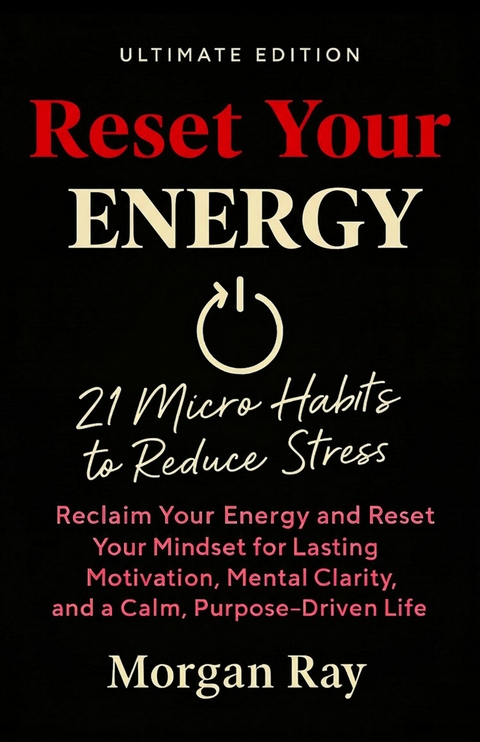
Reset Your Energy (eBook)
148 Seiten
Publishdrive (Verlag)
978-0-00-104718-1 (ISBN)
You are not failing, you are exhausted.
If you look put-together on the outside but feel anxious, foggy, and out of fuel on the inside, this book meets you where you are and gets you moving again in minutes a day.
Written by Morgan Ray, certified stress-recovery coach and former burnout case, Reset Your Energy turns science into tiny, doable actions that fit real, messy life.
Read this if you are feeling:
• Brain fog, decision fatigue, unfinished tasks everywhere
• Sunday dread, 3 a.m. wakeups, constant pressure in your chest
• People-pleasing, guilt, and boundaries that do not stick
What you will learn:
• Stop the spiral: 60-second nervous system resets that calm stress fast, no meditation app needed
• Reclaim mental clarity: cut input overload, end the start and stop cycle, finish what matters
• Restore real energy: small shifts in sleep, food, caffeine, and movement that actually help
• Set boundaries that hold: word-for-word scripts for work, texts, and family, goodbye guilt
• Rebuild motivation: micro wins that thaw the freeze response and bring back drive and joy
• Design a life you do not need to escape: keep your ambition, lose the exhaustion
Inside, you will also get:
• The Burnout Reset Method: four pillars, Mind, Body, Energy, Identity
• 21 Micro Habits under 5 minutes, stacked into a simple 21-day Reset Blueprint
• Real-life tools: grounding techniques, no-pressure tracking, journal prompts that do not feel like homework
• Hidden drain detox: calendar, inbox, and environment cleanups that give you back hours and headspace
• Relatable stories from the edge of burnout and back: so you feel seen, not judged
If you're high-performing on the outside but depleted on the inside, this book meets you where you are: calm, clear, and actionable.
Whether you are a driven professional holding everything together or a compassionate high achiever who lost your spark, this book gives you small steps that create real, lasting change so you feel steady, focused, and alive again.
Start your 21-day reset today.
UNDERSTANDING THE REAL FACE OF BURNOUT
YOU THOUGHT YOU COULD PUSH THROUGH - UNTIL YOU COULDN'T
You thought you could push through until you couldn't, and this moment of recognition often marks the beginning of understanding what burnout actually is rather than what we've been conditioned to believe it should look like in our achievement-obsessed culture. This is the story of countless high-achievers, ambitious professionals, dedicated parents, and conscientious individuals who pride themselves on their ability to handle whatever life throws at them, who have built their identity around being the person others can count on, the one who always says yes, always steps up, always takes on just one more responsibility because they genuinely believe they can manage it all without consequence. You might recognize yourself in this description: the person who thrives under pressure, who gets energized by challenges, who has always been able to dig deeper when others would quit, who has made a career or a life out of exceeding expectations and delivering results even when the odds are stacked against them. For years, maybe decades, this approach has worked for you, earning you recognition, advancement, respect, and the internal satisfaction that comes from knowing you can be counted on when things get difficult. You've probably been living in a state of controlled chaos for longer than you care to admit, burning the candle at both ends while telling yourself it's temporary, juggling an ever-expanding collection of tasks, responsibilities, deadlines, and expectations that would overwhelm most people, all while maintaining the outward appearance of having everything under control. You've become an expert at ignoring the early warning signs your body has been sending: the chronic tension headaches you dismiss with over-the-counter medication, the digestive issues you attribute to poor eating habits caused by your busy schedule, the sleep disturbances you blame on too much caffeine or stress that will surely resolve once you get through your current crisis. You've rationalized away the emotional symptoms too: the increasing irritability you chalk up to dealing with incompetent colleagues, the growing sense of dread you feel on Sunday evenings that you tell yourself is normal, the gradual loss of enthusiasm for work that once energized and inspired you, the creeping cynicism that you convince yourself is just realistic maturity rather than a sign that something fundamental has shifted in your relationship with your career and your life.
The breaking point, when it comes, rarely looks like the dramatic collapse we see portrayed in movies or read about in cautionary tales about executive burnout. Instead, it's more often a quiet recognition that the strategies that have always worked for you simply aren't working anymore, that the reservoir of energy and resilience you've been drawing from for years has finally run dry, leaving you feeling empty, depleted, and fundamentally changed in ways you can't quite articulate or understand. Maybe it manifests as finding yourself sitting in your car in the parking lot of your workplace, unable to summon the energy to walk into a building where you've spent years building your career, feeling disconnected from the person who used to bound up those same stairs with enthusiasm and purpose. Perhaps it's the realization that you've been going through the motions of your life for months without really being present, that you've been so focused on managing your overwhelming to-do list that you've stopped experiencing joy, satisfaction, or meaning in the activities that used to define who you are. It could be the moment you recognize that you've become short-tempered with people you care about, that your relationships have suffered because you have nothing left to give at the end of each day, that you've been so busy taking care of everyone else's needs and expectations that you've completely lost touch with your own. Or maybe it's a health scare that forces you to confront the toll your lifestyle has been taking on your physical body, a mistake at work that you never would have made if your cognitive resources weren't so depleted, or a relationship crisis that makes you realize you've been present in body but absent in spirit for far too long. Whatever form your recognition takes, it represents a fundamental shift in understanding: this isn't just a particularly challenging season that you need to power through with more discipline, better time management, or increased caffeine consumption; this is your mind and body staging an intervention on your behalf, refusing to continue operating at unsustainable levels that were slowly destroying your health, your relationships, and your capacity for the very success you've been so desperately trying to achieve.
SNEAKY SIGNS YOU'RE BURNED OUT (NOT JUST TIRED)
Burnout is a master of disguise, presenting itself through a constellation of symptoms that can easily be mistaken for ordinary stress, temporary fatigue, or simply the natural challenges of adult responsibility, which is why so many high-functioning individuals remain trapped in cycles of depletion for months or years before recognizing what's actually happening to their nervous system and their capacity for sustained performance. The insidious nature of burnout lies in its ability to mimic other conditions while gradually eroding your baseline functioning in ways that feel normal because the decline is so gradual, like the proverbial frog in slowly boiling water who doesn't realize the danger until it's too late to jump out. Unlike acute stress, which has a clear beginning and end, or normal fatigue, which can be resolved with adequate rest and recovery, burnout represents a chronic state of nervous system disregulation that affects every aspect of your functioning: physical, cognitive, emotional, and spiritual. The chronic exhaustion that characterizes burnout goes far beyond the normal tiredness you feel after a long day or a challenging week; it's a bone-deep depletion that persists even after you've had what should be adequate sleep, rest, or time off, leaving you feeling like you're operating with a phone battery that never charges beyond 20% no matter how long you leave it plugged in. This exhaustion affects not just your physical energy but your mental and emotional capacity as well, making even simple decisions feel overwhelming, routine tasks seem insurmountable, and previously automatic processes require tremendous conscious effort and concentration. You might find yourself needing to rest after activities that used to energize you, feeling wiped out by social interactions that once brought you joy, or discovering that you need significantly more recovery time between challenging tasks or busy periods than you used to require.
The motivational changes associated with burnout are particularly troubling for high-achievers who have built their identity around their drive, ambition, and ability to maintain enthusiasm even during difficult periods. You might notice that work that once felt meaningful and engaging now feels pointless or overwhelming, that projects you used to tackle with enthusiasm now feel like insurmountable obstacles, or that you're procrastinating on tasks that would have been routine for you in the past. This isn't laziness or a sudden loss of work ethic; it's your nervous system's attempt to protect you from further depletion by reducing your engagement with activities that have become associated with chronic stress and overexertion. The loss of motivation often extends beyond work into other areas of your life as well: hobbies that used to bring you pleasure may feel like additional burdens, social activities that once energized you might seem exhausting, and even basic self-care activities like exercise, cooking nutritious meals, or maintaining your living space can feel overwhelming and unmanageable. You might find yourself going through the motions of your daily routine without any real engagement or satisfaction, feeling like you're living your life on autopilot while the person who used to feel passionate and purposeful has gone missing. The cognitive symptoms of burnout can be particularly frightening for people who pride themselves on their mental acuity and professional competence: difficulty concentrating that makes it hard to focus on complex tasks for extended periods, memory problems that result in forgotten appointments or missed deadlines, decision-making challenges that leave you paralyzed by choices that used to be straightforward, and reduced creativity or problem-solving ability that affects your capacity to innovate or think strategically about challenges in your work or personal life.
What makes these symptoms particularly insidious is that they often develop so gradually that you adapt to the decline without recognizing it as abnormal, convincing yourself that everyone feels this way, that this is just what adult responsibility looks like, or that you need to try harder to overcome what you perceive as personal weakness or lack of discipline rather than recognizing these symptoms as clear indicators that your nervous system is overwhelmed and in need of systematic restoration and recovery.
WHEN JOY FADES AND CYNICISM CREEPS IN
The erosion of joy and the gradual infiltration of cynicism represent one of the most heartbreaking aspects of burnout, transforming individuals who once approached their work and relationships with enthusiasm, optimism, and genuine engagement into people who feel...
| Erscheint lt. Verlag | 3.9.2025 |
|---|---|
| Sprache | englisch |
| Themenwelt | Sachbuch/Ratgeber ► Gesundheit / Leben / Psychologie ► Lebenshilfe / Lebensführung |
| ISBN-10 | 0-00-104718-3 / 0001047183 |
| ISBN-13 | 978-0-00-104718-1 / 9780001047181 |
| Informationen gemäß Produktsicherheitsverordnung (GPSR) | |
| Haben Sie eine Frage zum Produkt? |
 EPUB (Adobe DRM)
Größe: 1,1 MB
Kopierschutz: Adobe-DRM
Adobe-DRM ist ein Kopierschutz, der das eBook vor Mißbrauch schützen soll. Dabei wird das eBook bereits beim Download auf Ihre persönliche Adobe-ID autorisiert. Lesen können Sie das eBook dann nur auf den Geräten, welche ebenfalls auf Ihre Adobe-ID registriert sind.
Details zum Adobe-DRM
Dateiformat: EPUB (Electronic Publication)
EPUB ist ein offener Standard für eBooks und eignet sich besonders zur Darstellung von Belletristik und Sachbüchern. Der Fließtext wird dynamisch an die Display- und Schriftgröße angepasst. Auch für mobile Lesegeräte ist EPUB daher gut geeignet.
Systemvoraussetzungen:
PC/Mac: Mit einem PC oder Mac können Sie dieses eBook lesen. Sie benötigen eine
eReader: Dieses eBook kann mit (fast) allen eBook-Readern gelesen werden. Mit dem amazon-Kindle ist es aber nicht kompatibel.
Smartphone/Tablet: Egal ob Apple oder Android, dieses eBook können Sie lesen. Sie benötigen eine
Geräteliste und zusätzliche Hinweise
Buying eBooks from abroad
For tax law reasons we can sell eBooks just within Germany and Switzerland. Regrettably we cannot fulfill eBook-orders from other countries.
aus dem Bereich