


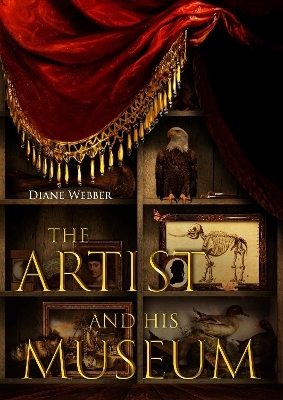
The Artist and His Museum
Seiten
2026
Casemate Publishers (Verlag)
978-1-955041-64-5 (ISBN)
Casemate Publishers (Verlag)
978-1-955041-64-5 (ISBN)
- Noch nicht erschienen (ca. Juni 2026)
- Portofrei ab CHF 40
- Auch auf Rechnung
- Artikel merken
The story of The Artist and His Museum is bigger than the insatiable curiosity and ambition of Charles Willson Peale. It’s the tale of a young country trying to find a voice in the world of big ideas.
Artist Charles Willson Peale was making detailed drawings of fossilized bones when a relative’s off-hand comment sparked an idea in his mind—why not turn his art gallery into a museum of the natural world? People would come. People might even pay! His reputation as a portrait painter was growing, but so was the number of people living under his roof. Charles Willson Peale turned from his career as a successful portrait artist to become the proprietor of America’s first public museum. Then (nearly) all of it disappeared, and (nearly) everyone forgot about it. What was Peale’s Museum? And where did it go?
Unlike the wealthy person’s “cabinet of curiosity” that came before, Charles wanted the museum to be organized by the latest ideas in scientific thinking. He believed useful knowledge should be available to the public, and hoped that his museum might offer Americans a sense of their emerging identity as citizens of a new nation. He dreamed that his museum would become a national, public institution, countering European views of American inferiority. Home to groundbreaking innovations in paleontology, taxidermy, and the role of scientific order, the museum survived yellow fever, multiple moves, and ongoing financial challenges before eventually closing. Today it’s largely forgotten. Yet Peale’s legacy lives on in the very idea of a museum as a space combining education and entertainment
Artist Charles Willson Peale was making detailed drawings of fossilized bones when a relative’s off-hand comment sparked an idea in his mind—why not turn his art gallery into a museum of the natural world? People would come. People might even pay! His reputation as a portrait painter was growing, but so was the number of people living under his roof. Charles Willson Peale turned from his career as a successful portrait artist to become the proprietor of America’s first public museum. Then (nearly) all of it disappeared, and (nearly) everyone forgot about it. What was Peale’s Museum? And where did it go?
Unlike the wealthy person’s “cabinet of curiosity” that came before, Charles wanted the museum to be organized by the latest ideas in scientific thinking. He believed useful knowledge should be available to the public, and hoped that his museum might offer Americans a sense of their emerging identity as citizens of a new nation. He dreamed that his museum would become a national, public institution, countering European views of American inferiority. Home to groundbreaking innovations in paleontology, taxidermy, and the role of scientific order, the museum survived yellow fever, multiple moves, and ongoing financial challenges before eventually closing. Today it’s largely forgotten. Yet Peale’s legacy lives on in the very idea of a museum as a space combining education and entertainment
For decades, Diane Webber has been inviting young people ages five to eighteen to dig deep into history. As an educator, she’s devoted to the integration of history into the study of the arts, literature, science, mathematics—nothing truly makes sense without the backstory. A Philadelphia-area resident and museum aficionado, Diane holds an MFA in Writing for Children and Young Adults and in Creative Nonfiction from Spalding University.
Introduction: The Spark of an Idea, Philadelphia—May 1784
Third and Lombard: A Museum is Born, 1776–1794
Philosophical Hall: In the Thick of It, 1794–1802
The Old State House: What’s Upstairs, 1802–1827
Afterword
| Erscheint lt. Verlag | 1.6.2026 |
|---|---|
| Zusatzinfo | 50–100 color illustrations |
| Sprache | englisch |
| Maße | 170 x 241 mm |
| Themenwelt | Literatur ► Biografien / Erfahrungsberichte |
| Kunst / Musik / Theater ► Kunstgeschichte / Kunststile | |
| Sachbuch/Ratgeber ► Geschichte / Politik ► Regional- / Landesgeschichte | |
| Technik ► Architektur | |
| ISBN-10 | 1-955041-64-4 / 1955041644 |
| ISBN-13 | 978-1-955041-64-5 / 9781955041645 |
| Zustand | Neuware |
| Informationen gemäß Produktsicherheitsverordnung (GPSR) | |
| Haben Sie eine Frage zum Produkt? |
Mehr entdecken
aus dem Bereich



aus dem Bereich
eine Geschichte der Vereinigten Staaten von 1950 bis heute
Buch | Hardcover (2024)
Klett-Cotta (Verlag)
CHF 48,95


