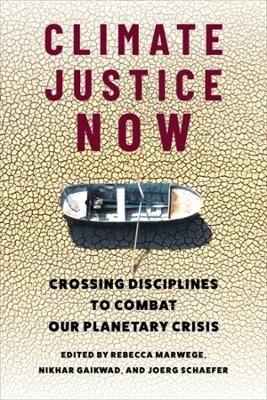
Climate Justice Now
Columbia University Press (Verlag)
978-0-231-22023-1 (ISBN)
- Noch nicht erschienen (ca. März 2026)
- Versandkostenfrei
- Auch auf Rechnung
- Artikel merken
Climate change is not only an environmental crisis but also a catalyst for worsening socioeconomic inequalities, leading to widespread calls for “climate justice.” Even though this term has become increasingly common, there remains no universally accepted definition. This challenge is compounded by the limitations of traditional scholarly frameworks, which struggle to encompass the dynamic and pervasive impact of the climate crisis across global, national, and local levels. The scope of the crisis requires ethical, social, and political considerations alongside scientific and environmental insights in order to shape equitable responses by states and societies.
This multidisciplinary book offers a comprehensive exploration of debates on climate justice across the natural sciences, social sciences, and humanities. Synthesizing these divergent approaches, it develops a new conceptual framework that transcends disciplinary divides, providing a deeper and richer understanding of climate justice. Contributors make an urgent case that climate justice must be centered within and across disciplines, creating a roadmap for multidisciplinary research and pedagogy on the climate crisis. Featuring a wide range of voices and actionable recommendations, this timely book illuminates how scholarship on climate change can become a call to action.
Rebecca Marwege is an assistant professor of environmental politics at the American University of Paris. She previously served as the junior director of the Columbia Climate School Earth Network on Decarbonization, Climate Resilience, and Climate Justice. Nikhar Gaikwad is an assistant professor of political science and a member of the Committee on Global Thought at Columbia University. He is the senior founding codirector of the Columbia Climate School Earth Network on Decarbonization, Climate Resilience, and Climate Justice. Joerg Schaefer is Lamont Research Professor in the Lamont-Doherty Earth Observatory and adjunct professor of earth and environmental sciences at Columbia University. He is the senior founding codirector of the Columbia Climate School Earth Network on Decarbonization, Climate Resilience, and Climate Justice.
Contents
Acknowledgments
Part I. Shifting Tides: Uniting Disciplines for Climate Justice
Prelude, by Sheila R. Foster
1. When Natural Scientists, Social Scientists, and Humanists Meet to Discuss Climate Justice, by Rebecca S. Marwege, Nikhar Gaikwad, Joerg M. Schaefer
Part II. The Intersection of Climate, Environment and Justice: Theory, Politics, Science, and Urban Perspectives
2. Introduction to Theories of Environmental and Climate Justice, by Mary E. Witlacil
3. The Politics of Climate Justice, by Zara Riaz and Page Fortna
4. Transport, Justice, and Climate Crisis in Cities: A Paradigm Shift, by Jacqueline M. Klopp and Festival G. Boateng
5. The Potential Conflict Between Climate Justice and Environmental Justice: Reducing Greenhouse Gas Emissions Does Not Improve Air Quality, by Róisín Commane
Part III. Climate Change as a Harm Multiplier: Exploring Sociology, Migration, and Environmental Health
6. Sociological Perspectives on Climate Justice, by Jennifer E. Givens and Mufti Nadimul Quamar Ahmed
7. Climate Justice and Climate Mobility: International Migration from Central America and West Africa
Alex de Sherbinin, David Wrathall, Susana Adamo, Sara Pan-Algarra, and Elena Giacomelli
8. Climate Justice in the Field: Climate Change and the Health of Migrant Agricultural Workers, by Lewis H. Ziska, Jeffrey L. Shaman, Emily Weaver, and Ami Zota
Part IV. Climate Justice, Capitalism, and Colonialism: From Literature to History to Science
9. Justice, the Incommensurable, and the Scale(s) of Business as Usual: A Literary Studies Approach, by Jennifer Wenzel
10. Climate Justice in the Arctic: Multispecies Approaches in History and Anthropology, by Emma Gilheany and Julia Lajus
11. Bridging the Gulf: Intersections of Geology, Biology, and Climate Justice, by Kailani Acosta and Gisela Winckler
12. How Much Positive Influence on the Climate Problem Can One Have as an Academic or Industry Climate Scientist?, by Adam Sobel and Melanie Bieli
Part V. Rethinking Knowledge at a Time of Crisis: Climate Justice, Expertise, and Community
13. Climate (In)justice for Whom? Alternative Theories and the Absence of Scientific Language, by Sheng Long
14. Climate Justice and Religion, by Raffaella Taylor-Seymour and Courtney Bender
15. Building a Better Model for Flood Protection Planning, by Paul Gallay
Part VI. Pursuing Climate Justice in Academia and Beyond: Embracing Complexity and Bridging Disciplines
16. The Elusive Challenge of Climate Justice and a Call to Action, by Rebecca S. Marwege, Nikhar Gaikwad, and Joerg M. Schaefer
Notes
Bibliography
Contributors
Index
| Erscheint lt. Verlag | 10.3.2026 |
|---|---|
| Zusatzinfo | 4 Maps |
| Verlagsort | New York |
| Sprache | englisch |
| Maße | 152 x 229 mm |
| Themenwelt | Sachbuch/Ratgeber ► Gesundheit / Leben / Psychologie |
| Naturwissenschaften ► Biologie ► Ökologie / Naturschutz | |
| Sozialwissenschaften ► Politik / Verwaltung | |
| Sozialwissenschaften ► Soziologie | |
| ISBN-10 | 0-231-22023-5 / 0231220235 |
| ISBN-13 | 978-0-231-22023-1 / 9780231220231 |
| Zustand | Neuware |
| Informationen gemäß Produktsicherheitsverordnung (GPSR) | |
| Haben Sie eine Frage zum Produkt? |
aus dem Bereich