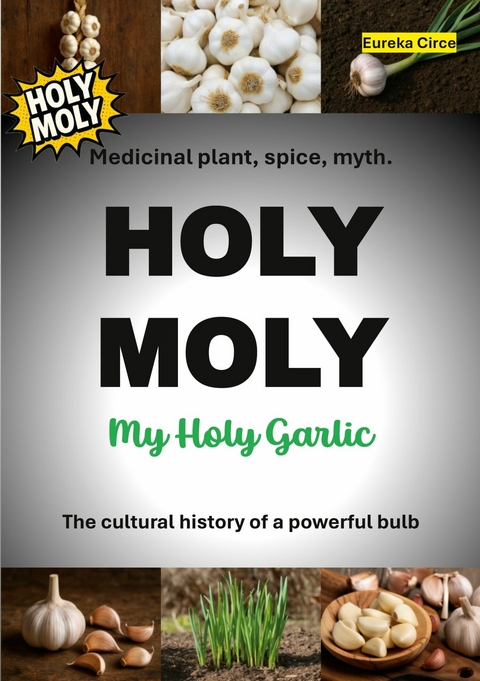
HOLY MOLY - My Holy Garlic (eBook)
182 Seiten
Books on Demand (Verlag)
978-3-6951-3737-4 (ISBN)
Chapter 1:
The fascination of garlic
The picture shows a large quantity of fresh garlic bulbs, densely and chaotically arranged. The bulbs are characterized by their pure white color and their typical bulbous, round shape. Particularly noticeable are the slightly fibrous, brownish root bases at the bottom of each bulb and the short, cut stems. The arrangement creates a lively, natural, and at the same time orderly impression.
Figure 1: A large quantity of fresh garlic bulbs.
Garlic (Allium sativum) has captivated people in almost all cultures around the world for thousands of years. Today, the pungent, aromatic bulb is used almost worldwide as a prized spice in cooking and as a traditional medicinal plant. At the same time, numerous myths and folkloric customs surround garlic – from warding off evil spirits to increasing vitality. This unique combination of culinary enjoyment, medicinal benefits, and mythological significance makes the "lovely" garlic one of the most fascinating cultivated plants in human history.
Garlic as the archetype of a medicinal plant
The connection between cuisine, healing arts, and myth: hardly any other plant combines culinary, medicinal, and mythical properties as well as garlic. The question arose early on: "Vegetable, spice, or medicinal herb - what exactly is garlic?" In fact, garlic combines all these facets. It is used as a spice in countless recipes around the world to add flavor and depth. At the same time, garlic is a well-known medicinal plant with a long history ( ): for over 5,000 years, the white bulb has been used by a wide variety of people to treat a wide range of illnesses. Due to its reputed powerful effects, it has even been given nicknames such as "panacea" or, during World War II, "Russian penicillin" because it was successfully used to fight infections in the absence of antibiotics. Garlic is therefore a prime example of an archetypal medicinal plant that is firmly anchored in everyday life (in the kitchen), has many uses in medicine, and plays a role in myths and folk beliefs.
Cross-cultural fascination: It is astonishing that cultures around the world – often without any contact with each other – independently valued garlic and gained similar insights into its effectiveness. Garlic was already known in ancient times in Egypt, Mesopotamia, Greece, Rome, India, and China as a food and remedy. It is mentioned for medicinal purposes in the ancient Egyptian Ebers Papyrus (ca. 1550 BC), and according to Herodotus, pyramid workers were given a daily ration of garlic to keep them healthy and productive. The Bible also mentions garlic: the Israelites in the desert longed for the garlic they had eaten in Egypt (Numbers 11:5). The healing powers of the plant were known in ancient Rome – Dioscorides recommended garlic in detail in the 1st century AD for a wide range of ailments.
In the Middle Ages, garlic was cultivated in monastery gardens (it appears, for example, in Charlemagne's Capitulare de villis) and was used to treat bite wounds, toothache, respiratory ailments, and much more. At the same time, magical beliefs surrounded it: garlic was considered a protective agent against evil. In Europe, bulbs were hung on houses to ward off vampires and demons, which later became legendary thanks to Bram Stoker's Dracula. In the Middle East – for example in Turkey, Arab countries and Jerusalem – it was used against the " " or "evil eye." This universal appreciation is due in no small part to the real properties of garlic: its pungent smell and proven antibacterial effect made it appear to be a remedy that embodies good and wards off evil (illness or misfortune).
Modern research confirms many of the historical uses: garlic has antibacterial properties, slightly lowers cholesterol, and protects the heart. Consequently, garlic was even voted medicinal plant of the year in Germany in 1989—an honor that underscores its status as an archetypal medicinal plant.
Botanical portrait of Allium sativum
Taxonomic classification: Botanically, garlic belongs to the genus Allium in the Amaryllidaceae family, subfamily Allioideae. Its scientific name Allium sativum is composed of the Latin allium ("leek" or, according to some sources, "burning/sharp" – a reference to its taste) and sativum ("cultivated/grown"). Garlic is a perennial herbaceous plant and, like onions, leeks, and chives, belongs to the onion family. Allium sativum is rarely found in the wild, as the species has been cultivated by humans for a long time. The original wild form originates from the steppe regions of Central Asia (as far as northern Iran), from where garlic was spread early on as a cultivated plant.
Morphology (cloves, stems, flowers, seedlessness): The characteristic garlic bulb is divided into several "cloves" – in fact, it is a main bulb composed of typically 5 to 20 partial bulbs (side buds). These individual cloves are surrounded by a tough outer layer and are collectively enclosed in the paper-thin white or purple outer skin (tunic) of the bulb ( ). A new garlic plant develops from a planted clove, which in turn forms a complete bulb with many cloves – this is how garlic reproduces vegetatively.
In spring, an upright, round stem sprouts from the center of the bulb, which can grow to a height of 30–90 cm, depending on the variety. The flat leaves are blue-green, ribbon-shaped, and grow in a tuft around the pseudostem. In suitable locations, some of the plants form a long inflorescence (flower stalk) in summer. At its tip is an almost spherical inflorescence in the form of a false umbel with a few small, mostly sterile flowers. At the same time, numerous bulbils (miniature tubers that serve for asexual reproduction) develop there, enclosed in a pointed leaf sheath (spathe). The true flowers of garlic are hermaphroditic and whitish to pink in color, but rarely produce viable seeds. As a rule, cultivated garlic no longer forms seeds – three-lobed capsule fruits with black seeds are a botanical rarity. In the course of domestication, the plant has thus largely lost its sexual reproductive capacity and relies on vegetative reproduction (cloves or bulbils).
Varieties: Hardneck and softneck: Within Allium sativum, two varieties are traditionally distinguished. The first is Allium sativum var. sativum, the "actual" cultivated garlic, also known as softneck. The second is Allium sativum var. ophioscorodon, often called hardneck or colloquially snake garlic (Rocambole). Softneck garlic does not form a firm flower stalk; the plant only produces leaves and remains shorter. Softneck varieties typically develop more cloves per bulb (in several rows) and have a milder flavor, but excellent storage life ( ). The lack of flower heads makes softnecks attractive for agriculture, as they are easy to grow and harvest mechanically – the majority of garlic traded worldwide belongs to this group. Hardneck garlic, on the other hand, forms a hard flower stalk that often grows in a snake-like curl (hence the name) and bears the aforementioned bulbils at its tip. Hardneck plants usually have fewer but larger cloves, which are arranged in a single row around the hard stem. Their flavor is described as stronger and more aromatic, and hardnecks are also considered more robust and particularly frost-hardy, making them ideal for cool climates. However, they cannot be stored as long as softnecks because their protective layers are thinner. In temperate zones such as Central Europe, many self-sufficient gardeners nevertheless prefer to grow hardneck varieties, which have adapted to the local climate and can be harvested as "young garlic" in the spring, for example.
A global phenomenon with local roots
Global distribution and significance: From its Central Asian origins, garlic has developed into a global phenomenon over the millennia. Today, it is cultivated and used on all inhabited continents – as a spice, remedy, and cultural asset. According to current FAO data, global garlic production in 2022 was around 29.1 million tons, of which an astonishing 73.2% was produced in China. This makes China by far the largest producer and exporter. Other important growing countries are India (around 11% of global production), Bangladesh, Egypt, and Spain. Although garlic is also cultivated in Europe (Spain and Italy are the leading producers), most of the garlic available in European supermarkets is still imported— ly from China, India, or Spain. This means that the white bulb often has a long journey behind it before it ends up in our kitchens. At the same time, however, more and more consumers are paying attention to regionality, which has led to a small boom in local garlic cultivation in some countries. Despite the dominance of a few large producers, garlic remains a globally appreciated plant, whose presence ranges from wholesale markets to the smallest herb gardens.
Regional variety – China, Italy, Germany, Russia: Although garlic is a global crop, it has taken root everywhere. In its region of origin, Asia (especially China), there is an enormous variety of garlic that has developed over centuries. China primarily produces and...
| Erscheint lt. Verlag | 29.8.2025 |
|---|---|
| Sprache | englisch |
| Themenwelt | Sachbuch/Ratgeber ► Gesundheit / Leben / Psychologie ► Alternative Heilverfahren |
| Schlagworte | cooking • garlic • Healing • Health • herbal |
| ISBN-10 | 3-6951-3737-1 / 3695137371 |
| ISBN-13 | 978-3-6951-3737-4 / 9783695137374 |
| Informationen gemäß Produktsicherheitsverordnung (GPSR) | |
| Haben Sie eine Frage zum Produkt? |
 EPUB (Ohne DRM)
Digital Rights Management: ohne DRM
Dieses eBook enthält kein DRM oder Kopierschutz. Eine Weitergabe an Dritte ist jedoch rechtlich nicht zulässig, weil Sie beim Kauf nur die Rechte an der persönlichen Nutzung erwerben.
Dateiformat: EPUB (Electronic Publication)
EPUB ist ein offener Standard für eBooks und eignet sich besonders zur Darstellung von Belletristik und Sachbüchern. Der Fließtext wird dynamisch an die Display- und Schriftgröße angepasst. Auch für mobile Lesegeräte ist EPUB daher gut geeignet.
Systemvoraussetzungen:
PC/Mac: Mit einem PC oder Mac können Sie dieses eBook lesen. Sie benötigen dafür die kostenlose Software Adobe Digital Editions.
eReader: Dieses eBook kann mit (fast) allen eBook-Readern gelesen werden. Mit dem amazon-Kindle ist es aber nicht kompatibel.
Smartphone/Tablet: Egal ob Apple oder Android, dieses eBook können Sie lesen. Sie benötigen dafür eine kostenlose App.
Geräteliste und zusätzliche Hinweise
Buying eBooks from abroad
For tax law reasons we can sell eBooks just within Germany and Switzerland. Regrettably we cannot fulfill eBook-orders from other countries.
aus dem Bereich