


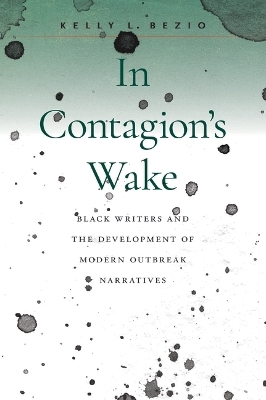
In Contagion's Wake
Black Writers and the Development of Modern Outbreak Narratives
Seiten
2026
University of Massachusetts Press (Verlag)
978-1-62534-935-4 (ISBN)
University of Massachusetts Press (Verlag)
978-1-62534-935-4 (ISBN)
- Noch nicht erschienen (ca. Juni 2026)
- Versandkostenfrei
- Auch auf Rechnung
- Artikel merken
An examination of early American literature that highlights how racial divides exacerbated—and were exacerbated by—the spread of infection
In April of 1721, the HMS Seahorse arrived in Boston from the West Indies, causing a smallpox epidemic that would plague the city for the next year. Of its 12,000 inhabitants, nearly fifty percent were infected, and 900 people died. Like the coronavirus pandemic that began in 2020, the outbreak also brought to the surface deep divides in the social fabric of colonial New England and laid the groundwork for racialized political inequities that we continue to grapple with today.
In Contagion’s Wake examines a range of American outbreak narratives, both historical and fictional, written between the early 1700s and the early 1900s—from the rise of inoculation through the advent of germ theory. Author Kelly L. Bezio argues that during this period, literature about communicable disease was dominated by white authors, such as Cotton Mather and Edgar Allen Poe, who tended to privilege white suffering and survival while obscuring Black suffering and vulnerability. Black authors, however, such as Olaudah Equiano and Frances E.W. Harper, developed variations on plot structures, metaphors, and imagery that drew upon contagion to represent racial injustice and further the cause of Black liberation.
The diverse texts Bezio analyzes vary extensively in genre and geographical location, and in the illnesses that feature in their pages. Significant disorders from the era, including yellow fever, smallpox, consumption, and cholera, make frequent appearances, as do less culturally dominant diseases such as St. Anthony’s Fire. In Contagion’s Wake contends that representations of communicable disease should not be understood only as within their own historical moment; rather, they function more like a DNA code for our present time.
In April of 1721, the HMS Seahorse arrived in Boston from the West Indies, causing a smallpox epidemic that would plague the city for the next year. Of its 12,000 inhabitants, nearly fifty percent were infected, and 900 people died. Like the coronavirus pandemic that began in 2020, the outbreak also brought to the surface deep divides in the social fabric of colonial New England and laid the groundwork for racialized political inequities that we continue to grapple with today.
In Contagion’s Wake examines a range of American outbreak narratives, both historical and fictional, written between the early 1700s and the early 1900s—from the rise of inoculation through the advent of germ theory. Author Kelly L. Bezio argues that during this period, literature about communicable disease was dominated by white authors, such as Cotton Mather and Edgar Allen Poe, who tended to privilege white suffering and survival while obscuring Black suffering and vulnerability. Black authors, however, such as Olaudah Equiano and Frances E.W. Harper, developed variations on plot structures, metaphors, and imagery that drew upon contagion to represent racial injustice and further the cause of Black liberation.
The diverse texts Bezio analyzes vary extensively in genre and geographical location, and in the illnesses that feature in their pages. Significant disorders from the era, including yellow fever, smallpox, consumption, and cholera, make frequent appearances, as do less culturally dominant diseases such as St. Anthony’s Fire. In Contagion’s Wake contends that representations of communicable disease should not be understood only as within their own historical moment; rather, they function more like a DNA code for our present time.
Kelly L. Bezio is professor of English at Texas A&M University – Corpus Christi. Her work has appeared in American Literature, Literature & Medicine, The Eighteenth Century: Theory and Interpretation, English Language Notes, Pedagogy, Interdisciplinary Journal of Leadership Studies, and more.
Preface
Acknowledgments
Introduction: 1721 and Its Afterlives – Racialization in Modern Communicable Disease Discourse
1. Early America and Modern Outbreak Narratives
2. Communicable Disease and Narrating a Right to Life
3. Outbreak, Victimhood Narratives, and Barriers to Imagining Racial Equality
4. Black Adaptations of Outbreak Narratives
Coda: Considering Epidemiology’s Need for Literary History
Notes
Index
| Erscheint lt. Verlag | 5.6.2026 |
|---|---|
| Reihe/Serie | Becoming Modern: Studies in the Long Nineteenth Century |
| Verlagsort | Massachusetts |
| Sprache | englisch |
| Maße | 152 x 229 mm |
| Themenwelt | Sachbuch/Ratgeber ► Gesundheit / Leben / Psychologie ► Krankheiten / Heilverfahren |
| Geisteswissenschaften ► Geschichte ► Regional- / Ländergeschichte | |
| Geisteswissenschaften ► Sprach- / Literaturwissenschaft ► Anglistik / Amerikanistik | |
| Geisteswissenschaften ► Sprach- / Literaturwissenschaft ► Literaturwissenschaft | |
| ISBN-10 | 1-62534-935-1 / 1625349351 |
| ISBN-13 | 978-1-62534-935-4 / 9781625349354 |
| Zustand | Neuware |
| Informationen gemäß Produktsicherheitsverordnung (GPSR) | |
| Haben Sie eine Frage zum Produkt? |
Mehr entdecken
aus dem Bereich



aus dem Bereich
die revolutionäre Strategie zur Knorpelregeneration nach Dr. Feil
Buch | Hardcover (2024)
Gräfe und Unzer (Verlag)
CHF 39,90
wie Frauen mit AD(H)S erfolgreich, selbstbewusst und stabil leben …
Buch | Softcover (2024)
Kösel (Verlag)
CHF 29,90
Geschichten gegen Angst und Stress
Buch | Softcover (2024)
Hogrefe Verlag
CHF 19,90


