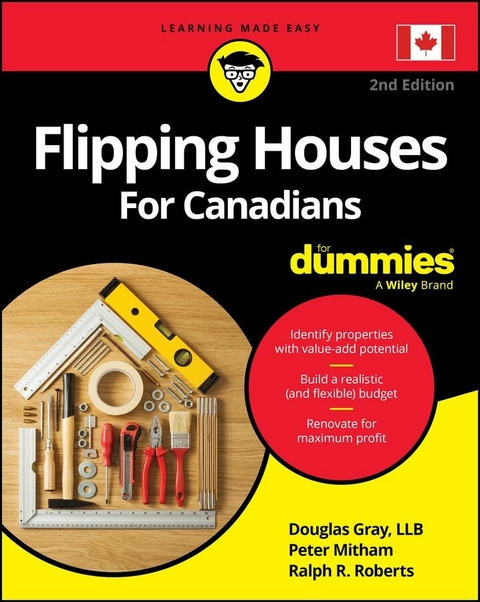
Flipping Houses For Canadians For Dummies (eBook)
508 Seiten
For Dummies (Verlag)
978-1-394-34830-5 (ISBN)
Everything the novice needs to flip houses in Canada
Flipping Houses For Canadians For Dummies can help you turn a quick and tidy profit by buying, fixing up, and reselling real estate. You'll learn to locate potential properties, get good deals on your purchases, complete high-value renovations, and sail through the selling process. Flipping houses can be profitable in any economic climate-as long as you know how to add real value to the properties you buy. This beginner-friendly guide covers all the important variables, so you can buy, renovate, and sell with confidence. Flipping Houses For Canadians For Dummies is perfect for responsible investors who want to flip houses the right way.
- Learn what it takes to flip houses, and get a step-by-step introduction to the process
- Get tips on negotiating, property inspections, mortgages, taxes, and working with contractors
- Avoid legal gray areas and optimize your tax situation
- Profit in any real estate market, thanks to tried-and-true, Canada-specific advice
Anyone exploring house flipping as an investment strategy needs this book. It's also a great choice for those who already have some experience but want to become more successful in the Canadian market.
Douglas Gray is a retired lawyer, consultant, financial columnist, and bestselling author with more than 35 years' experience in the real estate industry.
Peter Mitham is a seasoned business writer and editor of Western Investor.
Ralph R. Roberts is a real estate expert, investor, and author.
Everything the novice needs to flip houses in Canada Flipping Houses For Canadians For Dummies can help you turn a quick and tidy profit by buying, fixing up, and reselling real estate. You'll learn to locate potential properties, get good deals on your purchases, complete high-value renovations, and sail through the selling process. Flipping houses can be profitable in any economic climate as long as you know how to add real value to the properties you buy. This beginner-friendly guide covers all the important variables, so you can buy, renovate, and sell with confidence. Flipping Houses For Canadians For Dummies is perfect for responsible investors who want to flip houses the right way. Learn what it takes to flip houses, and get a step-by-step introduction to the process Get tips on negotiating, property inspections, mortgages, taxes, and working with contractors Avoid legal gray areas and optimize your tax situation Profit in any real estate market, thanks to tried-and-true, Canada-specific advice Anyone exploring house flipping as an investment strategy needs this book. It's also a great choice for those who already have some experience but want to become more successful in the Canadian market.
Chapter 1
Brushing Up on the Basics
IN THIS CHAPTER
Understanding the concept of flipping houses and appreciating its challenges
Flipping the right way — legally and ethically
Developing a winning strategy and the right connections
Marketing and staging a house to maximize your profit
Progress always involves risk. You can’t steal second base and keep your foot on first.
—FRED WILCOX
Flipping sounds easy. You can flip a pancake. You can flip a coin. Without too much effort, you can even flip out. Flipping a house, though, requires a level of knowledge, expertise, and persistence unrivaled by any of these mindless tasks. It requires access to cash, and lots of it. It demands time, energy, vision, attention to detail, and the ability and desire to network with everyone — from buyers and sellers to real estate professionals, contractors, and lenders.
In this chapter, we offer a broad overview of what flipping houses is all about. We introduce the overall strategy of flipping houses: buy low, renovate, and sell a property at fair market value to earn a fair market profit. We also reveal the difference between flipping the right way (legally and ethically) and flipping the wrong way (ripping off buyers, sellers, and lenders for a quick wad of cash).
Grasping the Concept of Flipping
In investment circles, the secret to success is cliché: Buy low, sell high. This same principle applies to flipping houses. To succeed, you buy a house substantially below market value, repair and renovate the property, and then turn around and sell it at market value — for a profit that makes it worth your time and effort. That three-step process — buy, fix, sell — certainly sounds easy enough, but each step carries with it a host of unique challenges, as we point out in the following sections.
Spotting distressed properties
Homeowners don’t exactly line up around the block waiting to sell their homes for less than they’re worth. As a house flipper, your job is to hunt for the homes in your area that are dontwanners, as in “The owners don’t want’er.” These orphan homes usually appear bedraggled: the yard looks like a weedy wasteland, the gutters are hanging off like false eyelashes the morning after a party, the paint is peeling, and the interior is trashed. These properties are often referred to as distressed, and their appearance indicates that their owners are distressed as well — their dream home has become a nightmare.
When homeowners need to shed the burden of a home they can no longer afford or simply no longer want, they may not have the time or resources to repair and renovate it, place it on the market, and wait for months or even a year for a buyer to make a reasonable offer. In such cases, they’re often willing to sell at a greatly reduced price to a serious buyer who has the financial resources to close the deal. How do you discover opportunities like this? In Part 2, we point out several techniques for locating distressed properties and motivated owners.
Doing your homework
Flipping houses is a risky venture, but you can minimize risk and maximize profit by doing your homework:
- Research the property. If you’re buying a property through the courts or some other unconventional avenue, research the property carefully to make sure you know what you’re buying. Research includes visiting the property, reviewing the title deed, and checking out other key documents.
- Estimate costs of repairs and renovations. Knowing how much you likely need to spend to make the property market-ready is key to knowing how much you can afford to pay for the property and still earn a profit. In Chapter 9, we explain how to inspect a property with an eye for repairs and renovations and estimate the renovation costs.
- Calculate the maximum purchase price. Before you make an offer on a property, you need to calculate the most you can pay for it to earn the desired profit after costs, including closing costs, renovation expenses, holding costs (interest, insurance, property taxes, utilities, and maintenance), and agent commissions. In Chapter 10, we walk you through the calculations.
- Negotiate the price and terms in your favour. The maximum amount you can afford to pay for a property probably isn’t the amount you want to pay — you want to pay as little as possible. In Chapter 11, we help you discover various strategies and techniques to negotiate a better price and terms.
Making a few minor (or major) alterations
When you buy a house at a bargain basement price, it usually requires some tender loving care to make it marketable. In some cases, a thorough cleaning, a fresh coat of paint (inside and out), and new carpeting do the trick. In a matter of days or a couple of weeks, and with a small investment, you can often boost the value of a home just by making it look and smell brand-new again.
Not all homes are created equal. Some houses require more extensive renovations. You may be able to convert unused attic or porch space into a bedroom; knock out a wall or two to combine the kitchen, dining room, and living room into a great room; install new windows; or even build a second story. In today’s technology-centric world, you can measure the house and build a 3D rendering of your property on a computer. Some companies, like landscapers or cabinet wholesalers, are also willing to help you maximize your home’s square footage by plugging measurements into a system that generates multiple floor plan options that make the best use of your space. In Part 4, we explain how to assemble and manage a rehab team to do everything from quick-flip cosmetic jobs to extensive renovations and provide plenty of tips to stay on budget.
Avoid the temptation to over-improve a property. You may be able to convert a $100,000 house into a $1 million mansion, but a buyer who wants a $1 million mansion will buy a house in a neighbourhood with million-dollar homes.
Reselling the property
“You make your money when you buy” is a guiding principle in the realm of real estate investing. But you realize your profit only after selling the house. Assuming that you purchase the property at the right price, avoid overspending on repairs and renovations, and flip in a relatively stable market, you should have no trouble selling the house at a profit by pricing it at or near market value. (See Part 5 for details.)
To sell the house quickly at a fair price, set a price that’s competitive with the prices of comparable houses in the same neighbourhood. If the asking price is too high, holding costs will chip away at your profit over time.
Flipping Legally and Ethically
Flipping has earned a bad name for itself in recent years, thanks to a growing shortage of affordable housing. Housing that used to be affordable no longer is, thanks to a host of factors. But politicians and housing advocates have been quick to point the finger at speculators. This has resulted in numerous laws aimed at limiting the misunderstood practice of flipping.
Also bear in mind that any business activity that turns a quick profit is likely going to attract the scrutiny of Canada Revenue Agency (CRA), so be sure to check with your accountant so that you know the rules about investing in real estate generally — and flipping especially — so that you are never offside.
Flipping illegally
Criminal minds have invented countless ways to milk the real estate industry, and one way is to flip houses. This sinister type of house flipping typically relies on some form of fraud — lying or misrepresenting information. In some cases, the con artists team up with crooked appraisers who artificially inflate home values and then sell overpriced homes to ill-informed buyers.
Another way con artists scam the system via flipping is to build a team of buyers, none of whom intends to own the property for any length of time. They buy homes from one another, increasing the price with each sale. False appraisals or crooked appraisers make the price hikes look legitimate, and the final buyer delivers the payoff to the previous owners. This kind of scheme is relatively rare in Canada, but it’s not unknown. In fact, it led to calls for greater transparency around property ownership and tighter regulation of the real estate sector.
The dark side of flipping undermines neighbourhoods and helps put home ownership beyond the reach of people who legitimately want a home where they can live, raise a family, and feel secure. It’s not what this book is about.
Flipping legally: Buy, fix, sell
Flipping the right way is a perfectly legitimate strategy for making money in real estate. You buy a property below market value, fix it up, and sell it for more than you invested in it. Do it well and you can earn a handsome profit. Make a serious blunder and you suffer a loss. This fix-it-and-flip-it approach has a positive effect on the real estate market: It increases property values, improves neighbourhoods, and provides quality housing for those who need it. It’s entrepreneurial and community minded.
Throughout this book, we encourage you to flip the...
| Erscheint lt. Verlag | 26.8.2025 |
|---|---|
| Sprache | englisch |
| Themenwelt | Sachbuch/Ratgeber ► Beruf / Finanzen / Recht / Wirtschaft ► Wirtschaft |
| Betriebswirtschaft / Management ► Spezielle Betriebswirtschaftslehre ► Immobilienwirtschaft | |
| Schlagworte | Canada real estate investing • Canadian real estate • fix and flip Canada • fix and flipping • Flipping Houses • flix and flip book • house flipping • house flipping book • house flipping Canada • real estate investing • real estate investing book |
| ISBN-10 | 1-394-34830-4 / 1394348304 |
| ISBN-13 | 978-1-394-34830-5 / 9781394348305 |
| Informationen gemäß Produktsicherheitsverordnung (GPSR) | |
| Haben Sie eine Frage zum Produkt? |
 EPUB (Adobe DRM)
Kopierschutz: Adobe-DRM
Adobe-DRM ist ein Kopierschutz, der das eBook vor Mißbrauch schützen soll. Dabei wird das eBook bereits beim Download auf Ihre persönliche Adobe-ID autorisiert. Lesen können Sie das eBook dann nur auf den Geräten, welche ebenfalls auf Ihre Adobe-ID registriert sind.
Details zum Adobe-DRM
Dateiformat: EPUB (Electronic Publication)
EPUB ist ein offener Standard für eBooks und eignet sich besonders zur Darstellung von Belletristik und Sachbüchern. Der Fließtext wird dynamisch an die Display- und Schriftgröße angepasst. Auch für mobile Lesegeräte ist EPUB daher gut geeignet.
Systemvoraussetzungen:
PC/Mac: Mit einem PC oder Mac können Sie dieses eBook lesen. Sie benötigen eine
eReader: Dieses eBook kann mit (fast) allen eBook-Readern gelesen werden. Mit dem amazon-Kindle ist es aber nicht kompatibel.
Smartphone/Tablet: Egal ob Apple oder Android, dieses eBook können Sie lesen. Sie benötigen eine
Geräteliste und zusätzliche Hinweise
Buying eBooks from abroad
For tax law reasons we can sell eBooks just within Germany and Switzerland. Regrettably we cannot fulfill eBook-orders from other countries.
aus dem Bereich