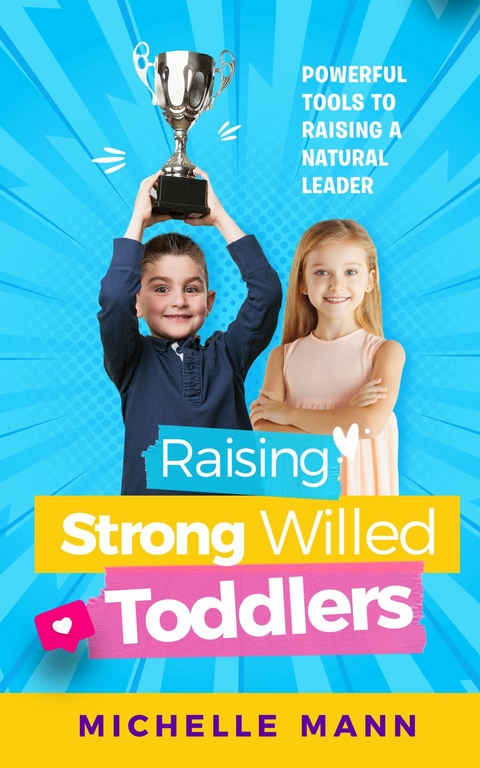
Raising Strong-Willed Toddlers (eBook)
150 Seiten
Publishdrive (Verlag)
978-0-00-103270-5 (ISBN)
When one of your tiny toddler's big emotions jumps up to bite you, one of the greatest feelings of shame for many parents comes from not knowing how to handle it; or worse still, feeling like you haven't handled it well.
I'm sure you don't need me to tell you, but parenting can be tough. You have a child destined for great things to be responsible for. There is no perfect parent or child, but somehow we always manage to find shame in not living up to these fanciful expectations.
It is a great service to your child to raise them with a strong will. The world isn't an easy place to get along in. Preparing your child to back themselves through life's trials is setting them up for success in the future. Unfortunately, it can also feel like setting yourself up for arguments in the supermarket snack aisle.
Describing a child as 'strong-willed' can often bring with it a hefty amount of negative baggage.
You went to the store for a gallon of milk, but for some reason or another, you've left with a screaming toddler unable to fathom the logic of not being allowed a whole box of chocolate cookies on a whim. It feels like the entire store is glaring at you. It feels somewhere along the way, somehow, like you've failed as a parent.
The reality is that perspective is everything, especially in raising a toddler. This isn't a failure, this is an opportunity to help mold your child into a dynamic individual prepared for whatever the future holds.
The change of perspective I want to share with you is understanding that the big emotions that often lead to 'meltdowns' or 'tantrums' or 'hissy-fits' often have nothing to do with you or your child's personality. They have everything to do with little minds processing ideas that are bigger than themselves.
What I want to share with you is an understanding of the way those little minds are wired and strategies to help your child wrangle with these big feelings without all the tears.
My book, and your go-to guide, Raising Strong Willed Toddlers: Powerful Tools to Raising a Natural Leader will teach you:
Strong-willed truths: the psychology behind why our children can act the way they do.
Step-by-step techniques for managing key parenting battlegrounds like saying 'no,' potty training, and many more.
Tips for helping to nurture your child's strong will, to grow it into genius or leadership ability in later life.
How to keep your head when things get to be a little too much.
All of these tips and strategies are backed by experience, and a psychological understanding of the little minds it is our responsibility to develop.
Whether you're struggling to implement your own strategies, or are completely at a loss for what to do, there's something in here to make parenting your strong-willed toddler that much more effective.
There's no reason to battle through your child's toddler years with stress and high emotions. There's even less reason to think of yourself as a failure for not having all the answers already.
There's no reason to think of yourself as an inadequate parent. Simply by picking up this book you prove you're willing to learn and develop new techniques to do right by your kids.
Chapter 1:
Strong-Willed Truths
When discussing the behavior of children, the term “strong-willed” can often carry with it a negative undertone. Recognizing that there are certain challenges associated with parenting these children, they are still just as amazing and precious as the child next to them who may not be displaying the same intense behaviors. To gain a well-rounded perspective on all the strategies and tools you can use for parenting strong-willed toddlers, I want to take it from the top. Meaning, I intend to help you build these principles from the ground up so that you and your tenacious toddler can hit the ground running. So, let’s get started!
Personality Is Everything...Or Is It?
Personality is such a complex and intricate component in how we define ourselves, but how do we define personality when it applies to our children—specifically our spirited toddlers? Have you, for instance, ever watched them in awe in the middle of what I’m going to call an “event,” and wondered to yourself if this is just who your child is? Or have you worried whether this is the personality that your toddler will have for the rest of their lives, and how on earth can this be fixed? Well, first, I would like you to take a deep breath with me and settle in for this section, because I have some excellent answers to those questions.
Let’s begin with the infancy stage, when your lovelies are still swaddled. One of the most widely misunderstood ideas surrounding a baby’s ‘behavior’ is that it is an indicator of what their personality will be later on in life. For example, there are fussy babies, happy-go-lucky babies, relaxed babies, and so much more in between. However, what you are witnessing is the “raw” form of what their personalities may become versus who they are. At this stage of development, the infant doesn’t have a “happy’’ or “stubborn” personality type because they haven’t had the necessary life experiences to shape what we as adults would understand as personality.
To provide you with a bit more context as to what makes up a “personality,” it can be defined as the culmination of the emotions, experiences, and attitudes of a person’s behavior. This definition is super important to parents, and for good reason because it’s the best way for parents of strong-willed children to wrap their minds around what their toddler is experiencing. Also, this helps to understand how their child is developing as an individual.
Some of the reasons parents might want to investigate the type of personality their child has are to know the most effective ways to carry out positive discipline. Moreover, they’re seeking strategies that work best in certain scenarios. The best way to explore this idea is to consider the two types of personalities that we are all familiar with: introverted and extroverted. The parent who is engaging with an extroverted child will have a far dissimilar experience and outcome than the parent of an introverted child. Especially where discipline and routines are concerned, and dependent of course on what the goal is, knowing your child’s personality type can add that extra something to your parenting toolkit. What’s most important is that whichever method you’re using is in line with what feels natural to the child.
You have undoubtedly noticed that in all the above mentions of personality, we haven’t yet touched on our strong-willed children and what their personality type might look like, or which personality type is most aligned with the behaviors you routinely experience. Stick with me, we are still building the footing before we start pouring the cement.
While personality considerations are important, that’s only half the story. First things first, personality and temperament are not the same. Although they can be widely mistaken as being the same thing, I assure you that’s not the case. At the toddler stage, you are not dealing with personality; it’s quite the opposite. Since personalities begin to develop when a child enters the elementary school system, anything before that point means you’re seeing your child’s temperament. Now, this is important to note because it’s one of the topics we’re going to explore a little further on; temperament is one of those things that appears within the infancy stage. It can be identified in behaviors such as whether your baby thrives on a consistent routine, or whether they are more flexible in how they adapt to change. These can be called “hints” and can indicate the child’s temperament as they age into their toddler years and older. So, if your baby is easily agitated when their routines are disrupted, it’s likely they will experience the same agitation as a toddler.
As your strong-willed toddler continues to grow, matters of personality will take on a greater degree of significance. With that in mind, here are the five “big” personality traits that are considered the most popular theories amongst professionals, and ones that I think will benefit your parenting strategy going forward:
Since we’ve gotten technical again, it would be useful to provide some background on popular misunderstandings of personality, and where the concept of “The Big 5” originated from. Interestingly, it wasn’t until 1930 that personality was even brought into the scientific community as something that could be measured. “The Big 5” personality measure was created and further developed by various researchers between 1949 and 1987. As studies of personality continued to evolve, so did the concept of individuals having what is called “overlapping traits.” This new perspective has allowed modern psychology to both condense and more accurately review the complexities of personality.
One of the stand-outs in “The Big 5” is the idea of extroversion and introversion being categorized as personality traits, when it’s commonly thought that these are more like points on a spectrum. While this idea is in part true, it’s the overlapping of traits that allows for the modern take on what we know to be “The Big 5.” It’s also quite common for introversion to be misunderstood—for example, that although these types of personalities are more energized by their solitude than extroverts, they’re not necessarily more likely to be “introspective,” or self-reflecting. For the purposes of this book, there is no pressing need to dive any deeper into the psychology behind the definition of personality, but it is valuable information to keep filed in your superhuman parental database.
Now that we have covered the basics on personality, we can move straight into how we navigate all of the above with a strong-willed toddler. Keeping in mind that temperament is the raw form of a toddler’s personality, personality, as we come to define it late in life, is in a constant state of development. This means you cannot simply look at your two-year-old and think, “Hey, you’re showing an undesirable personality, and I think we’re in trouble!” because you definitely aren’t! Temperament is, in essence, a reflection of how the toddler naturally regulates themselves. The thing with strong-willed toddlers is that they are so deeply attuned to the emotions they are feeling, perhaps even more so than other children of the same age. They play a bit harder, are more daring and adventurous, and are more likely to enter into social situations with no sense of anxiety of the unknown. Correct me if I’m wrong here, but as an adult and a parent, I would absolutely love to walk around every day with that keen sense of adventure and, well, just genuine joy and zest for life!
It turns out that, while this is still a rather new addition to child developmental theories, there is another unique category that is assigned to our kind of toddlers, and it is called the “strong-willed temperament.” To give you a bit of background, temperament for the toddler stage has traditionally been categorized as either “inhibited” or “uninhibited.” The most common research in this area has nearly always surrounded the study of children who are naturally “inhibited”—the children who are less likely to spontaneously combust if they don’t get their way, or who usually don’t find the tallest point of the jungle gym to dive from while you hold your breath and pray for the best. These children are most likely to avoid new social situations and be super cautious of new objects such as toys. Research (and there has...
| Erscheint lt. Verlag | 25.8.2025 |
|---|---|
| Sprache | englisch |
| Themenwelt | Sachbuch/Ratgeber ► Gesundheit / Leben / Psychologie ► Familie / Erziehung |
| ISBN-10 | 0-00-103270-4 / 0001032704 |
| ISBN-13 | 978-0-00-103270-5 / 9780001032705 |
| Informationen gemäß Produktsicherheitsverordnung (GPSR) | |
| Haben Sie eine Frage zum Produkt? |
 EPUB (Adobe DRM)
Größe: 1,2 MB
Kopierschutz: Adobe-DRM
Adobe-DRM ist ein Kopierschutz, der das eBook vor Mißbrauch schützen soll. Dabei wird das eBook bereits beim Download auf Ihre persönliche Adobe-ID autorisiert. Lesen können Sie das eBook dann nur auf den Geräten, welche ebenfalls auf Ihre Adobe-ID registriert sind.
Details zum Adobe-DRM
Dateiformat: EPUB (Electronic Publication)
EPUB ist ein offener Standard für eBooks und eignet sich besonders zur Darstellung von Belletristik und Sachbüchern. Der Fließtext wird dynamisch an die Display- und Schriftgröße angepasst. Auch für mobile Lesegeräte ist EPUB daher gut geeignet.
Systemvoraussetzungen:
PC/Mac: Mit einem PC oder Mac können Sie dieses eBook lesen. Sie benötigen eine
eReader: Dieses eBook kann mit (fast) allen eBook-Readern gelesen werden. Mit dem amazon-Kindle ist es aber nicht kompatibel.
Smartphone/Tablet: Egal ob Apple oder Android, dieses eBook können Sie lesen. Sie benötigen eine
Geräteliste und zusätzliche Hinweise
Buying eBooks from abroad
For tax law reasons we can sell eBooks just within Germany and Switzerland. Regrettably we cannot fulfill eBook-orders from other countries.
aus dem Bereich