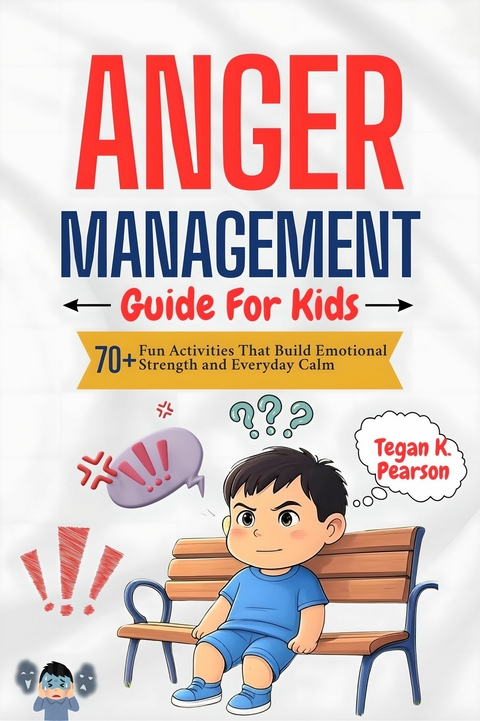
Anger Management Guide for Kids (eBook)
179 Seiten
Seahorse Pub (Verlag)
978-0-00-102666-7 (ISBN)
Help Kids Understand, Express, and Manage Big Emotions - All While Having Fun!
Every child experiences anger - but not every child knows how to handle it. This engaging and compassionate workbook offers 70+ fun, interactive activities designed to help kids aged 5-12 recognize, understand, and manage their emotions in healthy ways .
From drawing feelings and storytelling exercises to emotion charades and calming crafts, this workbook makes emotional learning feel like play. Each activity is crafted to build emotional strength , encourage self-awareness, and promote everyday calm , giving children the tools they need to navigate frustration, disappointment, and stress with confidence.
Whether you're a parent looking for practical tools, a teacher supporting social-emotional learning (SEL), or a counselor working with young clients, this workbook provides a flexible, easy-to-use resource that meets kids where they are - and helps them grow from there.
Inside You'll Find:
Step-by-step guidance for each activity
Tips for talking about emotions with kids
Tools to identify emotional triggers and responses
Creative ways to practice mindfulness, empathy, and self-regulation
This isn't just another anger management guide - it's a go-to toolkit for raising emotionally resilient, confident, and happy kids.
Start building emotional strength today - one fun activity at a time
Chapter 1
Understanding Your Anger
Picture this: You're having a perfectly normal day when your little brother accidentally deletes your saved game that you've been working on for weeks. Instantly, your face gets hot, your hands clench into fists, and you want to scream. Sound familiar? That rush of fury isn't something wrong with you—it's your brain's alarm system doing exactly what it's supposed to do.
Anger is actually one of your most important emotions. Think of it as your personal bodyguard, jumping into action whenever something threatens what matters to you. When someone treats you unfairly, disrespects your boundaries, or hurts people you care about, anger shows up to say "Hey, this isn't okay!" It gives you energy to stand up for yourself and protect what's important. The problem isn't feeling angry—the problem comes when we don't know how to handle that powerful energy in healthy ways.
Too many teens think anger makes them bad people or that they should never feel mad. That's completely wrong. The goal isn't to stop feeling angry; it's to get really good at choosing what you do with those feelings.
Get ready to become an anger expert through six hands-on activities that will change how you understand this powerful emotion.
Activity 1: Anger Awareness Check-In
Your Mission: Take an honest, judgment-free look at your current relationship with anger.
What You Need: Pen, paper, comfortable private space
Step 1: Write down the first three words that come to mind when you think about anger. Don't overthink it—just write whatever pops up first. These words reveal your current beliefs about anger, and there are no wrong answers here.
Step 2: Rate how comfortable you feel with your own anger on a scale of 1-10, where 1 means "I hate when I get angry" and 10 means "I'm totally fine with feeling angry sometimes." Write down your number and a few words about why you chose it.
Step 3: Think about the last time you felt really angry. Write three sentences describing what happened, how you felt physically, and what you did with those feelings. Focus on facts, not judgment.
Step 4: List three things you'd like to change about how you handle anger. Maybe you want to stop yelling, or understand your triggers better, or feel less guilty about getting mad.
Think About This: What surprised you most about your answers? What patterns do you notice? How do you think your anger affects your relationships?
Try This Today: Pay attention to small moments of irritation without trying to change them—just notice them like a curious scientist.
Activity 2: The Anger Iceberg
Your Mission: Discover the hidden emotions underneath your anger using the iceberg model.
What You Need: Paper, colored pencils or markers, quiet thinking space
Here's something most people don't realize: anger is usually just the tip of the iceberg. Like a real iceberg floating in the ocean, most of the "mass" is hidden underwater. Your anger might be the part everyone sees, but underneath there are often other feelings like hurt, disappointment, fear, or feeling powerless.
Step 1: Draw a large triangle on your paper with just the tip showing above a wavy line (that's your "water"). The tip represents anger—the emotion everyone sees. Below the water line, draw a much larger triangle section. This represents all the hidden emotions.
Step 2: In the tip section, write "ANGER" and add words describing how your anger looks to others (yelling, silence, sarcasm, etc.).
Step 3: In the underwater section, brainstorm emotions that might be hiding beneath your anger. Consider feelings like: hurt, embarrassment, disappointment, fear, loneliness, feeling misunderstood, or feeling powerless. Fill this section with words that resonate with your experience.
Step 4: Pick a recent anger situation and identify which underwater emotions were present. Understanding these deeper feelings helps you address the real issue instead of just reacting to surface anger.
Think About This: Which underwater emotions show up most often for you? How might your relationships change if you could express these deeper feelings instead of just anger?
Try This Today: Next time you feel angry, pause and ask yourself "What else am I feeling right now?"
Activity 3: Your Body's Anger Signals
Your Mission: Become an expert at recognizing your body's early warning signs of anger.
What You Need: Comfortable space, pen, paper
Your body is incredibly smart—it starts sending you anger signals long before you reach the explosion point. Learning to read these signals gives you power to choose your response instead of just reacting automatically.
Step 1: Sit comfortably and think about a mildly frustrating situation (not your biggest anger trigger—save that for later). Close your eyes and remember how your body felt during that situation.
Step 2: Starting from the top of your head, slowly scan down through your body. Notice: Does your jaw get tight? Do your shoulders tense up? Does your breathing change? Do your hands clench? Does your stomach feel different? Do you feel hot or cold? Write down everything you notice.
Step 3: Now think about a more intense anger situation and repeat the body scan. Notice how the signals get stronger or new ones appear. Your body might be telling you: "Warning—anger level rising!"
Step 4: Create your personal anger signal map by drawing a simple outline of a body and marking where you feel anger sensations. Use different colors for different intensity levels.
Step 5: Identify your earliest warning signals—these are your golden opportunities to use coping skills before anger takes over.
Think About This: Which body signals show up first for you? How early can you catch anger before it becomes overwhelming?
Try This Today: Practice quick body check-ins throughout the day to build awareness of your physical state.
Activity 4: Anger Myths vs. Facts
Your Mission: Sort through common anger misconceptions and discover the truth about healthy anger.
What You Need: Paper, pen, open mind ready to challenge old beliefs
Society teaches us a lot of confusing and wrong information about anger. These myths can make you feel ashamed of a normal emotion or handle anger in unhealthy ways.
Step 1: Read through these common anger myths and mark which ones you've believed: "Anger is always bad," "Good people don't get angry," "If you're angry, you have anger issues," "Anger means you're out of control," "You should never let people see you're angry," "Anger is just for aggressive people."
Step 2: Now learn the facts: Anger is a normal emotion that signals something needs attention. Everyone gets angry sometimes, including kind, good people. Feeling angry doesn't mean you have problems—it means you're human. Anger becomes problematic when we don't manage it well, not when we feel it. Expressing anger appropriately can actually strengthen relationships. Anger gives you energy to solve problems and protect what matters.
Step 3: Write down three anger myths you've believed and the corresponding facts that challenge them. Notice how these facts change your relationship with anger.
Step 4: Consider how these myths might have affected your past reactions to anger. Have you felt ashamed when you shouldn't have? Have you tried to never feel angry?
Think About This: Which myths had the strongest hold on you? How does knowing these facts change how you view your own anger?
Try This Today: When you notice anger arising, remind yourself "This is a normal emotion giving me important information."
Activity 5: Anger Intensity Thermometer
Your Mission: Create a visual tool to measure and track your anger intensity levels.
What You Need: Paper, colored pencils, creativity
Having a way to measure your anger intensity helps you choose the right coping strategy and communicate your needs to others.
Step 1: Draw a large thermometer on your paper, like the ones used to measure temperature. Create clear markings from 0 at the bottom to 10 at the top.
Step 2: Define each level: 0-1 (Completely calm, peaceful), 2-3 (Slightly annoyed, minor irritation), 4-5 (Noticeably frustrated, getting heated), 6-7 (Really angry, struggling to think clearly), 8-9 (Furious, hard to control actions), 10 (Explosive rage, dangerous territory).
Step 3: Add color coding—maybe cool colors (blue, green) for low levels, warm colors (yellow, orange) for medium levels, and hot colors (red) for high levels. This makes it easy to see your anger "temperature" at a glance.
Step 4: Practice using your thermometer with recent situations. Think of three different anger experiences and rate them. Notice how different triggers create different intensity levels.
Step 5: Identify your "action zones"—maybe levels 1-3 are your "green zone" where you can think clearly, 4-6 are your "yellow zone" where you need to use coping skills, and 7-10 are your "red zone" where you need immediate help to cool down.
Think About This: What patterns do you notice about your anger intensity? Which situations consistently push you into higher numbers?
Try This Today: Rate your anger level three times throughout the day to practice using your thermometer.
Activity 6: Your Anger Story...
| Erscheint lt. Verlag | 20.8.2025 |
|---|---|
| Sprache | englisch |
| Themenwelt | Sachbuch/Ratgeber ► Gesundheit / Leben / Psychologie ► Psychologie |
| ISBN-10 | 0-00-102666-6 / 0001026666 |
| ISBN-13 | 978-0-00-102666-7 / 9780001026667 |
| Informationen gemäß Produktsicherheitsverordnung (GPSR) | |
| Haben Sie eine Frage zum Produkt? |
 EPUB (Adobe DRM)
Größe: 2,0 MB
Kopierschutz: Adobe-DRM
Adobe-DRM ist ein Kopierschutz, der das eBook vor Mißbrauch schützen soll. Dabei wird das eBook bereits beim Download auf Ihre persönliche Adobe-ID autorisiert. Lesen können Sie das eBook dann nur auf den Geräten, welche ebenfalls auf Ihre Adobe-ID registriert sind.
Details zum Adobe-DRM
Dateiformat: EPUB (Electronic Publication)
EPUB ist ein offener Standard für eBooks und eignet sich besonders zur Darstellung von Belletristik und Sachbüchern. Der Fließtext wird dynamisch an die Display- und Schriftgröße angepasst. Auch für mobile Lesegeräte ist EPUB daher gut geeignet.
Systemvoraussetzungen:
PC/Mac: Mit einem PC oder Mac können Sie dieses eBook lesen. Sie benötigen eine
eReader: Dieses eBook kann mit (fast) allen eBook-Readern gelesen werden. Mit dem amazon-Kindle ist es aber nicht kompatibel.
Smartphone/Tablet: Egal ob Apple oder Android, dieses eBook können Sie lesen. Sie benötigen eine
Geräteliste und zusätzliche Hinweise
Buying eBooks from abroad
For tax law reasons we can sell eBooks just within Germany and Switzerland. Regrettably we cannot fulfill eBook-orders from other countries.
aus dem Bereich