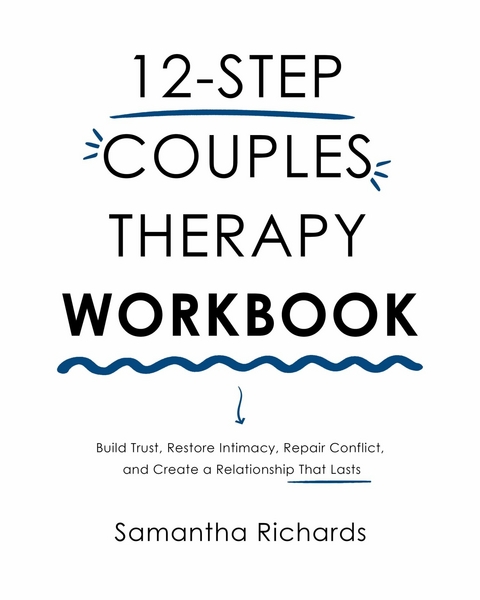
12-Step Couples Therapy Workbook (eBook)
198 Seiten
Publishdrive (Verlag)
978-1-78793-991-2 (ISBN)
Do you ever feel like the two of you are slowly drifting apart?
A text that never gets answered.
A sharp tone that leaves a sting.
The same fight replayed in different words.
Silence that feels heavier than words.
It doesn't take betrayal to create distance. Most relationships struggle in ordinary ways-through stress, mismatched expectations, and the erosion of small moments of care. What starts as love can quietly turn into cold efficiency, where partners share a home but not a bond.
The truth? Connection is a skill. Repair is a practice. And both can be learned-together.
This workbook is a practical playbook built for real couples with real lives. You won't find abstract theories or complicated frameworks. Instead, you'll find short, concrete tools you can use immediately: phrases that soften conflict, rituals that survive busy weeks, agreements that stop fights from spiraling, and repair strategies that actually land.
Inside, you and your partner will learn how to:
- Build your 'Team Us' identity with a one-page charter that sets your purpose, decision rules, and red lines.
- Catch tension before it explodes, using a simple traffic-light system that makes stress visible and manageable.
- Write Six Rules of Engagement you can both recall under pressure, turning conflict into workable conversations.
- Open softly and get further, with phrases that lower defensiveness and protect trust.
- Make your partner feel deeply heard, even when you disagree, by mastering validation instead of debate.
- Use timeouts that actually bring you back, with a protocol that prevents silence from feeling like rejection.
- Turn fights into workshops, designing small, testable plans instead of courtroom battles.
- Set boundaries that breathe, protecting dignity and privacy without building walls.
- Create time, tech, and privacy agreements that reduce digital jealousy and prevent late-night spirals.
- Decode your real mix of love languages, translating preferences into small daily actions that land.
- Rebuild after betrayal with a structured path: stabilization, no-contact agreements, trigger regulation, and paced reconnection.
- Foster intimacy that adapts, lowering brakes, raising accelerators, and keeping closeness alive across different seasons.
- Build a money system that fits, ending recurring fights with short money dates and safeguards against financial secrecy.
- Make the invisible mental load visible, so household management stops falling silently on one partner.
- Run your week like a team, with a 15-minute operational huddle that prevents chaos and aligns calendars.
- Catch relapses early and recover fast, using visible cues and agreed resets before small slips turn into crises.
Ready to stop the cycle?
If you've ever thought:
'Why do we keep having the same fight?'
'Why do small things turn into big ones so fast?'
'Why do I feel like I'm carrying this relationship alone?'
...then what you need isn't more effort or better timing. What you need is a clear, simple set of moves that work under stress and protect the bond you're building.
This is that set. Open the pages. Try one move tonight. Protect the bond first. Make the point second. And watch how quickly the climate of your relationship begins to shift.
Do you ever feel like the two of you are slowly drifting apart?A text that never gets answered.A sharp tone that leaves a sting.The same fight replayed in different words.Silence that feels heavier than words.It doesn t take betrayal to create distance. Most relationships struggle in ordinary ways through stress, mismatched expectations, and the erosion of small moments of care. What starts as love can quietly turn into cold efficiency, where partners share a home but not a bond.The truth? Connection is a skill. Repair is a practice. And both can be learned together.This workbook is a practical playbook built for real couples with real lives. You won t find abstract theories or complicated frameworks. Instead, you ll find short, concrete tools you can use immediately: phrases that soften conflict, rituals that survive busy weeks, agreements that stop fights from spiraling, and repair strategies that actually land.Inside, you and your partner will learn how to:- Build your Team Us identity with a one-page charter that sets your purpose, decision rules, and red lines.- Catch tension before it explodes, using a simple traffic-light system that makes stress visible and manageable.- Write Six Rules of Engagement you can both recall under pressure, turning conflict into workable conversations.- Open softly and get further, with phrases that lower defensiveness and protect trust.- Make your partner feel deeply heard, even when you disagree, by mastering validation instead of debate.- Use timeouts that actually bring you back, with a protocol that prevents silence from feeling like rejection.- Turn fights into workshops, designing small, testable plans instead of courtroom battles.- Set boundaries that breathe, protecting dignity and privacy without building walls.- Create time, tech, and privacy agreements that reduce digital jealousy and prevent late-night spirals.- Decode your real mix of love languages, translating preferences into small daily actions that land.- Rebuild after betrayal with a structured path: stabilization, no-contact agreements, trigger regulation, and paced reconnection.- Foster intimacy that adapts, lowering brakes, raising accelerators, and keeping closeness alive across different seasons.- Build a money system that fits, ending recurring fights with short money dates and safeguards against financial secrecy.- Make the invisible mental load visible, so household management stops falling silently on one partner.- Run your week like a team, with a 15-minute operational huddle that prevents chaos and aligns calendars.- Catch relapses early and recover fast, using visible cues and agreed resets before small slips turn into crises.Ready to stop the cycle?If you ve ever thought: Why do we keep having the same fight? Why do small things turn into big ones so fast? Why do I feel like I m carrying this relationship alone? then what you need isn t more effort or better timing. What you need is a clear, simple set of moves that work under stress and protect the bond you re building.This is that set. Open the pages. Try one move tonight. Protect the bond first. Make the point second. And watch how quickly the climate of your relationship begins to shift.
Introduction
The night the sauce hit the floor, we had two options.
Version one went like this: the pan slipped, red everywhere, the dog tried to help, and we locked eyes with that look that means, “Whose fault is this?” My voice sharpened. Your shoulders rose. The kitchen turned into a courtroom over ten seconds of gravity. We both made our case. Nobody ate.
Version two looked ordinary from the outside but felt different inside. Same splash, same dog, same clock ticking. You grabbed the towels; I killed the heat. No speech about responsibility, just four words over the sizzle: “Team Us. Quick reset.” Two minutes later the floor was clean, the sauce was salvageable, and we were laughing at the dog. We didn’t “win” against each other; we won against the mess.
If your relationship were a team, what would your playbook be today? Do you have one? Or do you improvise until a small stressor becomes proof of a big story: you never, I always, here we go again.
This workbook is a playbook. Not a long lecture, not a set of perfect scripts you’ll forget when your heart rate climbs. It’s a set of small, repeatable moves you can practice together until they feel like muscle memory. Simple on purpose. Because the moment that needs help most—the pause before you say something sharp, the text that could go sideways, the fatigue at 9:47 p.m.—isn’t the moment for speeches. It’s the moment for a move.
What this book is about
Relationships don’t thrive on theory; they thrive on things you can actually do under pressure. Love is not a feeling you wait to arrive; it’s behavior you invest in, especially when it would be easier not to. We’ll keep coming back to a few ideas:
- Identity before tactics. When tension rises, “me vs. you” is a fast default. The first shift is deciding who we are when things get hard: a pair in a tug-of-war, or a small team with a shared goal.
- Small beats grand. A 20-second repair is worth more than a two-hour post-mortem. A light rule you can follow beats a complicated plan you can’t.
- Visible and testable. If you can’t see the behavior, you can’t practice it. If you can’t test it, you can’t improve it.
- Protection of the bond. Protecting us doesn’t mean avoiding hard topics; it means tackling them without tearing the fabric you’re trying to mend.
Across the pages, you’ll keep finding micro-moves: a phrase you can say, a check-in format you can remember under stress, a timeout with a clear return, a ritual so small it survives messy weeks. We’ll ask you to write a few one-page tools you’ll actually use. Think pocket-sized, fridge-worthy, phone-screenshot-ready.
What this book is not
This isn’t therapy and doesn’t replace therapy. It’s not a moral scorecard, a personality test, or a promise that “if you just communicate better, everything will be fine.” It refuses the myth that some couples simply “match” and others don’t. Every couple builds something. This book helps you build a shared way to handle the ordinary and the difficult, so everyday stress stops becoming proof that you’re a bad fit.
If your relationship is unsafe because of abuse or intimidation, some of the tools here won’t apply; safety comes first, and outside help is non-negotiable. If your story involves trauma, addiction, or betrayal, you’ll find gentle guidance and structured pages, and you’ll also see clear pointers for bringing in a professional alongside your work at home.
How the workbook works
You’ll move from foundation to focus. Early pages help you define who we are as a team and the light rules of the road you’ll follow when a conversation matters. You’ll capture what already works (because you already do some things right), make early-warning cues visible, and set a short, usable protocol for high-stakes talks. Then you’ll build skills that make those rules easier to keep: softer starts, real listening that doesn’t require agreement, timeouts that lead you back, and a shared bank of phrases and micro-gestures that lower defensiveness. You’ll bring your values out of the fog and into everyday choices, so decisions stop feeling like power contests. You’ll learn to name the pursue–withdraw dance without blaming the dancers, turn anger into a clear need, and co-calm before you problem-solve. And because life is not just talk, you’ll get practical pages for intimacy, money, mental load, time and tech, and—in hard seasons—repair.
We’ll start by writing your Team Us Charter: a simple one-pager that aligns your shared purpose, the look of a week that works, a few credible red lines, how you decide when you disagree, and a maintenance rhythm you can keep when days are full. Think of it as an active compass, not a rigid contract. It tells you what to do when you don’t know what to do. Then we’ll add your “what already works” map, your early-warning cues, and a six-line set of Rules of Engagement for talks that matter—short enough to remember when tension rises. You’ll keep these pages visible and alive, not buried behind good intentions.
Why small works
When stress spikes, your body narrows your options. Curiosity shrinks; speed rises. That’s biology, not character. So we won’t ask you to “be your best selves” in the moment you feel least resourced. We’ll ask you to shape the moment with small, concrete moves you can reach for without a pep talk:
- One topic at a time—not a shopping list of past disappointments.
- A timeout with a guaranteed return, said out loud, with a time and a signal, so a pause doesn’t feel like an exit.
- A softer start that stays specific and short, so the other person has somewhere safe to land.
- A repair signal both of you recognize, so you can shift course before the cliff.
If you repeat these moves, they become the spine of your relationship under pressure. You won’t be perfect; you’ll be predictable—in the best way.
A double-take you’ll practice
Here’s a micro-conflict you may know. It’s Friday. You text, “Leaving soon?” No reply. Your brain writes a familiar story: “I’m not a priority.” They finally walk in, phone in hand. Your opening line is tight: “Nice of you to show up.” Their face hardens: “Traffic. And I worked late for us.” Round one begins.
Second take, same facts. You’ve agreed to a gentle opening and a one-topic rule. You breathe once before speaking: “When there’s no text after seven, I tense up. Could we try a quick ‘reading this, call at eight’ when you’re stuck?” They’ve practiced naming the 2% they can own: “You’re right, I disappeared. I can send that quick text next time.” The scene lasts under three minutes. Nobody is the villain. The problem shrinks to the size of a step.
You’ll practice these “double takes” across the book: not to stage life, but to change your default settings so fewer nights get burned by copy-paste fights.
How to use this book together
- Keep sessions short. Fifteen to thirty minutes is enough. Two short sessions beat one long one you’ll avoid.
- Write in the book. Use the one-page tools as living documents. Put review dates on them. Re-date instead of re-starting.
- Pick a few moves. Each step offers more ideas than you need. Choose three you can repeat. Repetition is the secret ingredient.
- Use the same start and stop. Begin the same way (a breath, a quick “are we good to talk?”) and end the same way (one line each about what you’re taking with you). Predictability lowers the load.
- Pause with a return. If you call a timeout, give a return time. If you miss it, you—who called it—restart contact. You’re not avoiding; you’re protecting the talk.
- Respect differences. One of you might need more space; the other, more reassurance. The goal isn’t to become the same; it’s to offer each other what makes staying present possible.
- Start where it helps. If your hot spot is money, or intimacy, or phones at night, you can visit those chapters when you need them. Still, we recommend building your team identity first; it makes everything lighter.
A note for different seasons
New relationship? You’ll set light rules now so early friction doesn’t calcify. Long-term? You’ll strip away habits that no longer fit and keep what still feeds you. Parents? You’ll aim for tiny rituals that survive bedtime chaos and sticky counters. Long-distance? You’ll build repair and touch by proxy and choose channels that lower fuel for misreads. Healing from a breach of trust? You’ll move slowly with clear windows, structure, and outside help when the pain is too loud to hold alone.
In every season you’ll find the same tone: warm, specific, kind, and operational. Nothing here asks you to perform romance. It asks you to protect connection.
Why we insist on “we”
Couples often say, “We tried everything.” Usually they mean, “We had the same fight a hundred times.” This book helps you try different: fewer lectures, more moves; fewer sweeping judgments, more small repairs; less looking for who started it, more choosing what we do next.
That begins with a shared identity. “Team Us” isn’t cute branding; it’s a real shift of stance. In a team, we can disagree without treating each other as the problem. We can say, “Here’s what I’m trying to protect right...
| Erscheint lt. Verlag | 18.8.2025 |
|---|---|
| Sprache | englisch |
| Themenwelt | Sachbuch/Ratgeber ► Gesundheit / Leben / Psychologie ► Familie / Erziehung |
| Schlagworte | Attachment Theory Anxious Avoidant Dismissive • Boundaries in relationship question for couples • Emotionally Focused Therapy Emotional Healing • Forgiveness betrayal Affair Retroactive Jealousy • Marriage Infidelity Questions for couples anxiety • Relationship workbook restore love conflict couple |
| ISBN-10 | 1-78793-991-X / 178793991X |
| ISBN-13 | 978-1-78793-991-2 / 9781787939912 |
| Informationen gemäß Produktsicherheitsverordnung (GPSR) | |
| Haben Sie eine Frage zum Produkt? |
 EPUB (Ohne DRM)
Digital Rights Management: ohne DRM
Dieses eBook enthält kein DRM oder Kopierschutz. Eine Weitergabe an Dritte ist jedoch rechtlich nicht zulässig, weil Sie beim Kauf nur die Rechte an der persönlichen Nutzung erwerben.
Dateiformat: EPUB (Electronic Publication)
EPUB ist ein offener Standard für eBooks und eignet sich besonders zur Darstellung von Belletristik und Sachbüchern. Der Fließtext wird dynamisch an die Display- und Schriftgröße angepasst. Auch für mobile Lesegeräte ist EPUB daher gut geeignet.
Systemvoraussetzungen:
PC/Mac: Mit einem PC oder Mac können Sie dieses eBook lesen. Sie benötigen dafür die kostenlose Software Adobe Digital Editions.
eReader: Dieses eBook kann mit (fast) allen eBook-Readern gelesen werden. Mit dem amazon-Kindle ist es aber nicht kompatibel.
Smartphone/Tablet: Egal ob Apple oder Android, dieses eBook können Sie lesen. Sie benötigen dafür eine kostenlose App.
Geräteliste und zusätzliche Hinweise
Buying eBooks from abroad
For tax law reasons we can sell eBooks just within Germany and Switzerland. Regrettably we cannot fulfill eBook-orders from other countries.
aus dem Bereich