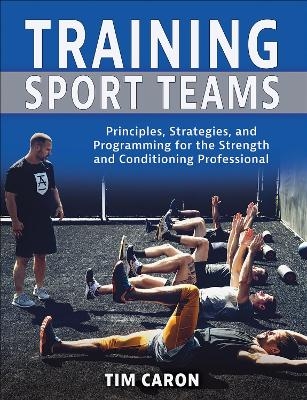
Training Sport Teams
Human Kinetics (Verlag)
978-1-7182-4335-4 (ISBN)
- Noch nicht erschienen (ca. Januar 2026)
- Versandkostenfrei
- Auch auf Rechnung
- Artikel merken
Program design for large groups of athletes is a daunting task, with far more factors to consider than in one-on-one training. Training Sport Teams: Principles, Strategies, and Programming for the Strength and Conditioning Professional offers practitioners invaluable guidance on the creation of training programs.
While many resources discuss what practitioners do with their teams, the practical application of these approaches is often not provided. Each team has its own set of constraints that must be factored into the program design. Training Sport Teams provides explanations, tools, strategies, and programming frameworks that address the challenges posed by large-group training.
Author Tim Caron brings technical concepts into a practical light, sharing his experiences as an assistant strength coach, head strength coach, and business owner. He describes the parameters programs should follow as well as the rules that help create an effective structure for training large groups of athletes.
Team training, says Caron, should be bound by two basic principles: biomechanical rules through structural balance and physiological rules through periodized program design. Programs need to address progression, progressive overload, specificity, individuality, diminishing returns, and reversibility. While most strength and conditioning professionals know these key elements, scaling them up to work in a team setting takes special expertise.
With guidance on communication, variance, and application, professionals will feel equipped to make changes, try new things, and deliver quality programming to athletes regardless of group size.
Tim Caron, CSCS, is the cofounder of Allegiate Gym in Los Angeles, California, established in 2017. He is directly responsible for programming for over 600 members and oversees more than 20 coaches working across three gym locations and remotely. He designed a comprehensive staff curriculum that has trained over 100 coaches, many of whom have gone on to work in the NFL, NBA, MLB, and Division I programs. He is also responsible for designing and outfitting each facility with the necessary equipment. From 2014 to 2017, Caron served as the head football strength and conditioning coach at the Army's West Point Academy. He led all strength and conditioning programming for the football team and was responsible for hiring and managing the football strength and conditioning staff. He also designed and implemented the team's nutrition program, sport science protocols, return-to-play strategies, and off-season competition planning. Prior to that, Caron worked as a football strength and conditioning coach at the University of Southern California. He held a similar position at the Georgia Institute of Technology. Caron began his coaching career in 2007 at Springfield College, where he served as the football strength and conditioning coach. Earlier in his career, he completed strength and conditioning internships at Harvard University, Georgia Tech, and at the University of Mississippi. Caron holds a master's of education in strength and conditioning from Springfield College. He also earned a master's of science in performance enhancement and injury prevention from California University of Pennsylvania. He completed his undergraduate education at Westfield State, where he received a bachelor's of education in mathematics and movement science. Caron is the author of two other books: Strength Deficit: Leveraging Ratios Between Eccentric and Concentric Strength and How to Become a Strength Coach: Periodize Your Career in Strength and Conditioning. He also hosts and produces digital content, including the pH Podcast and the Strength TC Collective website.
Part I. Principles
Chapter 1. First-Principles Thinking
How Should We Approach Training
What Is a Good Program?
Take Home
Chapter 2. Individuality
Training Age
Biological Age
Sex
Muscle Fiber Type
Athlete Tracking and Monitoring
Take Home
Chapter 3. Specificity
Bioenergetics
Biomotor Abilities
Biomechanics
Take Home
Chapter 4. Progressive Overload
Intensity
Volume
Density
Take Home
Chapter 5. Progression
Biomechanics
Biomotor Abilities
Bioenergetics
Take Home
Chapter 6. Reversibility
Force
Velocity
Work
Take Home
Chapter 7. Diminishing Returns and Critical Drop-Off
Force
Velocity
Work
Take Home
Part II. Rules
Chapter 8. Eliminating Noise
Establishing Rules
Types of Rules
Take Home
Chapter 9. Biomechanical Rules
Testing
Creating Biomechanical Rules
Take Home
Chapter 10. Applying Biomechanical Rules for Structural Balance
Structural Balance Rules
Take Home
Chapter 11. Physiological Rules
Adaptation
Physiological Rules
Physiological Rules Setup
Take Home
Chapter 12. Applying Physiological Rules for Periodization and Program Design
History of Periodization
Applying Physiological Rules
Take Home
Part III. Logistics
Chapter 13. Logistics
Control
Inventory
Appraise
Take Home
Chapter 14. Weight Room Design
How Big Is Your Space?
How Many Athletes Do You Have in Total?
When Are We Allowed to Train Our Athletes?
How Many Coaches Do You Have in Total?
What Equipment Will You Need?
Take Home
Chapter 15. Testing
Testing Rationale
Testing Logistics
Testing Interpretation
Take Home
Chapter 16. Coaching a Session
Newell's Model
Ericsson's Deliberate Practice Model
Meetings
Education
Training
Evaluation
Take Home
Part IV. The Program
Chapter 17. Training Session Design
Movement Prep
Training Session
Tracking and Organizing
Take Home
Chapter 18. Microcycle Design
Microcycle Length
Training Splits
Quality Arrangement
Take Home
Chapter 19. Mesocycle Design
Mesocycle Length
Mesocycle Organization
Mesocycle Progression
Take Home
Chapter 20. Macrocycle Design
Step 1: Working Forward or Backward?
Step 2: Annual Calendar
Step 3: Organizing the Mesocycles
Step 4: Organizing the Microcycles
Step 5: Organizing the Training Sessions
Take Home
| Erscheint lt. Verlag | 26.1.2026 |
|---|---|
| Verlagsort | Champaign, IL |
| Sprache | englisch |
| Maße | 216 x 279 mm |
| Themenwelt | Sachbuch/Ratgeber ► Sport ► Fitness / Aerobic / Bodybuilding |
| ISBN-10 | 1-7182-4335-9 / 1718243359 |
| ISBN-13 | 978-1-7182-4335-4 / 9781718243354 |
| Zustand | Neuware |
| Informationen gemäß Produktsicherheitsverordnung (GPSR) | |
| Haben Sie eine Frage zum Produkt? |
aus dem Bereich