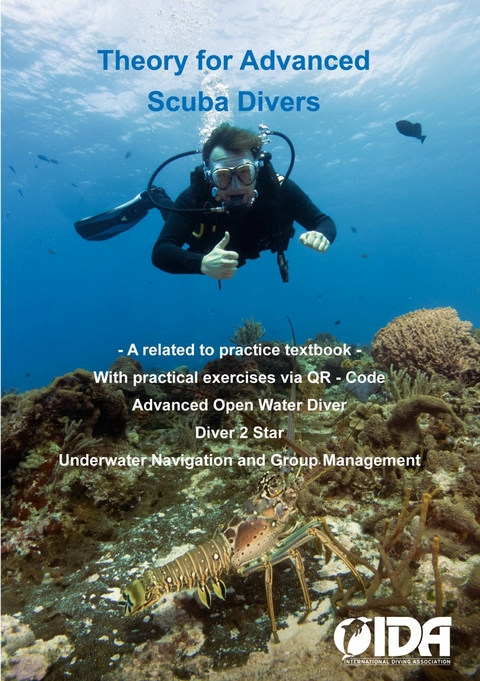
Theory for Advanced Scuba Divers (eBook)
288 Seiten
Books on Demand (Verlag)
978-3-8192-7275-2 (ISBN)
The author, Karsten Reimer, born in Kiel in 1961, had the great advantage of being born right by the sea. When he saw Flipper on television for the first time, he knew that he wanted to become a diver. His first attempts with homemade compressed air tanks made of cardboard went wrong, as expected, and his mother had her hands full regularly preventing him from drowning. It was only many years later, at the age of 18, that the author finally found a diving school in Kiel that took on the task of turning him into a real recreational diver. At that time, diving schools were still few and far between in Germany. It was inevitable that after training as a CMAS 1-star diver, he would go on to train as a CMAS 2-star diver, and so on. In 1986, he took his first diving instructor exam on Elba, followed by many more courses and exams. Now, after more than 45 years, the author is not only an instructor and examiner for divers and diving instructors for CMAS and R.S.T.C., but also holds a management position at an international diving association, the IDA. As the Baltic Sea is only 10 minutes away from his home, the author still dives a lot and enjoys it very much when he is not busy overhauling his compressor, as high air quality is very important to him.
1.2 The minimum equipment for open water dives with SCUBA equipment according to IDA standard and Euronorm!
ABC equipment complete (mask, snorkel and fins)
You can read more about these items of equipment in the IDA textbook Basics-Theory for SCUBA divers ISBN 9783756827589
.
Two independent regulators.
For cold water dives (water temperature 10˚ Celsius and below, at the planned water depth) on two separately lockable valves.
The two regulators can either be mounted on a double or on a single tank.
Which of the two combinations you choose depends solely on the amount of air required or, if the amount of air is not the criterion, on the equipment currently in the diver's store.
Example 1
10 litre tank with double valve and LP hose for the dry suit
LP stands for low pressure and HP for high pressure. There are several outlets for LP on the first stage. Depending on the manufacturer, the medium pressure is between 5 bar and 15 bar for the regulators, the dry suit and the jacket and one or two outlets for high pressure (tank pressure) for the pressure gauge and possibly a radio transmitter for the dive computer (to show the tank pressure on the display).
Example 2
Double 7 litre tank, connected by a lockable bridge and two separately lockable valves. The valve in the centre (also known as the manifold) of the bridge allows the two tanks to be used either separately (2 x 7 litres) or as a unit (14 litres).
The inclined reader may now wonder what all this tangle of tubes is for and whether it is really necessary to go into the water with so much equipment ("Gedöns" in North German). In terms of diving safety, the answer to this question is a clear "yes". In the past, when everything was undoubtedly better, we dived with minimal equipment and still survived. But since we (should) continue to develop and there were no airbags in cars in the past, but today no one disputes that these things have saved lives and continue to do so every day, we accept these hoses as necessary and live with them. Speaking of hoses. Your main unit should have a LP hose of 90-120 cm. If your partner gets into difficulty breathing and indicates this (see photo and film via QR code),
then simply give him your main regulator and then take your second regulator yourself. In this way, you can end the dive without alternate breathing, which can also bring a certain restlessness or uncertainty to the dive. It also has a psychological effect if you give your partner the regulator from which you have been breathing yourself. Your partner now has a problem; otherwise they would not have given you the "I've run out of air" sign and this problem could worry him, depending on their experience and "coolness". It is therefore a little reassuring if your partner gets a regulator that works reliably and also allows enough freedom of movement for both divers due to its hose length. To ensure that your second regulator and the octopus are also working properly, you should check these regulators frequently and breathe from them from time to time during the dive. If, in an emergency, you hand your partner a regulator that is stiff or contains sand, for example, the situation can escalate very quickly and this should be avoided at all costs. So always make sure that all your equipment is working properly at all times.
The configurations shown on the previous pages are intended for diving in cold water (water temperature below 10° Celsius) and when a dry suit is used. The distribution of the outlets (dry suit, jacket, regulators) must be selected in such a way that the so-called "cold load" is distributed in such a way that icing of the regulators (here primarily those of the first stages) cannot occur. The cooling load is the sum of all effects caused by the cold. Firstly, of course, we have the water temperature, which has a negative effect on all our equipment and (usually) on us. And then, of course, there is the amount of air that we take from the tank via the first stages of our regulators. Of course, this includes not only the air we take out by breathing, but also the air we put into the jacket and the drysuit. As experienced or fairly experienced divers, we know that air that expands removes heat from the immediate surroundings, i.e. it cools. See also the IDA book "Basic Theory for Scuba Divers". Here is the main statement on this topic once again:
And since Mr Joule (James Prescott Joule, British physicist, 1818 to 1889) and Mr Thomson (William Thomson, British physicist, 1824 to 1907) discovered that gases that expands at a nozzle extract the energy required for this from the environment and thus generate cold, the first stage is cooled down when breathing from the regulator. This process of cold generation is called the Joule-Thomson effect, after the gentlemen mentioned above. Now you may ask yourself, why is he telling me this? Because this Joule-Thomson effect can spoil your dive! It can always happen that a drop or two of water creeps into the first stage. Either because you did not press your thumb firmly enough on the high-pressure inlet of the first stage when flushing the first stage or because the compressor operator did not take the drying of the breathing air seriously enough. So if the droplet in the first stage encounters the cold of the expanding gas, it will freeze and impair the function of the first stage. As a rule, your regulator, i.e. the second stage, blows off uncontrollably until the tank is empty or your partner closes the valve of your tank. Due to the frozen water in the first stage, it can no longer close and the medium pressure increases until the second stage, due to its design, opens and releases the outflowing air into the water. This process is called internal icing.
Now let's take a look at the two configurations above. In principle, they are identical, differing only in the volume of the tanks. Quite apart from the fact that, as a rule and depending on the tank size, a double tank unit is better positioned on the back, as the centre of rotation of the tank unit is closer to the diver's body and therefore has less influence on the rotation around the longitudinal axis of the diver.
As a diver, you now breathe from the main regulator, which is connected to the main valve and plays the main role in terms of the "cooling load", as you breathe continuously from it and therefore cool the first stage down considerably. At the same time, you tare with the drysuit via the main regulator; however, in contrast to breathing, this only happens rarely and only in short (taring) blasts and therefore has a small influence on the first stage. One could now comment that it is not possible to speak of a distribution of the cooling load here, as both "air extraction points" are located at a first stage. But that is true..... The devil is in the detail here too, and we are concerned with safety when diving. Let's assume that the first stage of your main valve ices up and we or our partner have to close the main valve. With the configuration shown above, we have a complete system available as a redundancy (reserve, in German) at the second outlet and can finish the dive in peace. In other words, to end means to surface, not to continue. Your partner can now "hang" on to your octopus or, alternatively, your second automatic unit without having you to alternate breathing with him and the ascent can be carried out in peace.
If an accident occurs and we have to rescue our partner, we can use our jacket as a buoyancy compensator and rescue device, as it is located on the second outlet and is therefore supplied with air. If the jacket were connected to the first stage of the main regulator and the dry suit to the first stage of the second regulator, we would have to carry out a rescue using the dry suit as a rescue and buoyancy compensator, which is much more difficult than a rescue with the jacket. Anyone who has ever been in such a situation, whether intentionally or unintentionally, will surely agree with me that it is not easy, even for experienced drysuit divers, to rescue a person and at the same time buoyancy control over the drysuit to prevent them from "shooting up" to the surface or sinking. Strictly speaking, you would need many more hands in such a situation than we have, as we now have to operate our drysuit, possibly our jacket and the jacket of the casualty, but at the same time have at least one hand free to hold the casualty. If the person to be rescued is also travelling with the drysuit, it becomes very difficult to slowly ascend to the surface. But you can learn how to do this on a drysuit diver course (SC). But don't worry unnecessarily, modern regulators and modern compressor systems prevent such icing very reliably. If you now ensure that no water can enter the first stage when rinsing your regulator, icing is almost impossible. But never impossible, remember this when diving in cold water.
The dry suit is also called a constant volume suit, at least among professionals. Why? Quite simply, if the suit always has a constant volume, which we as divers can/should/must ensure, the buoyancy also always remains constant, according to Archimedes. The jacket is therefore only used for rescue in an emergency. If you make a mistake and, as usual, tare with the jacket, physics will make you aware of your mistake. When descending, if no air is put into the drysuit, a relative negative pressure is created compared to the external pressure and therefore water is sucked into the drysuit, which means "it gets wet and cold". As a rule, you will then...
| Erscheint lt. Verlag | 6.8.2025 |
|---|---|
| Sprache | englisch |
| Themenwelt | Sachbuch/Ratgeber ► Sport ► Segeln / Tauchen / Wassersport |
| Schlagworte | Advanced Open Water Diver • Advanced Scuba Diving • CMAS • Recreational Diving • Scuba Diving |
| ISBN-10 | 3-8192-7275-5 / 3819272755 |
| ISBN-13 | 978-3-8192-7275-2 / 9783819272752 |
| Informationen gemäß Produktsicherheitsverordnung (GPSR) | |
| Haben Sie eine Frage zum Produkt? |
 EPUB (Wasserzeichen)
DRM: Digitales Wasserzeichen
Dieses eBook enthält ein digitales Wasserzeichen und ist damit für Sie personalisiert. Bei einer missbräuchlichen Weitergabe des eBooks an Dritte ist eine Rückverfolgung an die Quelle möglich.
Dateiformat: EPUB (Electronic Publication)
EPUB ist ein offener Standard für eBooks und eignet sich besonders zur Darstellung von Belletristik und Sachbüchern. Der Fließtext wird dynamisch an die Display- und Schriftgröße angepasst. Auch für mobile Lesegeräte ist EPUB daher gut geeignet.
Systemvoraussetzungen:
PC/Mac: Mit einem PC oder Mac können Sie dieses eBook lesen. Sie benötigen dafür die kostenlose Software Adobe Digital Editions.
eReader: Dieses eBook kann mit (fast) allen eBook-Readern gelesen werden. Mit dem amazon-Kindle ist es aber nicht kompatibel.
Smartphone/Tablet: Egal ob Apple oder Android, dieses eBook können Sie lesen. Sie benötigen dafür eine kostenlose App.
Geräteliste und zusätzliche Hinweise
Buying eBooks from abroad
For tax law reasons we can sell eBooks just within Germany and Switzerland. Regrettably we cannot fulfill eBook-orders from other countries.
aus dem Bereich