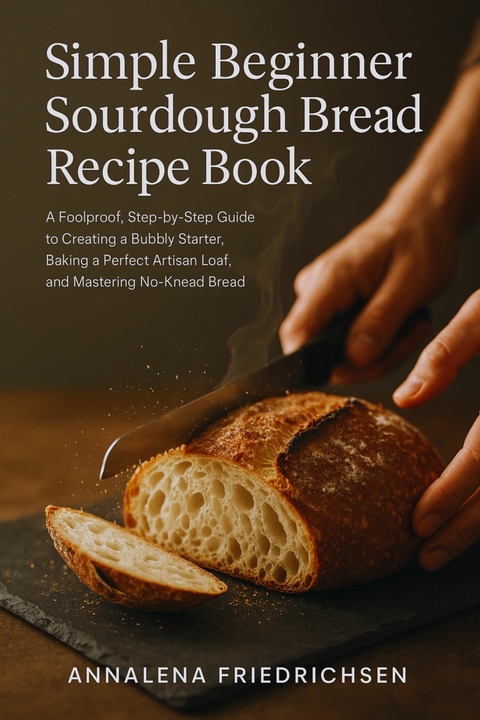
Simple Beginner Sourdough Bread Recipe Book (eBook)
142 Seiten
Dapen Pubs (Verlag)
978-1-0670978-4-4 (ISBN)
Imagine pulling a warm, crackling loaf of artisan sourdough from your own oven-the golden crust, the heavenly aroma, the airy, open crumb.
For most of us, that dream feels impossibly out of reach, lost in a world of confusing jargon, complicated steps, and the fear of a flat, dense failure. This book was written to destroy that fear. It is not an encyclopedia of confusing techniques; it is a foolproof, step-by-step master plan that holds your hand and focuses on one thing: helping you bake one perfect, no-fail artisan loaf. We will build your confidence, demystify the starter, and guide you to that first triumphant bake. Your journey from baker-in-waiting to confident sourdough artist starts now. It's time to bake the bread you've always dreamed of.
MASTER YOUR SOURDOUGH STARTER WITH EASE: Finally, a simple, day-by-day guide that demystifies the starter process. Our foolproof method shows you exactly how to create and maintain a bubbly, active starter without any confusing jargon or stress.
BAKE A PERFECT ARTISAN LOAF ON YOUR FIRST TRY: Experience the thrill of pulling a bakery-worthy loaf from your own oven. This guide focuses on one perfect, no-fail recipe to give you a golden, crusty crust and a beautiful open crumb, guaranteed.
ENJOY THE MAGIC OF NO-KNEAD BREAD: No stand mixer? No problem! Discover our simple, no-knead technique that lets time do all the hard work for you. It's the easiest way to achieve incredible flavor and texture with minimal effort.
NEVER FEAR FAILURE WITH OUR TROUBLESHOOTING GUIDE: Is your starter not rising? Is your loaf too dense? We've included a complete troubleshooting chapter that addresses every common beginner problem, turning potential failures into learning moments.
GO BEYOND THE BASIC LOAF: Once you've mastered the classic loaf, explore a collection of delicious recipes using your new skills. From savory focaccia to tangy sourdough pancakes, you'll find exciting new ways to enjoy your homemade starter.
3
The One Recipe to Master First
My Perfect No-Knead Artisan Loaf
This is the moment.
Everything we have done so far—creating our starter, feeding it, watching it grow—has been leading to this. This single loaf of bread. Forget everything else you may have seen or read. For now, this is the only recipe that matters.
Why? Because the greatest gift I can give you is not a book with a hundred recipes, but the unshakeable confidence that comes from one, single, triumphant success. The thrill of pulling this beautiful, crusty, bakery-worthy loaf from your own oven will be the fuel for your entire baking journey.
This recipe is designed to be as foolproof as possible. We will use a no-knead method, letting time do the work for us. We will use a long, cold proof, which not only develops incredible flavor but also makes the dough easy to handle. I will walk you through every stage, explaining the why behind each step so you are not just following instructions, but truly understanding the craft.
Take a deep breath. You are ready for this. Let's bake your first perfect loaf of sourdough bread.
Understanding Baker’s Percentages (The Simple Way)
Before we jump in, I want to share a small but powerful secret of the baking world: baker’s percentages. This might sound intimidating, but I promise you, it's simple.
Think of it this way: if you have a recipe for one person, you double it for two people. Baker's percentages are just a universal way of writing a recipe so it's easy to scale up or down. In baking, everything is expressed as a percentage of the total flour weight.
So, in a recipe with 1000g of flour, if the water is listed at 75%, it means you need 750g of water. If the salt is 2%, you need 20g of salt.
You absolutely do not need to do this math yourself for the recipes in this book. I have already done it for you. I am only showing you this because understanding the concept will empower you later. It’s the key that unlocks your ability to read more advanced recipes or even create your own. For now, just know that it exists, and trust the grams I've laid out for you below.
My Perfect No-Knead Artisan Loaf
This recipe will produce a classic artisan boule with a crisp, golden crust and a tender, open crumb. It is the foundational recipe that will teach you everything you need to know about the feel and rhythm of sourdough.
-
Servings: 1 large loaf (about 12 slices)
-
Active Prep Time: 25-30 minutes
-
Total Time (from mix to bake): Approx. 24 hours (mostly hands-off time)
-
Difficulty: Medium (Requires patience, not complex skill)
-
Dietary Notes: Vegan.
Ingredients:
-
100g bubbly, active sourdough starter (fed 4-8 hours prior, and has passed the float test)
-
375g lukewarm water (about 85°F / 29°C)
-
500g bread flour
-
10g fine sea salt
Step-by-Step Instructions:
-
Mix: In a large bowl, whisk the active starter and lukewarm water until the starter is mostly dissolved. Add the bread flour and salt. Mix with your hands or a spatula until a shaggy, cohesive dough forms and no dry flour remains.
-
Bulk Ferment: Cover the bowl and let the dough rise in a warm place for approximately 4-6 hours. During the first 2 hours, perform 3-4 sets of "stretch and folds."
-
Shape: Turn the dough out onto a lightly floured surface. Gently pre-shape it into a round. Let it rest for 20 minutes, then perform a final shaping, creating a tight boule (round).
-
Cold Proof: Place the shaped dough, seam-side up, into a proofing basket or a bowl lined with a well-floured tea towel. Cover it and place it in the refrigerator for at least 12 hours, and up to 24 hours.
-
Preheat: The next day, place a cast-iron Dutch oven (with its lid) in your oven and preheat it to 450°F (230°C) for a full hour.
-
Score & Bake: Remove the cold dough from the refrigerator. Turn it out onto a piece of parchment paper. Score the top with a sharp blade. Carefully lower the dough (on the parchment) into the hot Dutch oven. Bake covered for 25 minutes, then remove the lid and bake for another 20-25 minutes, until the crust is a deep, dark golden brown.
-
Cool: Turn the loaf out onto a wire rack and let it cool completely for a bare minimum of 4 hours before slicing.
My Personal Chef’s Tips:
- The temperature of your water matters. Using lukewarm water helps kickstart fermentation, giving your starter a warm, happy environment from the beginning.
- Don't add the salt until you add the flour. Salt can be harsh on raw yeast, so we want to buffer it with the flour.
- This recipe is incredibly forgiving. If your bulk fermentation goes a little longer, or your cold proof is 18 hours instead of 12, your bread will still be wonderful.
Variations:
-
Heartier Loaf: For a more rustic flavor and texture, you can substitute 100g of the bread flour with 100g of whole wheat flour. Do not change the water amount.
-
Once you have mastered this plain loaf, you can begin to experiment with the add-in loaves from Chapter 6, using this recipe as your base method.
Estimated Nutritional Information (per slice):
-
Calories: 140
-
Protein: 4g
-
Fat: 0.5g
-
Carbohydrates: 28g
Step 1: Mixing the Dough
This first step is gentle. We are not kneading; we are simply combining our ingredients and encouraging the flour to begin hydrating. When you see the word autolyse (pronounced auto-lees) in other recipes, it simply refers to a brief rest period after mixing flour and water. By mixing our ingredients and letting them sit, we are giving the flour a head start on absorbing the water, which makes the gluten easier to develop later. Our stretch-and-fold process includes this rest period naturally. The main goal here is to ensure every bit of flour has met the water and starter. Your hands are the best tool for this, as you can feel for any dry, forgotten pockets at the bottom of the bowl.
Step 2: Bulk Fermentation & The Magic of the "Stretch and Fold"
This is the period of the first rise, and it's where all the flavor and structure are born. "Bulk" simply refers to the fact that we are fermenting the entire mass of dough at once, before dividing or shaping it. During this time, the yeast is busily producing the gases that will give our bread its airy crumb. Our job is to build a structure strong enough to trap those gases.
We do this with the "stretch and fold." Instead of the intensive work of kneading, we perform a series of simple, gentle movements that align and strengthen the gluten network.
How to Perform a Stretch and Fold:
With wet hands to prevent sticking, reach into the bowl and grab one quadrant of the dough. Gently stretch it upwards, and fold it over the center of the dough. Rotate the bowl a quarter turn and repeat: stretch, and fold. Do this two more times, for a total of four folds (one for each compass direction: North, South, East, West). That's it. You've completed one "set." Cover the dough and let it rest for 30-45 minutes before you perform the next set.
Step 3: Shaping Your Loaf for a Beautiful Rise
Shaping is where we take our puffy, fermented dough and create the structure and surface tension it needs to rise up, not spread out, in the oven. This may feel awkward at first, but it will soon become second nature.
First, we pre-shape. Turn the dough out onto a lightly floured surface. Gently press it down and fold the edges into the center to form a loose round. Let this rest for 20 minutes. This step teaches the dough its new shape and makes the final shaping...
| Erscheint lt. Verlag | 6.8.2025 |
|---|---|
| Reihe/Serie | Sourdough Bread Recipes |
| Sprache | englisch |
| Themenwelt | Sachbuch/Ratgeber ► Essen / Trinken |
| Schlagworte | artisan sourdough bread recipe book • easy sourdough bread recipe book • sourdough bread baking book • sourdough bread baking cookbook • sourdough bread making book • sourdough bread making recipe book • sourdough bread recipe cookbook |
| ISBN-10 | 1-0670978-4-8 / 1067097848 |
| ISBN-13 | 978-1-0670978-4-4 / 9781067097844 |
| Informationen gemäß Produktsicherheitsverordnung (GPSR) | |
| Haben Sie eine Frage zum Produkt? |
 EPUB (Ohne DRM)
Digital Rights Management: ohne DRM
Dieses eBook enthält kein DRM oder Kopierschutz. Eine Weitergabe an Dritte ist jedoch rechtlich nicht zulässig, weil Sie beim Kauf nur die Rechte an der persönlichen Nutzung erwerben.
Dateiformat: EPUB (Electronic Publication)
EPUB ist ein offener Standard für eBooks und eignet sich besonders zur Darstellung von Belletristik und Sachbüchern. Der Fließtext wird dynamisch an die Display- und Schriftgröße angepasst. Auch für mobile Lesegeräte ist EPUB daher gut geeignet.
Systemvoraussetzungen:
PC/Mac: Mit einem PC oder Mac können Sie dieses eBook lesen. Sie benötigen dafür die kostenlose Software Adobe Digital Editions.
eReader: Dieses eBook kann mit (fast) allen eBook-Readern gelesen werden. Mit dem amazon-Kindle ist es aber nicht kompatibel.
Smartphone/Tablet: Egal ob Apple oder Android, dieses eBook können Sie lesen. Sie benötigen dafür eine kostenlose App.
Geräteliste und zusätzliche Hinweise
Buying eBooks from abroad
For tax law reasons we can sell eBooks just within Germany and Switzerland. Regrettably we cannot fulfill eBook-orders from other countries.
aus dem Bereich