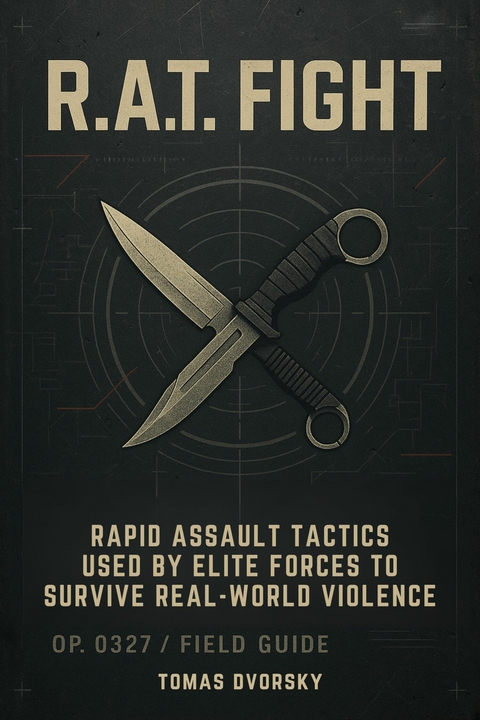
R.A.T. Fight (eBook)
124 Seiten
Publishdrive (Verlag)
978-0-00-098623-8 (ISBN)
When seconds count, elite tactics save lives.
In the chaos of real-world violence, there's no time for complex techniques or lengthy combinations. Elite military and special operations forces rely on Rapid Assault Tactics (R.A.T.) - devastatingly effective methods designed to neutralize threats instantly and escape alive.
What You'll Master:
✓ Lightning-Fast Threat Assessment - Read danger signals before others even notice
✓ Explosive Counter-Attack Techniques - Turn the tables on any aggressor in seconds
✓ Close-Quarters Combat Essentials - Proven methods for confined spaces and surprise attacks
✓ Psychological Warfare Tactics - Disrupt your opponent's mindset before the first strike
✓ Emergency Escape Protocols - Get out alive when everything goes wrong
✓ Weapon Retention & Disarmament - Handle armed confrontations with confidence
Battle-Tested by Elite Forces. Adapted for Real Life.
This isn't another martial arts manual filled with impractical moves. Every technique has been refined in actual combat by special operations personnel, law enforcement tactical units, and military combatives instructors. Now these closely-guarded methods are available to serious practitioners who refuse to be victims.
No Fluff. No Theory. Just What Works.
When your life is on the line, you need techniques that work under extreme stress, in poor lighting, wearing street clothes, against larger, stronger, or armed opponents. R.A.T. Fight delivers exactly that - stripped-down, brutal efficiency that can be learned quickly and applied immediately.
Your safety isn't negotiable. Get the tactics that elite forces trust with their lives.
Chapter 1: The Predator’s Advantage
“The enemy gets a vote in every plan.”
— General James Mattis
1.1 Understanding Criminal Psychology and Attack Patterns
There is no such thing as a random attack.
Though victims often describe acts of violence as sudden or unprovoked, the truth is that most predatory assaults are preceded by a process—a sequence of decisions and behaviors on the attacker’s part that culminate in action. That process is often invisible to the untrained eye, but it leaves a trail. If you know what to look for, you can spot that trail early, long before the point of no return.
This chapter is about learning to think like the adversary. Not to emulate their malice, but to decode the strategies they use—because in the realm of personal defense, knowledge of the predator’s playbook is your first real weapon.
Predatory Behavior Analysis
Predators, whether animal or human, follow patterns. They don’t attack at random. They search for opportunity. They observe. They wait. They test.
In every environment, there are indicators that scream vulnerability. These cues can be visual, behavioral, or contextual. To the trained eye, they’re like neon signs pointing toward an easy win.
So, how does an attacker choose a victim?
First, body language.
The average criminal may not have a degree in psychology, but they are deeply attuned to human behavior—often because their livelihood or survival depends on it. They learn quickly, often through violent trial and error, what kind of body language signals strength… and what signals weakness.
Someone walking with their head down, shoulders slouched, eyes fixed on a phone—they’re projecting disengagement. Someone walking with hesitant steps, avoiding eye contact, reacting nervously to proximity—these are red flags. They suggest a lack of confidence, a lack of awareness, and most importantly, an unlikely threat.
Predators subconsciously (or consciously) calculate risk vs. reward. They don’t want a fair fight. They want the kind of target who will freeze, hesitate, or comply. An ideal victim isn’t just physically smaller or weaker—they are mentally and emotionally unprepared.
Consider this: studies of violent offenders, including interviews with incarcerated criminals, have shown that many attackers can assess a potential victim’s vulnerability within seconds—just by watching them walk. Stride length, gait rhythm, head movement, shoulder alignment—all of it contributes to the impression of someone who is either “in control” or “in trouble.”
But beyond body language, environmental positioning also plays a key role.
The context in which someone is moving can amplify their vulnerability. A person walking alone at night, in poorly lit areas with few exits, is inherently more exposed than someone in a crowd. A person sitting with their back to the door in a public place—lost in headphones or conversation—may seem like a softer target than someone scanning the room periodically and keeping a clear view of exits.
Environmental vulnerability indicators are often invisible to the average person but crystal clear to those seeking advantage. They look for choke points, blind corners, obstructed sightlines. A predator’s mind constantly scans for terrain advantages—places where they can corner, ambush, or flee with minimal resistance.
To combat this, you must learn to reverse the lens.
You must become the watcher of watchers.
When you enter a room or walk a street, ask yourself: If I were hunting someone, who would I pick? Why? What body language would catch my eye? What escape routes would I consider? Where are the blind spots? Then ask the hard question—do I fit the profile I just imagined?
By consciously examining how predators think, you begin to deconstruct your own habits, mannerisms, and patterns. You stop broadcasting weakness. You become a harder target before a confrontation even begins.
The Interview Process
Predators don’t always strike without warning. In fact, many of them conduct an unspoken “interview” beforehand. This pre-attack ritual is used to test boundaries, gauge reactions, and assess resistance.
The interview can be subtle or overt. It might involve a stranger approaching with a question—“Do you have the time?” or “Can you help me find this address?” It might be a compliment that feels slightly off, or a joke made too early in an encounter. On the surface, these may seem like ordinary social interactions. But to a trained eye, they are probes.
The purpose of this probing is not conversation. It’s evaluation.
The predator is watching how you respond. Do you look them in the eyes? Do you step back or hold your ground? Do you respond with clarity or with uncertainty? Do you glance around the environment, checking for others or for exits?
Each answer gives them more data.
Some interviews escalate in stages. If the first probe succeeds, the predator might push further—standing closer, asking a more invasive question, or using touch as a test. They are looking for one thing above all: permission. Not in the legal or ethical sense, but in the psychological one. They want to see whether you’ll allow their escalation to continue unchecked.
In this sense, a confrontation doesn’t begin with the first punch or the first shout—it begins the moment the boundary is crossed and not pushed back.
This is why many seasoned professionals train to respond to these interviews with calm but clear resistance. The response doesn’t have to be aggressive. In fact, in many cases, aggression only escalates things unnecessarily. But it must be firm. An assertive “No, I’m good,” delivered with eye contact and steady posture, is a far stronger deterrent than a fearful compliance.
The danger of the interview is that most people don’t recognize it for what it is. Social conditioning teaches us to be polite, even when we feel uncomfortable. We’re taught not to make assumptions, not to offend, not to judge. Predators exploit that hesitation. They use your decency as a shield.
Breaking that pattern starts with awareness. Once you learn to identify pre-assault interviews, you’ll never experience them the same way again. You’ll feel the difference between a genuine question and a manipulative probe. And more importantly, you’ll respond from a place of control, not confusion.
Escalation Triggers and Micro-Expressions
Not all violent encounters begin with surprise. Some begin with words—arguments that shift suddenly, dramatically into assault.
Understanding the escalation triggers that turn verbal conflict into physical confrontation is essential for navigating those situations safely. There is a threshold in every heated interaction—a moment where posturing becomes action, where control is lost, and where danger becomes imminent.
But that threshold doesn’t always shout. Often, it whispers.
The signs of an impending attack are subtle but predictable. They live in the body. In the breath. In the eyes.
A person about to launch an assault will often display involuntary micro-expressions—tiny, rapid muscle movements that escape conscious control. These might include:
- Jaw clenching: a rapid tightening of the facial muscles, often in preparation for aggression.
- Lip compression: lips pressed together hard and flat—often a sign of internal restraint or pending release.
- Shoulder drop or weight shift: unconscious adjustment of stance to prepare for movement.
- Fist clenching or hand wringing: signs of nervous energy channeling into potential action.
- Eye aversion or stare-down: depending on the person, either avoiding eye contact or maintaining it with unnatural intensity.
Then there are behavioral markers. The person might begin blading their body—turning slightly sideways to minimize their profile and prepare to strike. They might begin pacing, using motion to burn off adrenaline or to position themselves advantageously. Their voice may drop or rise suddenly. They might begin repeating themselves, losing rational coherence.
All of these are signs that the situation is escalating past words.
You must train yourself to detect these signs early—before the swing, before the grab, before the lunge. Because once the first blow lands, your ability to control the outcome is already compromised.
But perhaps most crucially, you must learn to identify your own escalation triggers. You must know what frustrates you, what frightens you, what causes you to freeze or lash out. The predator may not have your training—but they may know how to press your buttons. Your defense is only as strong as your ability to stay calm under pressure.
The predator thrives in environments where people are unaware, unprepared, and untrained. Their success depends not on brute force but on your predictability. Every signal you send—how you walk, how you stand, how you speak—tells them whether to move on or move in.
Understanding criminal psychology and attack patterns allows you to invert the dynamic. You cease to be a passive participant in your own safety. You become an active force—hard to read, harder to reach, and almost impossible to exploit.
Violence begins long before the first strike. But so does defense.
The coming sections will train you to assess environments like a professional, to construct mental maps that reveal danger before it strikes, and to orient yourself...
| Erscheint lt. Verlag | 1.8.2025 |
|---|---|
| Sprache | englisch |
| Themenwelt | Sachbuch/Ratgeber ► Sport |
| ISBN-10 | 0-00-098623-2 / 0000986232 |
| ISBN-13 | 978-0-00-098623-8 / 9780000986238 |
| Informationen gemäß Produktsicherheitsverordnung (GPSR) | |
| Haben Sie eine Frage zum Produkt? |
 EPUB (Adobe DRM)
Größe: 3,4 MB
Kopierschutz: Adobe-DRM
Adobe-DRM ist ein Kopierschutz, der das eBook vor Mißbrauch schützen soll. Dabei wird das eBook bereits beim Download auf Ihre persönliche Adobe-ID autorisiert. Lesen können Sie das eBook dann nur auf den Geräten, welche ebenfalls auf Ihre Adobe-ID registriert sind.
Details zum Adobe-DRM
Dateiformat: EPUB (Electronic Publication)
EPUB ist ein offener Standard für eBooks und eignet sich besonders zur Darstellung von Belletristik und Sachbüchern. Der Fließtext wird dynamisch an die Display- und Schriftgröße angepasst. Auch für mobile Lesegeräte ist EPUB daher gut geeignet.
Systemvoraussetzungen:
PC/Mac: Mit einem PC oder Mac können Sie dieses eBook lesen. Sie benötigen eine
eReader: Dieses eBook kann mit (fast) allen eBook-Readern gelesen werden. Mit dem amazon-Kindle ist es aber nicht kompatibel.
Smartphone/Tablet: Egal ob Apple oder Android, dieses eBook können Sie lesen. Sie benötigen eine
Geräteliste und zusätzliche Hinweise
Buying eBooks from abroad
For tax law reasons we can sell eBooks just within Germany and Switzerland. Regrettably we cannot fulfill eBook-orders from other countries.
aus dem Bereich