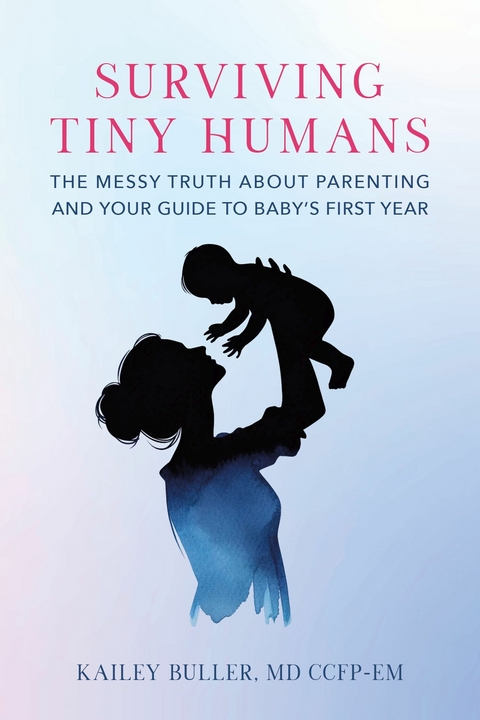
Surviving Tiny Humans (eBook)
188 Seiten
Bookbaby (Verlag)
979-8-3178-0864-8 (ISBN)
Dr. Kailey Buller is a double board-certified physician in emergency and family medicine who's delivered hundreds of babies - and raised two of her own. Her goal? To help new parents cut through the noise, ditch the guilt, and survive the first year with their sanity (mostly) intact. In her book, 'Surviving Tiny Humans', she brings the calm, practical advice of a doctor with the unfiltered honesty of a parent who's been there - through sleepless nights, mystery rashes, and 3 a.m. Googling of 'is this normal?' When she's not soothing the emotional toll of a broken banana or stitching up ER patients, Dr. Buller teaches postpartum classes, busts parenting myths online, and fiercely believes that telling parents the truth - with compassion and a bit of humour - is the most helpful thing of all.
Exhausted, overwhelmed, and wondering if everyone else has the secret handbook for surviving baby's first year? "e;Surviving Tiny Humans"e; is here to share the messy, hilarious truth that other books won't tell you! Dr. Kailey Buller a double board-certified family and emergency physician who learned firsthand that even medical school doesn't prepare you for 3 A.M. diaper disasters delivers a reassuring blend of expert advice and mom-to-mom real talk filled with warmth, wit, and hard-earned wisdom. Guiding readers through postpartum recovery, newborn care, and the wild ride of baby's first 12 months, Dr. Buller dishes out honest answers to questions you didn't even know to ask, from "e;Is it normal that my baby hasn't pooped in a week?"e; to "e;Are soothers good or bad?!?"e;. All along, she tells it like it is (with a healthy dose of humor), so you can stop feeling alone in your worries and start feeling empowered as a new parent. Inside this candid baby survival guide, you'll discover:- Practical tips from a doctor-mom: Get evidence-based answers on breastfeeding vs. formula, soothing colic, managing fevers, and more minus the judgment. - Sleep strategies that work: Learn the truth about baby sleep regressions and sleep training without the sugar-coating. - Postpartum sanity savers: Find out how to cope with "e;baby blues,"e; body changes, and sheer exhaustion, all while keeping your sense of humor intact. - Baby milestones & mom hacks: Chapters packed with time-saving hacks, doctor-approved checklists, and encouragement to celebrate small wins. - A judgment-free, relatable voice: This isn't a by-the-book, Pinterest-perfect parenting manual; it's a conversation with a friend who gets it. By the end of this book, you'll feel comforted, confident, and ready to handle whatever parenthood throws at you (yes, even projectile spit-up). If you've read the traditional baby manuals and still feel unprepared or if you just need a good laugh and a pat on the back this book is the refreshing lifesaver you've been looking for! Embrace the chaos, trust your instincts, and let Dr. Buller be your guide through the hardest, most beautiful year of your life.
Chapter 2:
Bleeding
Let me start, again, by imparting a quick piece of advice before we dive in.
Shed any self-consciousness you may have and embrace the old-lady diapers.
Yes, seriously. And you’re welcome. Regardless of how that baby came out of you, there will be blood. There may even be some pee. Pads are also absolutely fine, but nothing else will give you that sense of complete coverage like a diaper. And the waistband of a diaper is much more comfortable than underwear over a c-section scar. Obviously, do what makes you most comfortable, but the real point I am making is that childbirth is messy. And it is absolutely ridiculous for anyone (including yourself) to expect that you will be anything less than messy yourself. So you go ahead and rock that diaper under those oversized sweatpants, that comfortable maternity bra, and tattered old t-shirt with spit-up on the shoulder. That, my friend, is what a strong, sexy momma looks like.
When it comes to bleeding, specifically, it’s important for you to know that the amount of bleeding is very different from one woman to another and one pregnancy to another.
Case in point, my first pregnancy was an emergency c-section. My recovery was relatively easy, my bleeding had stopped by three weeks, and I was back to light exercise.
Fast-forward three years and my second pregnancy (a slightly less urgent c-section), wasn’t nearly as nice. I bled for fourteen weeks. Yes. Fourteen weeks.
Don’t worry, fourteen weeks isn’t the norm. And I wouldn’t recommend anyone else wait for fourteen weeks before talking to their doctor about it. But the reality is that this can happen. And the second piece to this reality is . . . as long as you are still bleeding a normal amount and feel relatively well, doctors probably aren’t going to do anything. So I bled. And bled. But I survived.
That said, there are a few things that you may not be expecting, but you should know.
When Bleeding is Too Much
Too much bleeding is soaking through a pad each hour for four hours, and you should go to the emergency room for this (or obviously if you soak through four pads in less time than this, you should also go to the ER). But you might have periods of time where you soak through two or three pads in two or three hours, and then it slows down again. As long as it slows back down (and you don’t have fevers or dizziness or trouble breathing or anything) then you should be fine to stay at home.
You might pass some clots. A few clots here and there are normal. And if or when you pass a clot the size of a tennis ball, it will freak you out. But this isn’t necessarily scary. It just means that the blood was hanging out in your uterus for a bit and clumped together before it came out. As long as the total amount of blood wouldn’t soak through more than one pad per hour over four hours, it’s okay.
When to See Your Doctor
If at any point you have a fever, increased pain, or the blood has a foul odour, you need to see a doctor. They will likely do blood work, a swab, and/or start you on antibiotics if they suspect endometritis, which is an infection of the uterus.
If at any point you feel dizzy, lightheaded, or short of breath, regardless of how heavy your bleeding is, you should see your doctor to check that your haemoglobin (the part of your blood that carries oxygen) levels are high enough.
If you are ever uncertain or concerned, talk to your midwife or doctor.
How To Make Your Life Easier
So, now that you have either pushed a baby out and torn your vagina in the process, or had some stranger slice your belly open and pull your baby out, let’s talk about how to make the healing process as painless as possible.
To start, find your village. Or just find your person. And if you have no one, tell your doctors and nurses when you are in the hospital. We might keep you in hospital a little longer, and we most certainly will work to connect you with any and all supports that are available to you. You will want to have someone whose main job is looking after you while you worry about looking after your baby.
Put a bassinet beside your bed, or set up a space for you to sleep in the nursery. While bed sharing increases the risk of sudden infant death syndrome (SIDS) and we try to discourage having baby in bed with you, room sharing actually reduces SIDS risk. And it also makes it much more convenient to be close by for middle-of-the-night feedings and diaper changes.
If you aren’t breastfeeding, consider having a bottle warmer in the nursery and packing a bottle of formula or two in a cooler before bed, along with everything else you might need. Then, when you wake in the middle of the night, you can just pop the bottle in the warmer while you change baby’s diaper, and you don’t have to trudge through the house in the middle of the night.
Don’t use your travel crib or pack ’n play for just travel! Putting a bassinet or a pack ’n play in your living room or kitchen is super handy when baby still naps five to six times each day. Plus, having baby sleep in a brighter and louder environment during the day will help with day/night inversion.
Have everything you need for breastfeeding or pumping stored together in a portable storage basket, including snacks, water, pump parts, nipple cream, wipes, burp cloths, and so on. There is nothing more annoying than having company over and wanting to pump or breastfeed in private, only to get all set up and realize you now have nothing to do except sit and stare at the wall for fifteen minutes.
If you have had a c-section or are struggling with significant abdominal pain, consider tying a rope made of bed sheets to the footrest of your bed so that you can pull yourself up without straining your core!
Bowels & Bladder
Next, we need to discuss how to survive your first bowel movement (and every bowel movement thereafter). Because it’s going to be unnerving. And probably uncomfortable.
Try using a pad or pillow or something else to hold against your lower abdomen; it will help you feel like your insides will stay where they belong.
PEG 3350 (brand names Restoralax or Laxaday) is a very safe and effective stool softener that I highly recommend. It simply pulls water into the bowels to keep them soft, so you don’t have to push out golf-ball sized concrete poops along with your tennis ball-sized blood clots.
Start your pelvic-floor and abdominal physiotherapy and rehabilitation early! This can help with incontinence (peeing when you don’t mean to) as well as improving sexual health and reducing chronic pain.
Your Pelvic Floor
If it fits within your budget, seeing a pelvic-floor physiotherapist even once or twice can be extremely beneficial in teaching you what exercises you need and how to do them properly.
If you are interested, there are other modalities for pelvic-floor rehabilitation, such as vaginal EMS (like using a TENS machine in your vagina) and pelvic-floor devices (such as a vaginal cone).
All right, now that we have all of that boring stuff out of the way, let’s talk about exercise. And sex. And all the fun things you can’t do when you’re first recovering.
Exercise
When it comes to exercise, this is going to be based on how you feel more than any concrete limitations. You’ll actually want to do whatever low-impact activity you feel you can handle as soon as your baby is born to help with the recovery process. But let’s not go crazy; I mean getting up and walking to the bathroom those first few days. You might then choose to walk to the end of your driveway when you’re feeling up to it. Early movement can be incredibly important for recovery, both physically and mentally (and it will also help you with gas pains and uterine cramping, believe it or not!).
But let’s not confuse this with me saying “You should be getting up and walking x number of minutes a day” . . . . No. You do what you feel ready for. Don’t set any expectations for what you should or should not be doing or should or should not be capable of. Your recovery is going to be different than anyone else’s.
You can start simple pelvic-floor or other physiotherapy as soon as you want and, if you had a vaginal delivery, you can gradually return to your normal level of exercise as quickly as is comfortable for you.
If you’ve had a c-section, there will be slightly more limitations on what you can and cannot do, but, again, exercise is mostly going to be based on how you feel. You will want to avoid stairs and straining or clenching your abdominal muscles for at least the first two to three weeks, as much as possible. More importantly, though, you will need to avoid heavy lifting for at least four, likely up to six weeks (and I mean it! I had a woman in my ER just yesterday who popped a uterine stitch from trying to carry her groceries). So please, if you can, ask for help instead.
Sex
This isn’t going to be a simple “You can have sex as soon as you stop bleeding” kind of guide, my friends. Returning to sexual activity after giving birth is a big deal. And there is far more to it than what’s going on with your uterus....
| Erscheint lt. Verlag | 2.9.2025 |
|---|---|
| Sprache | englisch |
| Themenwelt | Sachbuch/Ratgeber ► Gesundheit / Leben / Psychologie ► Familie / Erziehung |
| ISBN-13 | 979-8-3178-0864-8 / 9798317808648 |
| Informationen gemäß Produktsicherheitsverordnung (GPSR) | |
| Haben Sie eine Frage zum Produkt? |
 EPUB (Ohne DRM)
Größe: 8,9 MB
Digital Rights Management: ohne DRM
Dieses eBook enthält kein DRM oder Kopierschutz. Eine Weitergabe an Dritte ist jedoch rechtlich nicht zulässig, weil Sie beim Kauf nur die Rechte an der persönlichen Nutzung erwerben.
Dateiformat: EPUB (Electronic Publication)
EPUB ist ein offener Standard für eBooks und eignet sich besonders zur Darstellung von Belletristik und Sachbüchern. Der Fließtext wird dynamisch an die Display- und Schriftgröße angepasst. Auch für mobile Lesegeräte ist EPUB daher gut geeignet.
Systemvoraussetzungen:
PC/Mac: Mit einem PC oder Mac können Sie dieses eBook lesen. Sie benötigen dafür die kostenlose Software Adobe Digital Editions.
eReader: Dieses eBook kann mit (fast) allen eBook-Readern gelesen werden. Mit dem amazon-Kindle ist es aber nicht kompatibel.
Smartphone/Tablet: Egal ob Apple oder Android, dieses eBook können Sie lesen. Sie benötigen dafür eine kostenlose App.
Geräteliste und zusätzliche Hinweise
Buying eBooks from abroad
For tax law reasons we can sell eBooks just within Germany and Switzerland. Regrettably we cannot fulfill eBook-orders from other countries.
aus dem Bereich