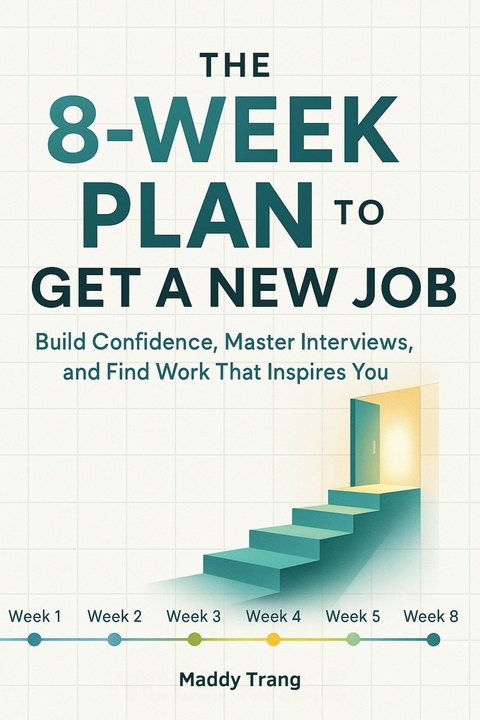
The 8-Week Plan to Get a New Job (eBook)
138 Seiten
Publishdrive (Verlag)
978-0-00-098470-8 (ISBN)
The 8-Week Plan to Get a New Job: Build Confidence, Master Interviews, and Find Work That Inspires You
Transform Your Job Search from Frustrating to Fulfilling in Just 8 Weeks
Are you tired of sending countless applications into the void? Struggling with interview anxiety? Feeling lost in today's competitive job market? Whether you're a recent graduate, career changer, or experienced professional seeking new opportunities, this comprehensive guide provides the proven system you need to land your dream job.
Stop playing the job search lottery. Start following a plan that works.
What You'll Discover:
A proven 8-week system that transforms your job search from scattered to strategic
Confidence-building techniques that help you present your best self to employers
Modern resume and LinkedIn strategies that get past ATS systems and attract recruiters
Interview mastery methods including the psychology of turning nerves into confident energy
Networking approaches that feel natural (even for introverts) and uncover hidden opportunities
Salary negotiation tactics that help you secure the compensation you deserve
Application strategies that get responses instead of silence
Perfect For:
✓ Recent graduates struggling to break into their field
✓ Career changers pivoting to new industries or roles
✓ Experienced professionals navigating layoffs or seeking advancement
✓ Anyone who wants a structured, proven approach to job searching
Why This Book Works:
Unlike generic career advice, this 8-week system is based on real-world recruiting insights and has helped thousands of job seekers reduce their search time by 60% while landing positions they're genuinely excited about. Each week builds on the last, creating momentum that transforms your mindset from desperate to confident.
You don't need to spend months or years searching for the right opportunity. You need the right strategy.
Ready to Take Control of Your Career?
Stop letting the job search happen to you. In just 8 weeks, you'll have the tools, confidence, and strategy to find work that truly inspires you. Your future self will thank you for starting today.
Chapter 1: The Death of Traditional Credit Scoring
1.1 The FICO Monopoly Crumbles
For decades, the FICO score sat atop the business credit throne as an unquestioned arbiter of financial trustworthiness. It was a silent gatekeeper, determining who could access capital and under what terms. Banks, insurers, landlords, and even employers leaned on it as if it were gospel, a precise and impartial metric to assess risk. But the truth was always more complicated. The FICO score—created by the Fair Isaac Corporation in 1989—was never designed to serve the complex needs of 21st-century businesses. And now, the cracks in its foundation are too deep to ignore. The age of FICO dominance is ending, not with a bang, but with a quiet revolution built on code, data, and entirely new ideas of what constitutes “creditworthiness.”
The irony of FICO’s fall is that it reigned not because it was perfect, but because it was simple and standard. Lenders needed a quick way to filter applicants at scale, and FICO offered a magic number—a three-digit summary that claimed to reflect a person’s or small business owner’s likelihood to repay a loan. It synthesized credit utilization, payment history, length of credit, credit mix, and recent inquiries into one supposedly objective score. It worked, at least within the narrow parameters of the banking system of the late 20th century. Back then, credit meant going to a bank, applying for a loan, and showing traditional paperwork. Most businesses had tangible assets, a stable cash flow, and a history of borrowing.
But today, the world that created FICO is long gone. Businesses are leaner, faster, and often digital-first. Founders launch brands from their bedrooms. Revenue might flow from Shopify stores, Patreon subscribers, NFT royalties, or a Twitch livestream. There may be no physical location, no long credit history, no mortgage or car loan to anchor a traditional profile. These businesses are real, profitable, and growing—but invisible to FICO.
Even more damaging is how FICO has become a bottleneck. It’s not just outdated—it’s exclusionary. Roughly 20% of adults in the United States are “credit invisible” or “unscorable” by FICO standards. That’s tens of millions of people and countless small business owners unable to access funding, not because they are high risk, but because they exist outside the narrow box FICO was designed to measure. Immigrants with limited credit history, freelancers, gig economy workers, and bootstrapped entrepreneurs fall through the cracks. And for many, those cracks are chasms.
The market has taken notice. Startups and alternative lenders are asking: Why should a single score dictate the financial fate of a business? Why ignore rich data streams just because they don’t fit into the FICO formula? Why treat every borrower as a static snapshot, instead of a living, evolving entity? These are not philosophical musings—they’re market opportunities. And the fintech world has responded with a wave of innovation aimed squarely at bypassing the old model.
Consider the rise of alternative credit scoring systems. Companies like Plaid, Square Capital, and Brex are using real-time transaction data, sales figures, payroll behavior, and even user reviews to build dynamic risk profiles. A business’s daily Stripe revenue or Google Ads performance may now matter more than its owner’s credit card history. Where FICO is reactive, these systems are predictive. Where FICO penalizes volatility, they embrace momentum.
Take the case of Clearco, a fintech that offers funding to e-commerce businesses based on real-time performance data rather than credit scores. By linking to sales platforms like Shopify, it can analyze trends, margins, customer churn, and average order values to decide how much capital a company qualifies for. There are no interest payments—just a percentage of future sales. It’s fast, data-rich, and adaptive. Most importantly, it bypasses FICO entirely.
Or look at Pipe, a platform that transforms recurring revenue into upfront capital. SaaS companies that generate stable monthly income can essentially “sell” their future revenue streams for cash today—without taking on debt and without needing to pass a credit check. The system doesn't care if the founder defaulted on a personal loan five years ago; it cares about whether the product is sticky, the churn is low, and the revenue is real. This represents a profound philosophical shift: capital is allocated based on the health of a business model, not the borrowing history of its owner.
Even in more traditional lending environments, FICO is losing ground. Banks and credit unions are piloting machine learning models that weigh thousands of data points, from invoice payment patterns to customer lifetime value, to create multidimensional borrower profiles. These systems don’t just score—they learn. They evolve. They adjust for seasonality, for pandemic disruptions, for inflationary pressures. They understand that a bakery’s January numbers don’t mean much without context. FICO can’t do that. It wasn’t built to understand stories—only statistics.
But it’s not just about technology—it’s also about trust. Many business owners are increasingly suspicious of how opaque the FICO process has become. The exact algorithm is proprietary. Few truly understand why their score is what it is. Disputing errors is a bureaucratic nightmare, and the consequences of a mistake can be dire. In contrast, newer models often offer transparency. Dashboards show which behaviors are boosting or hurting a company’s profile. Some platforms even offer suggestions—pay this invoice sooner, reduce that churn rate—to help businesses improve their standing.
This shift isn’t only happening in the United States. Around the world, nations are developing alternative credit frameworks that reflect the realities of their populations. In China, the government-backed Social Credit System evaluates individuals and businesses based on a wide range of behaviors, financial and otherwise. While controversial, it represents a form of credit assessment that goes far beyond narrow financial metrics. In Kenya, mobile lending apps like Tala and Branch evaluate creditworthiness using smartphone metadata—texts, call logs, GPS patterns—often issuing loans in under five minutes without a credit score in sight.
Even within the U.S., new legislative and regulatory pressure is adding weight to FICO’s decline. The Consumer Financial Protection Bureau (CFPB) has signaled concerns about the fairness and accuracy of traditional credit reporting. Lawsuits against the major bureaus are increasing. And fintech lobbyists are pushing for recognition of alternative data in credit underwriting. The tide is turning.
To be clear, FICO isn’t going to vanish overnight. For now, it still matters—especially in mortgage lending, auto financing, and some lines of business credit. But its monopoly is fading. What’s replacing it is not one new score, but a decentralized ecosystem of scores, profiles, and indicators—each tailored to a different market, business model, or borrower behavior. Instead of one gatekeeper, there are many pathways.
This diversification is a good thing. It reflects the diversity of the modern economy. It rewards innovation. It empowers the previously invisible. But it also requires new skills, new norms, and a new understanding of how credit works. Lenders must rethink their risk models. Entrepreneurs must learn how to shape and communicate their data story. Policymakers must catch up—and fast.
The FICO era gave us the illusion of objectivity, but at great cost. In its place, we are building a new era of credit: more fluid, more responsive, more inclusive—but also more complex. Business credit is no longer just about numbers. It’s about narrative. It’s about networks. It’s about visibility into operations that were once opaque.
In the chapters ahead, we’ll explore the technologies driving this shift, from AI-powered scoring engines to blockchain-based reputation systems. We’ll examine the ethical dilemmas, the regulatory gaps, and the practical tools businesses can use to thrive in this new environment. But it all starts here, with the fall of a giant and the rise of a thousand alternatives.
The FICO monopoly isn’t just crumbling. It’s being replaced—one data point at a time.
1.2 Beyond Payment History: The Data Revolution
To grasp the scale of what’s changing in business credit, we need to begin with a basic truth: for decades, creditworthiness was judged mostly by what wasn’t there. A lack of late payments, a clean record, a low debt-to-income ratio—these were the gold standards. Payment history was the bedrock of the traditional credit system. If a business or its owner had consistently paid their bills, the system extended trust. If not, doors closed. The entire logic rested on the assumption that past behavior was the most reliable predictor of future performance. It was a simple formula, neat and somewhat comforting in its consistency. But it was also fundamentally limited—because it looked backward rather than forward, and it ignored everything that didn’t fit within its narrow lens.
That narrowness is no longer sustainable. In a world where data is being generated at every touchpoint, the idea that creditworthiness should hinge solely on whether an invoice was paid 30 days late two years ago begins to seem almost absurd. Today, a business leaves behind a trail of information that is both vast and incredibly revealing. Transaction histories, online reviews, email open rates, customer churn data, social media engagement, even how frequently a business updates its...
| Erscheint lt. Verlag | 1.8.2025 |
|---|---|
| Sprache | englisch |
| Themenwelt | Sachbuch/Ratgeber ► Beruf / Finanzen / Recht / Wirtschaft ► Bewerbung / Karriere |
| ISBN-10 | 0-00-098470-1 / 0000984701 |
| ISBN-13 | 978-0-00-098470-8 / 9780000984708 |
| Informationen gemäß Produktsicherheitsverordnung (GPSR) | |
| Haben Sie eine Frage zum Produkt? |
 EPUB (Adobe DRM)
Größe: 3,1 MB
Kopierschutz: Adobe-DRM
Adobe-DRM ist ein Kopierschutz, der das eBook vor Mißbrauch schützen soll. Dabei wird das eBook bereits beim Download auf Ihre persönliche Adobe-ID autorisiert. Lesen können Sie das eBook dann nur auf den Geräten, welche ebenfalls auf Ihre Adobe-ID registriert sind.
Details zum Adobe-DRM
Dateiformat: EPUB (Electronic Publication)
EPUB ist ein offener Standard für eBooks und eignet sich besonders zur Darstellung von Belletristik und Sachbüchern. Der Fließtext wird dynamisch an die Display- und Schriftgröße angepasst. Auch für mobile Lesegeräte ist EPUB daher gut geeignet.
Systemvoraussetzungen:
PC/Mac: Mit einem PC oder Mac können Sie dieses eBook lesen. Sie benötigen eine
eReader: Dieses eBook kann mit (fast) allen eBook-Readern gelesen werden. Mit dem amazon-Kindle ist es aber nicht kompatibel.
Smartphone/Tablet: Egal ob Apple oder Android, dieses eBook können Sie lesen. Sie benötigen eine
Geräteliste und zusätzliche Hinweise
Buying eBooks from abroad
For tax law reasons we can sell eBooks just within Germany and Switzerland. Regrettably we cannot fulfill eBook-orders from other countries.
aus dem Bereich