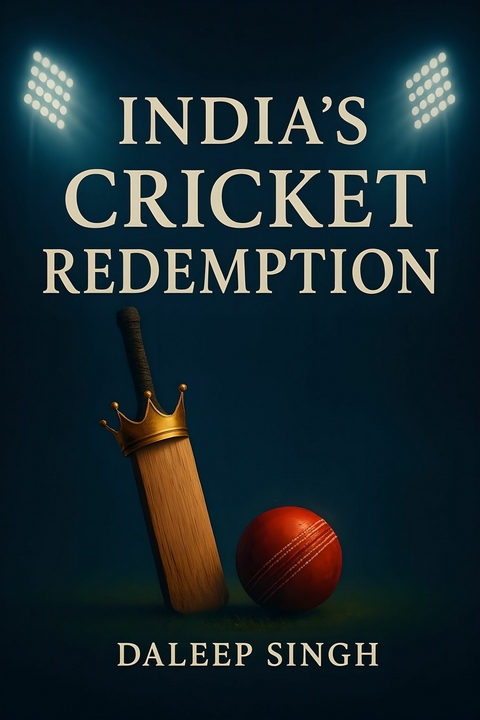
India's Cricket Redemption (eBook)
12 Seiten
Publishdrive (Verlag)
978-0-00-098088-5 (ISBN)
From 2007 to 2013, India won three ICC trophies and reached the peak of world cricket. But over the next decade, despite many strong performances, they failed to win a single ICC title-falling short time and again.
The Curse and The Crown tells the story of that long drought, the heartbreaks, and the changes that followed. It focuses on how India rebuilt its team and mindset to prepare for the 2024 T20 World Cup-and finally won it. This book takes you through the journey, the key matches, the big decisions, and what it meant to a nation hungry for glory.
Chapter 1: After the Peak – A Legacy to Uphold (2007–2013)
The Golden Dawn
In September 2007, a young Indian cricket team, led by Mahendra Singh Dhoni, took the field at Wanderers Stadium in Johannesburg. Few believed in their chances. India was not favoured to win the first ICC T20 World Cup. That honour seemed destined for teams like Australia, fresh off their World Cup success, or the West Indies, known for their explosive style. Yet, in the weeks that followed, India would start a glorious chapter in cricket. They would dominate ICC tournaments for six years.
India's success from 2007 to 2013 was more than just three trophies. It represented a new cricketing philosophy that dared to think differently. This era saw the rise of new stars who would become legends. It also created a legacy that inspired many but felt heavy for years to come.
2007 T20 World Cup: The Unlikely Beginning
The Gamble That Changed Everything
When the BCCI sent a young and experimental team to South Africa for the first T20 World Cup, it was seen as a chance to develop players rather than a serious attempt to win the title. With senior players like Sachin Tendulkar, Rahul Dravid, Sourav Ganguly, and Anil Kumble opting out, captain MS Dhoni was left to lead a team with an average age of just 24.
What they lacked in experience, they made up for in fearlessness. The most experienced players in the squad were the 25-year-old Yuvraj Singh,28-year-old Virender Sehwag,29-year-old Ajit Agarkar and 28-year-old Harbhajan Singh. This wasn't India's strongest team on paper—but, it was their hungriest.
The Campaign That Defied Logic
The tournament began with a shocking upset that would set the tone for everything that followed. India faced Pakistan in the group stage, and in a match that ebbed and flowed like a thriller novel, they emerged victorious in a bowl-out—cricket's equivalent of a penalty shootout. Robin Uthappa, Harbhajan Singh, and Virender Sehwag found the stumps when it mattered most. It was a sign of things to come.
India experienced an early setback in the Super Eight stage, losing to New Zealand in the first encounter. But in the next game against England, they scored a mammoth 218 in 20 overs as Yuvraj Singh announced himself on the world stage with a breathtaking 58 off 16 balls. This 58-run knock also included an over where 6 consecutive sixes were scored. The next game saw the arrival of Rohit Sharma, who scored an unbeaten half-century to help India qualify for the semi-finals, and knock the hosts South Africa out of the tournament.
But it was against Australia in the semi-final that the tournament's defining moment arrived. Facing the world's number one team, India found themselves in familiar territory—under pressure, with low expectations. 8 overs into the game India was struggling at 41-2. That’s when Yuvraj Singh showed up at the crease. Yuvraj scored a blistering 70 off just 30 balls. A handy 36 off 18 balls by the Indian captain M.S.Dhoni powered India to 188-5. A brilliant bowling spell by S Sreeshanth helped India win the game by 15 runs, landing them a place in the final against their arch-rivals Pakistan.
The Final
The final against Pakistan was more than a cricket match—it was a collision of histories, cultures, and dreams. Pakistan, led by the mercurial Shoaib Malik, had their star players in Shahid Afridi and Umar Gul. The match at the Wanderers would be decided by the finest of margins.
India batted first and posted 157, a competitive total built around Gautam Gambhir’s calculated 75 and Rohit Sharma’s quickfire 30. Pakistan's chase began tentatively, with wickets falling at regular intervals. At 77 for 6, it seemed like India were set to be the maiden T-20 World Cup champions. But Misbah-Ul-Haq had other plans. As wickets kept tumbling at the other end, Misbah stayed calm and kept on picking the right moments to attack. The match came down to 6 runs needed off 4 deliveries with just one wicket in hand. Then came the moment - Misbah tried to scoop the next ball, but as the ball went high it did not go very far. Standing under it was Sreesanth who grabbed the catch and the Cup with both hands.
The Impact: More Than Just a Trophy
The 2007 T20 World Cup victory did more than just add a trophy to India's cabinet—it revolutionized Indian cricket's approach to the game. The fearless, attack-first philosophy that brought success in South Africa became the template. The Indian Premier League, launched in 2008, was built on the foundations of this triumph. More importantly, it established MS Dhoni as more than just a captain—he became Indian cricket's crisis man, the leader who thrived when others wilted. This reputation would prove crucial in the challenges that lay ahead.
2011 ODI World Cup: Carrying the Burden of a Billion Dreams
The Weight of Expectation
By 2011, Indian cricket had undergone significant evolution. The success of 2007 and the IPL had created a new generation of confident, globally-minded cricketers. But with success came pressure—immense, suffocating pressure. India were the hosts of the ODI World Cup along with Sri Lanka and Bangladesh. The scenario, however, was much different compared to the 2007 T20 World Cup, as this time India started as favorites.
The squad was a blend of experience and youth. Sachin Tendulkar, at 37, was playing his last World Cup. Virat Kohli, at 22, was the promising future. Yuvraj Singh was at his peak. The pieces were in place, but could they handle the weight of expectation?
The Group Stage: Building Momentum
India's journey began with a dominant victory over Bangladesh in Dhaka, with Virender Sehwag and Virat Kohli scoring a ton each. The next match against England in Bangalore exposed some weaknesses. India scored 338 batting first, but were not able to defend it successfully. The match ended in a tie despite India having scored such a huge total; the bowling attack had a lot of work to do.
In the next couple of games, India beat Ireland and the Netherlands respectively with ease. But then the match against South Africa followed suit of the one against England. This time India scored 296 , thanks to a batting collapse after the 40th over where India lost 9 wickets for just 29 runs. But much like the game against England, India failed to defend the total and lost the game in the last over.
The group stage ended with India thrashing the West Indies by 80 runs as Yuvraj Singh scored a gritty century in the heat of Chennai.
The Knockouts
The quarter-final against Australia in Ahmedabad was billed as the match of the tournament. Australia, the defending champions and four-time winners, were still formidable despite being past their peak. Australia batted first and posted 260, a total that seemed under-par on a good batting surface. Halfway through the chase, India looked set having only lost 2 wickets and maintaining the required run-rate. But a mini-collapse happened, and India were left with 74 runs to win and the last 2 recognised batsmen at the crease. Yet another gritty performance by Yuvraj Singh and a handy contribution by Suresh Raina helped India knock out the mighty Aussies from the tournament and advance to the semi-finals.
The semi-final against Pakistan in Mohali was cricket at its most dramatic. With the Prime Ministers of both nations in attendance, the pressure was unprecedented. India batted first and posted 260, a competitive total built around a mature innings by the god of cricket - Sachin Tendulkar and another handy finish by Suresh Raina.
The chase for Pakistan never quite took off. They formed partnerships and kept on trying to keep up with the required run-rate. But much like the 2007 T-20 World Cup final, nobody except Misbah-Ul-Haq gave Pakistan hope. This time the match ended with a bigger margin as Virat Kohli standing at long-on caught Misbah with Pakistan still 29 runs short of the target.
The Final: Completing the Circle
The final against Sri Lanka at Wankhede Stadium in Mumbai marked a key moment in Indian cricket. It showed how far India had come since the early 2000s. India and Sri Lanka had met in many finals over the past decade. But this was the biggest one.
It took two attempts to have a successful toss. Sri Lanka won the toss and elected to bat first. Mahela Jayawardene played a scintillating knock of 103 not out and led Sri Lanka to 274 runs. Despite it being a batting pitch, the pressure of the final meant that it was not going to be an easy target to chase.
India's chase began poorly as both openers Virender Sehwag and Sachin Tendulkar were dismissed quickly. But Gautam Gambhir steadied the innings alongside Virat Kohli. After stitching together a decent partnership, India lost Virat Kohli with the target still far away. MS Dhoni walked in at number 5, a surprising promotion that he had demanded from coach Gary Kirsten. What followed was an innings that epitomized Dhoni's captaincy—calculated, nerveless, and perfectly timed. Gautam Gambhir got bowled after a brilliant 97, but by that time India smelled victory. M.S. Dhoni batted till the end along with the hero of the tournament—Yuvraj Singh. The winning moment came in the 49th over when Dhoni deposited Nuwan Kulasekara over long-on for a six. As the ball sailed into the Mumbai night, 28 years of World Cup hurt ended.
The sight of Sachin Tendulkar being carried on his teammates' shoulders remains one of the most emotional moments in Indian sport. The Master Blaster had finally won the one trophy that had eluded him throughout his illustrious career.
The Cultural Impact: A Nation United
The 2011 World Cup victory transcended cricket. In a country often...
| Erscheint lt. Verlag | 21.7.2025 |
|---|---|
| Sprache | englisch |
| Themenwelt | Sachbuch/Ratgeber ► Sport |
| ISBN-10 | 0-00-098088-9 / 0000980889 |
| ISBN-13 | 978-0-00-098088-5 / 9780000980885 |
| Informationen gemäß Produktsicherheitsverordnung (GPSR) | |
| Haben Sie eine Frage zum Produkt? |
 EPUB (Adobe DRM)
Größe: 613 KB
Kopierschutz: Adobe-DRM
Adobe-DRM ist ein Kopierschutz, der das eBook vor Mißbrauch schützen soll. Dabei wird das eBook bereits beim Download auf Ihre persönliche Adobe-ID autorisiert. Lesen können Sie das eBook dann nur auf den Geräten, welche ebenfalls auf Ihre Adobe-ID registriert sind.
Details zum Adobe-DRM
Dateiformat: EPUB (Electronic Publication)
EPUB ist ein offener Standard für eBooks und eignet sich besonders zur Darstellung von Belletristik und Sachbüchern. Der Fließtext wird dynamisch an die Display- und Schriftgröße angepasst. Auch für mobile Lesegeräte ist EPUB daher gut geeignet.
Systemvoraussetzungen:
PC/Mac: Mit einem PC oder Mac können Sie dieses eBook lesen. Sie benötigen eine
eReader: Dieses eBook kann mit (fast) allen eBook-Readern gelesen werden. Mit dem amazon-Kindle ist es aber nicht kompatibel.
Smartphone/Tablet: Egal ob Apple oder Android, dieses eBook können Sie lesen. Sie benötigen eine
Geräteliste und zusätzliche Hinweise
Buying eBooks from abroad
For tax law reasons we can sell eBooks just within Germany and Switzerland. Regrettably we cannot fulfill eBook-orders from other countries.
aus dem Bereich