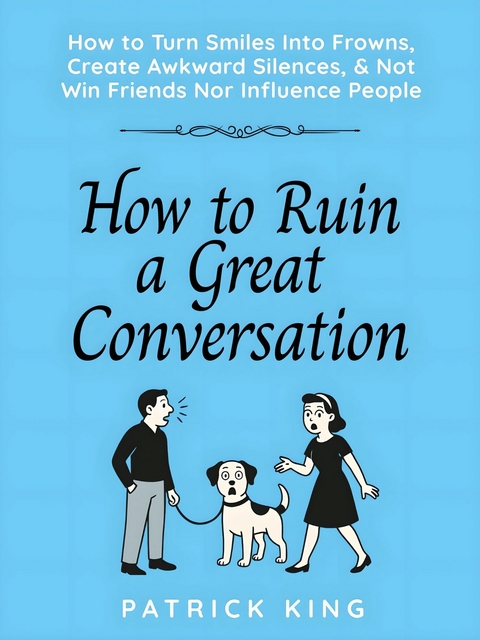
How to Ruin a Great Conversation (eBook)
261 Seiten
Publishdrive (Verlag)
978-0-00-097867-7 (ISBN)
Congratulations-you might've just ruined a great one. And this book is here to make sure you keep doing it... unless you want to stop.
In How to Ruin a Great Conversation, Patrick King hilariously dismantles every awkward, cringey, well-intentioned-but-totally-misguided way people sabotage social interactions. From asking weirdly invasive questions, to oversharing your entire life story, to playing defense like your ego's in a UFC match-you'll learn exactly what not to do if you want connection, not confusion.
This book is for you if:
You panic and word-vomit your autobiography to a stranger.
You turn curious questions into interrogations.
You get stuck recycling the same two conversation topics.
You're more focused on 'sounding smart' than being present.
With chapters like 'Only Be Interested in Yourself,' 'Recycle the Same Conversation,' and 'Play Defense Instead of Being Open,' King doesn't just hand you a mirror-he hands you the script to burn and rewrite.
You'll learn:
Why silence isn't awkward-you just made it that way.
The formula for asking better questions that actually get answers.
How to stop protecting yourself and start connecting instead.
What to say when someone else overshares and makes it weird.
If you've ever walked away from a chat and thought, 'Yikes,' this book is your antidote.
Chapter 2. Ask Questions No One Wants to Answer
Not all curiosity is created equal. Not all questions are, either.
Being truly curious about the world outside of your head—and the fascinating people who live there–is great. But sincere curiosity on its own won’t guarantee that you ask good questions.
Sometimes, a poor question is just a lazy question.
Sometimes, it’s a careless way to waste time.
Some questions don’t mean any real harm, they’re just so bloated with assumptions that they don’t leave much room for a real answer, and the real connection that may follow.
One of the best ways to wreck a promising conversation is to cram it full of low-quality questions that take away space that could have gone to excellent questions.
There’s an art to asking the right question.
Questions have their own unique shape and structure; they come built in with certain assumptions and expectations, and, ultimately, they all serve quite different purposes.
Think of questions like the interchangeable bits on a screwdriver. Sure, the tool is always a screwdriver, but the exact shape of the bit on the end makes a world of difference.
A bad question is better than not asking questions at all.
But asking the right question may simply be a matter of fine-tuning—of finding the right screwdriver bit, so to speak.
Over time, you will start to recognize the tell-tale structure of a good question, how to use it, and when. You’ll start to develop a preference for questions that are
• Open-ended
• Simple
• Unbiased
• Sincere and curious
One happy side effect of mastering this skill set is that you’ll be able to field other people’s bad questions with more grace and ease. According to Find Out Anything from Anyone, Anytime: Secrets of Calculated Questioning From a Veteran Interrogator (Pyle, Karinch & Hartley, 2014) a smart approach to inviting real dialogue is to ask clear, efficient, and well-structured questions. Here’s how:
Start with a Strong Interrogative
“Did you do something last night?”
Pause for a moment and consider how you might respond to this question. What is this question actually asking you? Well, the expectation for a yes/no response is built right into the structure of the question.
This question is literally asking for a monosyllabic response. Did you do something, yes or no?
If you ask someone a question like this, that’s exactly how they’ll answer. If that’s not the kind of response you want, you’re in trouble.
On top of this, there are all sorts of hidden assumptions about what this “something” might mean. What if I consider that all the dozens of things I did don’t technically count as “something”?
If you’ve ever asked a child that tired old question, “Did you learn anything interesting at school today?” then you already know that you’re asking for a monosyllabic response—and you know exactly which one you’ll get, too. Consider instead:
“What did you do last night?”
It’s the same question, with a different screwdriver bit attached. This one might get the job done.
As a rule, never ask a yes/no question unless you have a sadistic desire to strangle the conversation to death.
Instead, use interrogators like
• Who
• What
• Where
• When
• Why
• How
These will help trigger detailed, story-based responses, making dead-end yes/no responses an impossibility.
“What did you do at school today?”
“Who did you play with at break?”
“How did math class go?”
Interrogatives signal that you’re not just trying to confirm a suspicion, you’re genuinely interested in learning more. You’re not just asking someone to comply with your pre-existing vision of the conversation. You’re inviting them to contribute in real time to that conversation.
Keep the Question Short and Focused
One way that people can feel steered in conversations is when they’re forced to respond to questions that are overly long and confusing. Take a look:
“Given the difficulty of this project and the conflicting demands placed on you, do you think that you managed to meet the objectives you set, or are there some areas you’re still concerned about? If so, why or why not?”
This question is, as you can plainly see, a dog’s breakfast.
Pitching a question like this is not only mildly rude, but it also feels like you’re conducting market research or weaseling your way through a tedious job interview. It feels intrusive, overly planned and slightly suspicious. While the person is simply trying to figure out what on earth you’re asking, the conversational momentum dribbles away and any connection you had dies a slow death.
Instead, give the other person enough space to think, reflect, and freely respond to what you’re asking—without feeling that you’re anticipating their response.
Be clear and simple.
A good question isn’t a carefully worded contract. It’s just a prompt; an invitation. So, keep it short and sweet.
“How’s it going with your objectives?”
Strip Out Biases and Hidden Agendas
Loaded questions are like loaded guns. They (rightly) put people on the defensive.
When you ask a biased question, you aren’t asking a question at all, but rather forcing a statement in an underhanded way. Such a question does not come from a desire for discovery, but to assert what is already felt to be known. No surprise then that the most common responses to a biased question are:
• Being guarded
• Going on the attack
• Shutting down entirely.
In worst case scenarios, loaded, forceful questions push people to lie and conceal things from you.
If you want people to be honest with you, be honest with them. If you want to be told something you genuinely didn’t know before, then ask a question that makes room for that, rather than one that pushes them down some pre-conceived path.
• “So, what pet insurance do you use?” (Assumes you use pet insurance… and have a pet).
• “Why the overreaction?” (Already concluded that it is indeed an “overreaction”).
• “What made you give up on such a great career?” (Value judgment: Is it a great career? And did you “give up” or did you bravely seek something better suited to you?).
• “When did you get over your childhood trauma?” (Uh…)
How do we remove bias?
If we’re being honest, sometimes it means ditching the question completely (“Why are you such a stupid jerk?” is not, in fact, a sincere inquiry into someone’s current state of mind).
Go back to basics. Pretend you’re an alien visiting earth or a scientist or journalist trying to investigate a phenomenon in as neutral a way as possible. Play dumb. Assume you know nothing and go from there.
One of the best questions you can possibly ask: “Can you tell me more?”
The Anatomy of a Good Question
Good conversationalists know how to ask the right questions.
According to the New Hampshire Business Review (Pubali Chakravorty-Campbell, 2018), a good question has the five following characteristics:
1. The question should be open (CONSTRUCT)
No yes/no questions. Make a little gesture of invitation for people to tell a story—not just supply a data nugget. Let people reflect and explain, in their own way. Give them the chance to unfold, not merely respond.
• “What surprised you the most about…?”
• “Tell me more about...”
• “What was it like to…?”
2. The question should have RELEVANCY
Read the room. Ask a question that fits the context, the other person, and the nature and stage of the relationship you have with them.
Curiosity is good, but it needs to be appropriately tempered by respect for time and place.
• At a work conference, ask about people’s expertise and training.
• At a dinner party, ask about their relationship to the host.
• In a casual setting at the school gates, ask people about their children or holidays.
• With people you met a minute ago—the weather is your go to!
3. Know what your INTENT is...
| Erscheint lt. Verlag | 29.7.2025 |
|---|---|
| Sprache | englisch |
| Themenwelt | Sachbuch/Ratgeber ► Gesundheit / Leben / Psychologie ► Lebenshilfe / Lebensführung |
| ISBN-10 | 0-00-097867-1 / 0000978671 |
| ISBN-13 | 978-0-00-097867-7 / 9780000978677 |
| Informationen gemäß Produktsicherheitsverordnung (GPSR) | |
| Haben Sie eine Frage zum Produkt? |
 EPUB (Adobe DRM)
Größe: 895 KB
Kopierschutz: Adobe-DRM
Adobe-DRM ist ein Kopierschutz, der das eBook vor Mißbrauch schützen soll. Dabei wird das eBook bereits beim Download auf Ihre persönliche Adobe-ID autorisiert. Lesen können Sie das eBook dann nur auf den Geräten, welche ebenfalls auf Ihre Adobe-ID registriert sind.
Details zum Adobe-DRM
Dateiformat: EPUB (Electronic Publication)
EPUB ist ein offener Standard für eBooks und eignet sich besonders zur Darstellung von Belletristik und Sachbüchern. Der Fließtext wird dynamisch an die Display- und Schriftgröße angepasst. Auch für mobile Lesegeräte ist EPUB daher gut geeignet.
Systemvoraussetzungen:
PC/Mac: Mit einem PC oder Mac können Sie dieses eBook lesen. Sie benötigen eine
eReader: Dieses eBook kann mit (fast) allen eBook-Readern gelesen werden. Mit dem amazon-Kindle ist es aber nicht kompatibel.
Smartphone/Tablet: Egal ob Apple oder Android, dieses eBook können Sie lesen. Sie benötigen eine
Geräteliste und zusätzliche Hinweise
Buying eBooks from abroad
For tax law reasons we can sell eBooks just within Germany and Switzerland. Regrettably we cannot fulfill eBook-orders from other countries.
aus dem Bereich