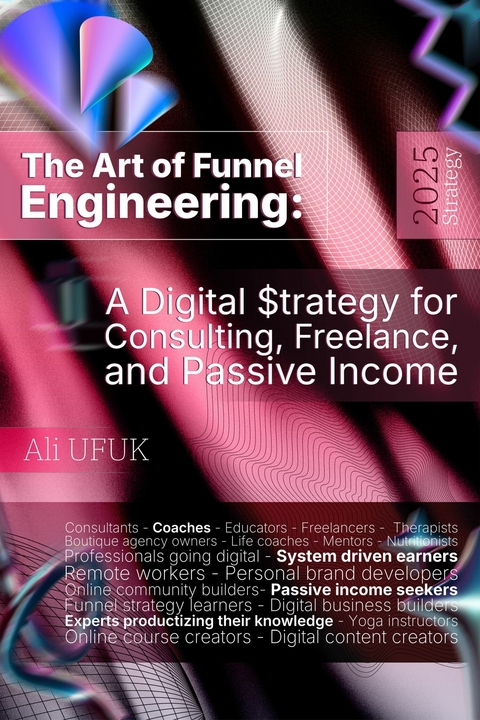
The Art of Funnel Engineering (eBook)
215 Seiten
Publishdrive (Verlag)
978-0-00-097221-7 (ISBN)
What if you could work from home, set your own schedule, and earn a living without being tied to one location?
Imagine a setup where your system keeps working even while you sit at your desk, enjoying a quiet coffee. No rush, no pressure, just a business that runs smoothly in the background.
If your days are still filled with endless meetings, long phone calls, or projects that seem to restart every week, something may be missing.
And that something might not be what you expect.
Sometimes, what we need isn't more effort. It's structure. It's a system that works with you, not against you.
This book is for those who want to take their work online and build a life of independence.
It's for consultants, coaches, trainers, therapists, freelancers, boutique agency owners, and digital marketers.
It's for content creators and entrepreneurs ready to turn their knowledge into a working business.
In short, it's for anyone who wants to organise their skills, ideas, and efforts into a clear, scalable framework.
But a word of warning. This isn't a collection of ready made solutions.
It won't give you shortcuts.
It will ask more of you than just reading.
It will push you to understand why each step matters.
And it will guide you in building something of your own, something that lasts.
Inside this book, you'll discover:
-A new way of thinking about funnels, grounded in strategy
-How to segment your audience into cold, warm, and hot stages
-The right timing, place, and method to reach the right people
-How to create content that attracts, builds trust, and converts
-Webinar systems and evergreen funnels that work while you sleep
-Visibility strategies using golden and cross-audience targeting
-And most importantly, a shift in mindset, because it's not knowledge that builds a business but the systems behind it.
Who is this book for?
-Those who want to work from anywhere using only their laptop
-Those tired of being tied to an office or stuck in rigid routines
-Those who want to take control of their time and work on their own terms
-Freelancers looking for consistency instead of constant hustle
-Coaches and consultants wanting to scale their services online
-Digital professionals ready to turn their expertise into a brand
-And anyone who feels ready to start, but isn't sure how
Why should you read it?
Because this book won't just teach you. It will move you.
It will help you think differently, act intentionally, and create something you can grow.
It's about building a business where people find you, not the other way around.
It's about designing a life where your time is yours to manage.
A business that runs with purpose and clarity, not chaos.
This is not a book about careers.
This is a roadmap for digital transformation.
And maybe, just maybe, the first step you've been searching for is already here, waiting on this very page.
Turn it.
Start building your system.
And finally, stop living to work.
Start working to live.
CHAPTER THREE
THE PSYCHOLOGY OF INCREASING CONVERSIONS
In this section, we will discuss the psychology behind increasing conversions. As part of this, we will explore the concepts of the 100 Visitor Test and the Value Ladder. These two approaches provide a mental framework for those who understand the fundamentals of funnels to advance to the next level. In particular, we will show how free content can improve conversion rates and how the value ladder model can be integrated into marketing processes.
We will begin by examining the 100 Visitor Test, which is used to evaluate the performance of your sales funnel. Next, we will define the value ladder concept and explain the roles of upsell and downsell steps within the funnel structure.
We will also focus on the relationship between the upsell strategy and the Zeigarnik effect. We will analyze how this connection influences customer psychology and purchasing behavior. Then we will explore the downsell strategy and its role in warming up the audience. In addition, we will present examples from various funnel templates. However, these examples are intended for reference only.
THE 100 VISITOR TEST
This test shows how offering free value within a funnel system can increase conversion rates. In the basic scenario, 100 people visit your site through paid ads. If you present the product directly and say, "Here is the product, here is the price," the conversion rate remains very low. Tests have shown that this rate is, on average, below 1 percent. In other words, only one out of 100 people makes a purchase.
For example, if the product you are selling is 3,000 dollars, this setup results in only one sale.
In the second scenario, 100 people again visit your funnel site. But this time, instead of offering the product directly, you provide them with something valuable for free. This could be an e-book, a physical sample, a short seminar, or another piece of free content relevant to your industry. The key is to offer something that genuinely benefits your target audience.
This strategy creates a psychological connection and a natural tendency to reciprocate. The individual recognizes the value they received and feels a sense of obligation. As a result, interest in your product offer and the likelihood of a purchase increase significantly in the next step.
In short, offering free value not only builds trust but also lays the foundation for a sale. This approach directly improves funnel performance.
When a product is presented directly to a visitor, the conversion rate is typically around 1 percent. For example, only one out of 100 people might purchase the product, and if your product costs 3,000 dollars, that would be your total revenue.
However, when you add free value, the picture changes. When the same 100 people visit your site, 8% of them will take advantage of the free content. That means you’ve engaged with 8 people. At least 25% of these 8 will buy the product—that's 2 people. This results in $6,000 in revenue. By simply adding free content, you've doubled your conversion rate.
Free content builds trust. If people don't know you, it's hard for them to trust your product directly. But someone who benefits from the free content you offer will think, “If the free content is this helpful, imagine how good the paid version must be.” That’s where the conversion begins.
This approach is particularly effective in online course or consulting funnels. In our funnel system, the first free value is a video. This video delivers the first step of a solution that helps the user move closer to their goal. In doing so, the visitor both gains value and becomes motivated to move forward to the next stage.
The second free value is a strategy session. This is a 30-minute one-on-one consulting call with the user. It provides free value while also bringing the user closer to a purchasing decision. The conversation focuses on the person’s hopes, concerns, and goals. In this way, value is delivered and resistance is lowered.
These two free stages significantly boost funnel conversion rates.
VALUE LADDER
The value ladder refers to gradually moving your audience upward to increase product or service sales. The foundation of this method is to reach a broad audience first. This can only be achieved through very low-cost or free content. That’s how you draw people into your funnel.
The first step is to attract people. The second step is to build trust through low-priced products. The higher the price, the greater the resistance. That’s why the sales process should begin from the bottom, not the top.
There’s a well-known analogy for this: If you throw a frog into hot water, it will immediately jump out. But if you place it in lukewarm water and gradually heat it, the frog will boil without realizing it. Customers behave the same way. If you present a high-priced offer right away, they’ll leave. But if you start with a low-priced offer, they become more open to buying the high-ticket one later on.
Let’s break this down using an online fitness coaching example:
The coach launches a campaign via social media and ads: “Free body analysis and goal-setting plan for the first 100 participants.” It’s both free and time-limited, creating a sense of scarcity and urgency. While users benefit from this free session, the coach offers, “If you’d like, we can continue with a 7-day low-cost exercise plan.” This transitions them to step two—a small purchase.
This is how the value ladder works:
This structure produces highly successful results not only for physical products but also for digital services.
At this stage, the principle of commitment and consistency comes into play. When you start something, you feel a mental pressure to follow through. The deeper you go, the harder it becomes to turn back. This psychological effect is a powerful tool in the sales process.
When you offer free value to the user, it creates a sense of trust and indebtedness. So when they encounter a low-priced offer at the next step, they are more inclined to buy. Why? Because they already trust you and have taken the first step. The thought process becomes, “I’ve already started—might as well continue.”
As a result, sales of low-priced products increase. Even if you raise the price slightly above market level, users who have made it this far are likely to continue purchasing. Your profit margin grows. As the process continues, introducing higher-ticket products or services becomes easier. By then, the user is familiar with your solutions and has developed trust in your brand.
At this point, the user has shifted from a cold lead to a warm customer. They now want to fulfill their needs through you. When you identify new problems or needs—for example, something they hadn’t yet considered—the likelihood of a purchase increases when you present a solution. The user becomes receptive to your offer because the buying relationship is already established, and the psychological threshold has been crossed.
At this stage, emotional triggers like fear-based motivation also come into play. Statements such as “If you don’t take action, here’s what might happen” help accelerate decision-making. The process naturally moves from low-ticket introductory offers to higher-priced services.
This is precisely what the value ladder facilitates. It warms up a cold audience, and heats up a warm audience. But there is a critical principle to remember: if your product or service doesn’t genuinely provide value, this system simply won’t work. No matter how many steps you add to the ladder, you won’t achieve results without a solid, benefit-driven offer at the core.
As long as users continue to gain value, they’ll naturally seek the next step. And ultimately, they will reach your highest-ticket offer as well.
UPSELL AND THE ZEIGARNIK EFFECT
The Zeigarnik effect states that unfinished tasks continue to occupy the mind. The human brain has a natural tendency to seek completion. This means that once a user starts a process, they are more likely to continue it to the end. This psychological pattern can be effectively used in sales strategies. When a user engages with one step of the process, the likelihood of moving forward increases.
In funnel design, combining this effect with upsell strategies can significantly boost conversion rates.
If you can get the user to take even a small initial step, they will feel a psychological urge to complete the journey. For example, someone who begins with a free training session will, as they learn, want to see the full process and reach the final result. This applies not only to users but also to you: if you want to accomplish a big task, start with a small step. The phrase “Getting started is half the battle” captures this insight perfectly.
This is where the Zeigarnik effect becomes especially powerful. The brain feels mental tension from incomplete tasks. Every process that is started but not finished creates internal pressure—and this pressure pushes the person to take the next step.
For example, if a user has received a teeth cleaning service, they are likely to want teeth whitening afterward. They may think, “Since I’ve already had them cleaned, they...
| Erscheint lt. Verlag | 23.7.2025 |
|---|---|
| Sprache | englisch |
| Themenwelt | Sachbuch/Ratgeber ► Beruf / Finanzen / Recht / Wirtschaft ► Bewerbung / Karriere |
| ISBN-10 | 0-00-097221-5 / 0000972215 |
| ISBN-13 | 978-0-00-097221-7 / 9780000972217 |
| Informationen gemäß Produktsicherheitsverordnung (GPSR) | |
| Haben Sie eine Frage zum Produkt? |
 EPUB (Adobe DRM)
Größe: 18,7 MB
Kopierschutz: Adobe-DRM
Adobe-DRM ist ein Kopierschutz, der das eBook vor Mißbrauch schützen soll. Dabei wird das eBook bereits beim Download auf Ihre persönliche Adobe-ID autorisiert. Lesen können Sie das eBook dann nur auf den Geräten, welche ebenfalls auf Ihre Adobe-ID registriert sind.
Details zum Adobe-DRM
Dateiformat: EPUB (Electronic Publication)
EPUB ist ein offener Standard für eBooks und eignet sich besonders zur Darstellung von Belletristik und Sachbüchern. Der Fließtext wird dynamisch an die Display- und Schriftgröße angepasst. Auch für mobile Lesegeräte ist EPUB daher gut geeignet.
Systemvoraussetzungen:
PC/Mac: Mit einem PC oder Mac können Sie dieses eBook lesen. Sie benötigen eine
eReader: Dieses eBook kann mit (fast) allen eBook-Readern gelesen werden. Mit dem amazon-Kindle ist es aber nicht kompatibel.
Smartphone/Tablet: Egal ob Apple oder Android, dieses eBook können Sie lesen. Sie benötigen eine
Geräteliste und zusätzliche Hinweise
Buying eBooks from abroad
For tax law reasons we can sell eBooks just within Germany and Switzerland. Regrettably we cannot fulfill eBook-orders from other countries.
aus dem Bereich