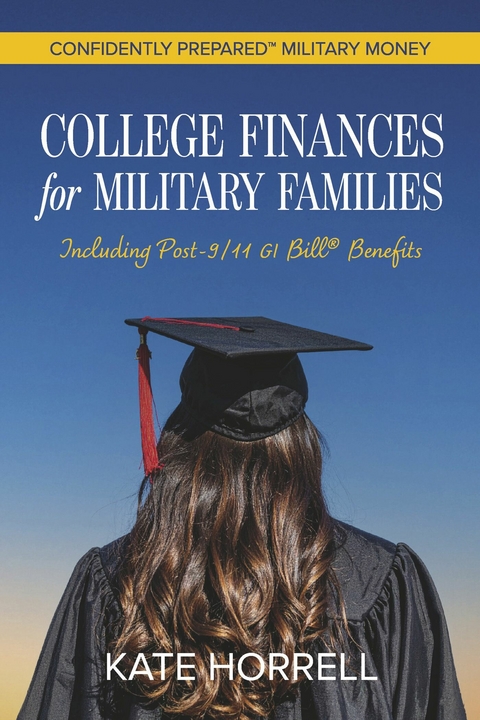
College Finances for Military Families (eBook)
100 Seiten
Bookbaby (Verlag)
979-8-9985324-1-2 (ISBN)
Kate Horrell AFC®, ChFC®, MQFP® is a trusted financial educator who helps military and veteran families navigate their pay and benefits. As the mom of four, it was crucial that she figure out how to fit the Post-9/11 GI Bill into their family's college funding plan. She used her years of experience analyzing military and veteran benefits and applied it to the Post-9/11 GI Bill, general financial aid, and scholarship opportunities. As a result, their family got all four kids through undergraduate educations on budget and on time. They even have resources remaining to help with graduate school! Kate shares her knowledge with clear, actionable advice on maximizing education benefits like the GI Bill, Tuition Assistance, and state-specific programs. Her deep understanding of how these benefits interact with federal financial aid and tax considerations makes her a go-to resource for military parents and students planning for higher education. Her practical approach ensures that service members and their families can make informed decisions that minimize out-of-pocket costs and student-loan burdens. Through her writing, speaking engagements, and one-on-one advising, Kate empowers families to be confidently prepared for every stage of life.
College Funding for Military Families is a simple yet comprehensive guide designed to help service members, veterans, and their families make smart, informed decisions about paying for higher education. With clear explanations and practical information, this book walks readers through the entire planning process-from understanding the education benefits earned through military service to learning how to coordinate those resources with other forms of financial aid. When you're done reading, you'll have a clear view of how to build a college financial plan that supports the education goals of the entire family. Whether you're navigating your first duty station or left the service years ago, this guide demystifies the complex landscape of military education benefits. It provides straightforward information about the most widely used programs, including the Post-9/11 GI Bill, Montgomery GI Bill, Tuition Assistance, and the Yellow Ribbon Program. It also breaks down how and when to transfer GI Bill benefits to a spouse or child, what happens when eligibility changes, and how to ensure that those benefits are used efficiently and strategically. In addition to federal programs, College Funding for Military Families shines a light on state-level programs for military dependents, outside scholarships, and the implications of military life on in-state tuition. Military families will see how to layer military-connected education benefits with civilian financial tools such as 529 college savings plans, federal student aid (including the FAFSA and Pell Grant), and private scholarships and grants. You'll learn how prioritize all these resources to build a strategic college funding plan that stretches resources for multiple children or degrees. This guide also addresses the realities of military life that affect educational planning frequent moves, deployment cycles, unpredictable orders, and the transition to civilian life. You'll find tips on how to maintain eligibility through these challenges, how to choose flexible or military-friendly schools, and how to spot red flags in schools that aggressively market to military families. Written by a financial educator with deep expertise in both college funding strategies and military benefit systems, this book is packed with real-life examples, timelines, and plain-English explanations that help military households avoid costly mistakes. It's not a textbook it's a practical resource you can refer to again and again as your family's education needs evolve. Whether your goal is a four-year university, a trade school, a graduate degree, or professional certification, College Funding for Military Families will help you unlock the full value of your benefits and build a cost-effective plan that works for your family. It's a must-read for any military household thinking about higher education whether you're planning years in advance or scrambling to meet next semester's deadlines.
Chapter 1:
Finding the Best Financial Fit
Financial fit is at least as important as all the other factors
that go into choosing a college.
One of the most underrated factors in the college selection process is finding the right financial fit. There’s plenty of talk about finding an academic fit and a social fit, but none of that matters if the money isn’t right. A poor financial fit can cause immense stress, jeopardize college completion, and create an economic fallout for years to come.
Financial issues are a leading reason why students drop out of college, and federal student loan debt can impact life choices for you and your family well into adulthood. While cost shouldn’t be the only consideration when choosing a college education, research shows it is an important one. Yet just 7.5 percent of students picked their college based upon affordability, prioritizing location, personal fit, and expectations of finding a good job.
The cost of higher education can be shocking. Most sources place the most expensive college at around $95,000 for the 2024–2025 school year. That’s per year, not total.
The good news is that we all have choices. The bad news is that those choices can be unnecessarily limited by a misunderstanding of the financial aid process, over-reliance on student loans, or not exploring all the options.
I belong to a Facebook group full of pre-college parents, and I’ve heard some scary things. I’ve also noticed many misconceptions about the availability of financial aid and scholarships. And this is perfectly normal because most of us have not financed a college education recently. How are families supposed to know this stuff?
“I’ll be taking out a home equity line of credit for the $40,000 per year we need to cover.”
“She’s worked so hard, she can go wherever she wants. I’ll figure out how to pay for it.”
“We don’t have good enough credit for parent loans, so he’ll be able to borrow more than the average student.”
“We’re not worried about paying for college, since we’re sure he’ll get a full ride. He has a 38 ACT score, a 9.2 GPA, he plays six varsity sports, he’s the world robotics champion, and during his internship at the Mayo Clinic, he cured cancer. Plus, he plays guitar.”
Obviously, this last example is an exaggeration. But as a financial educator, it terrifies me to hear parents confidently voice misconceptions and assumptions about financing higher education. I hate to think of the long-term consequences of financial choices that are made when families approach the college selection process without realistic expectations and reasonable knowledge of the facts of financing a college education.
Research and Plan Realistically
Finding the right financial fit becomes more complicated when we’re talking about parents navigating options with their children. Parents want their kids to have the best possible opportunities given their available finances. Kids typically don’t have enough life experience to understand the far-reaching consequences of their college choices. Parents have to take the lead and provide guidance and support.
Start Talking About College Finances Early
Okay, maybe it isn’t great preschool conversation, but don’t wait until April of your child’s senior year to start talking about how your family will pay for college. As parents, you can start thinking about this when your kids are in preschool. Then you’ll be informed and ready to talk to your kids when they begin high school—or sooner if they take an early interest in their higher education.
Be prepared to talk about whether your family has money set aside to pay for college and how much. Explore the costs of tuition, room, and board at your student’s preferred schools. Talk about what things you’ll pay for, and what things you expect them to pay for themselves. (For example, we told our children we would fund dining hall meals, but not Starbucks.) Explore your thoughts on student loans, whether you think it’s okay for your kids to take them, and whether you’re willing to take them on behalf of your kids. Emphasize the concept of finding a “financial fit” as an important consideration in the college selection process, along with academic, geographic, and social considerations.
Be Realistic About Financial Aid
Many families are shocked when they find out how much college costs, and they often have unrealistic expectations about the aid their student will receive. Regardless of where you are in the process, it’s not too early to start getting a realistic idea of how much money you’ll receive from other sources, and how much you will need to pay.
Merit aid is highly competitive. Those full-ride scholarships? They’re less common than you may think, and the competition is incredibly fierce. For example, the 2022–2023 University of Virginia’s Jefferson Scholars Foundation selected only 40 students out of 2,400 highly competitive nominees.
On the need-based aid side, it’s hard to tell what a school will offer until a student is admitted to the school and receives a financial aid award letter. (More about that in Chapter 11.) However, most schools have an online tool called a “net price calculator” that provides a nonbinding estimate of what education will cost at their institution.
Find this tool for any school by doing an internet search for “{name of school} net price calculator.” Some schools’ calculators are more accurate than others, and many don’t have the capacity to include their merit aid programs. So, it’s a useful tool to provide a starting estimate, but not the actual price tag.
You may want to download or screenshot the NPC results in case you need that information later.
Don’t Assume You Know What Aid Your Student Will Receive
There’s only one way to know exactly what financial aid a student will receive at any school: apply and fill out the required financial aid documentation. Don’t make assumptions about affordability based on the type of school—whether in-state, out-of-state, public, private, large, small, well recognized or obscure. While you can have a good idea of your prospects, as I just mentioned, a student has no concrete idea what sort of aid they’ll get until they are accepted to their school and receive a financial aid award letter.
I say this as the parent of a kiddo who got a shockingly generous merit aid package at a school that has a reputation for being stingy with merit aid. Before she applied, I warned her she would need a miracle to be able to afford it. But I’m so glad I said, “Go ahead and apply,” because she did get a miracle. Her entire academic career was changed by her decision to apply.
Don’t decide that one option is going to be either out of reach or more affordable based on anything other than cold hard facts. Find a way to gather all the information in an easily digestible form. When working with my coaching clients, I use the spreadsheet that I’ve shared in the resources on the books page of my website. As we go along, we’ll talk about how to gather the information you can add to this template.
The Guidance Counselor is for Guidance
Don’t count on your guidance counselor to do the heavy lifting for your college search and financial planning. Expecting a high school guidance counselor—or any one person—to have all the answers is unrealistic. Unless the counselor is at a small, private school, the school simply has a stellar guidance program, or the counselor is a demigod, usually a high school counseling office is not equipped (or paid enough) to give individualized help and hand-holding to every single student. Your family and your student are the drivers of this process and the ones making the decisions. To do that effectively, you’ll need to learn to navigate the college admissions and financial aid process.
So where does your guidance counselor help in this process? Very likely, they’re subject matter experts about major state colleges in your area, where most of their students probably attend. They probably also have a good understanding of their state’s education benefits. Depending on your situation, they may be able to provide a third point of view when parents and students are disagreeing. And lastly, you will likely need the guidance counselor’s help with some scholarship or other financial aid application packages. Guidance counselors are an important resource, but they are there to offer guidance on this journey, not to make the journey for you.
The Myth of the Perfect School
Many students have the idea that there’s only one perfect school for them. This myth may be exacerbated by peer pressure or social media. Encourage your student to realize they are choosing from an array of good possibilities. You may even want to make a rule that your student needs to apply to at least three or four colleges.
This concept can be reinforced by visiting a wide variety of types of schools before applying or making a decision. While college visits can be expensive and time-consuming, every college visit adds perspective. Visiting various types of schools closer to your home, even if they aren’t in serious consideration, is a good way to learn likes and dislikes and to see what college campuses are like. In-person experiences like these provide a frame of reference for the rest of the college search.
Consider Alternatives
Despite what you see in the movies, the...
| Erscheint lt. Verlag | 17.7.2025 |
|---|---|
| Sprache | englisch |
| Themenwelt | Sachbuch/Ratgeber ► Beruf / Finanzen / Recht / Wirtschaft ► Geld / Bank / Börse |
| ISBN-13 | 979-8-9985324-1-2 / 9798998532412 |
| Informationen gemäß Produktsicherheitsverordnung (GPSR) | |
| Haben Sie eine Frage zum Produkt? |
 EPUB (Ohne DRM)
Digital Rights Management: ohne DRM
Dieses eBook enthält kein DRM oder Kopierschutz. Eine Weitergabe an Dritte ist jedoch rechtlich nicht zulässig, weil Sie beim Kauf nur die Rechte an der persönlichen Nutzung erwerben.
Dateiformat: EPUB (Electronic Publication)
EPUB ist ein offener Standard für eBooks und eignet sich besonders zur Darstellung von Belletristik und Sachbüchern. Der Fließtext wird dynamisch an die Display- und Schriftgröße angepasst. Auch für mobile Lesegeräte ist EPUB daher gut geeignet.
Systemvoraussetzungen:
PC/Mac: Mit einem PC oder Mac können Sie dieses eBook lesen. Sie benötigen dafür die kostenlose Software Adobe Digital Editions.
eReader: Dieses eBook kann mit (fast) allen eBook-Readern gelesen werden. Mit dem amazon-Kindle ist es aber nicht kompatibel.
Smartphone/Tablet: Egal ob Apple oder Android, dieses eBook können Sie lesen. Sie benötigen dafür eine kostenlose App.
Geräteliste und zusätzliche Hinweise
Buying eBooks from abroad
For tax law reasons we can sell eBooks just within Germany and Switzerland. Regrettably we cannot fulfill eBook-orders from other countries.
aus dem Bereich