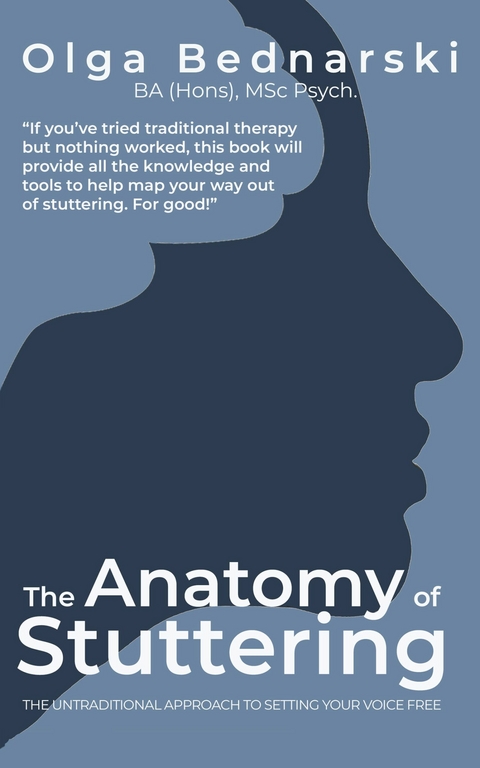
The Anatomy of Stuttering (eBook)
348 Seiten
Holistic Wellness Publishing (Verlag)
978-1-0681520-0-9 (ISBN)
The Anatomy of Stuttering is a groundbreaking guide for adults who want to overcome speech anxiety and stuttering-not temporarily, but for life. Written by Olga Bednarski, BA (Hons), MSc Psych., this book offers a radically different, psychology-based approach to speech recovery that focuses on clearing mental and emotional blocks, rather than managing symptoms.
Drawing from over 18 years of personal experience with speech anxiety and a decade of teaching others, Olga reveals how traditional stuttering therapies often miss the root cause. Instead of forcing fluency, her method restores it naturally by healing the subconscious beliefs and inner conflicts that create speech blocks in the first place.
This book empowers readers with deep insight and practical tools to restore fluency, inner peace, and lasting confidence. Whether you've tried everything or are just beginning your journey, The Anatomy of Stuttering offers a proven, compassionate path to finally set your voice free.
Chapter 2 – My Story: From a Stutterer to a Public Speaker
Looking into the starry sky, I began seeking for the answers …
Olga Bednarski
If somebody had told me that I would achieve what I have achieved, I would have felt mocked and deeply offended. I speak for a living, working as a language tutor and a coach. I start to speak as soon as I wake up and only stop when all the lights go off. Not only must I speak without interruptions, but I must sound convincing, eloquent, entertaining and confident. Mumbled or interrupted speech will simply not do! I cannot afford to have less fluent or ‘bad speaking days’.
My speech is spontaneous and flows ‘like a river’. This is not because I use control techniques or tricks but because I apply no technique at all. I say what I want, when I want, regardless of the situation.
However, ten years ago the situation was starkly different. Stuttering out of control, I could hardly utter a word without blocking. Saying my name was the toughest challenge. Petrified, I would simply avoid it. Having lost all hope of recovery, I felt helpless, clinically depressed and suicidal.
How did I suddenly become so fluent? I was always certain that I would stutter all my life.
Within this book, we will come full circle as I lead you through the journey to stuttering and out of it. I will explain the intricate workings of stuttering, its algorithm and provide a workable and pliable solution to every person who stutters to dismantle it – the solution that will not only assist you in reaching fluency but will ensure you maintain it, restoring total and unconditional control over your life.
Stuttering is not what you think. This book provides evidence that debunks hardened myths about stuttering and provides tangible, empirical research evidence and solid arguments to show that stuttering is not a disease nor a brain malfunction as was previously thought. It will also show how it can be permanently eliminated without having to rely on control, medication, breathing techniques or other superficial methods or devices.
It all began with a huge will to achieve more …
Born out of seven years of empirical research, experiments, observations and insights, this book brings together stories from PWS from across the world. This included hours of interviews, conferences and conversations with those who still stuttered, those who significantly improved, as well as those (who I could count on the fingers of one hand) who had fully recovered. Like a jigsaw, the data merged together naturally to reveal the essence of stuttering, its anatomy, the algorithms that propel it, ultimately showing the way to much-coveted freedom.
In light of the conventional views on stuttering, this may sound like a complete impossibility, yet the proof is in the pudding – I recovered. The result of the work undertaken is impossible to deny. But before I hear your protests, I suggest you read the book.
My early childhood
I was born in 1983 in Tallinn, the capital of Estonia, to an ordinary Soviet family. My childhood was uneventful as it must have been for the majority of children born and raised behind the Iron Curtain. I never travelled abroad, and the only entertainment was running around on the street, playing hide and seek with my friends from the neighbourhood.
Born perfectly healthy, my speech developed without abnormalities. By the time I was four, I talked nineteen to the dozen. There was no history of stuttering in my family, so it was inconceivable to imagine that such a talkative child would at any point in her life develop a condition as perplexing as stuttering.
There are three particular things from my childhood that stand out in my memory: I was effortlessly fluent and never held back in interactions; I was extremely sensitive and impressionable; and I had a vivid imagination. Whenever something unpleasant happened, I would relive and agonise over this experience for days. Thanks to my vivid imagination, I would often blow things out of proportion – exaggerating, fantasising, daydreaming. In fact, when I was vividly daydreaming, I could imagine anything.
Then, when I was just four years old, I contracted pneumonia and was taken to hospital. I can still feel the sadness I felt then as I saw my mother walking out of the hospital building. I felt abandoned, as if I would stay there for good.
The revolution of the 1990s
In December 1991, just over a year after I started school, all Socialist republics were dissolved, marking the collapse of the Soviet Union. Estonia endured nothing short of shock therapy as it had to abruptly shift from a centralised to a market-oriented economy, from communism to capitalism, from socialism to democracy. The bright Soviet future that people had been promised and worked for all their lives had folded overnight. The umbilical cord was cut off, including all the provisions that Mother Russia previously provided. With this sudden economic freedom and independence came uncertainty and fear for tomorrow.
This set in motion a succession of distressing events. Estonia suffered shortages in food supply, numerous bouts of inflation that decimated people’s savings, salaries and pensions and forced closures of many major factories. Thousands of people were thrown out of work and left out on the street. They were made redundant without notice, explanation or any statutory redundancy pay. At the time, losing your job equated to a death sentence as there were no social, hardship or other benefits provided. It was survival of the fittest. Every person’s fate was placed in their own hands.
Perestroika severely corroded all areas of everyday life, including relationships. Disoriented, weary, anxious and fearful of tomorrow, people lost faith in their fellow humans. They grew increasingly distrustful and fearful towards each other. Manically preoccupied with fulfilling their basic needs, they were prepared to go to any lengths. The primary agenda of most families was to fulfil the bottom level of Maslow’s hierarchy of needs – the basic physiological needs such as food, drink, clothing and shelter. And when all else failed, some would turn to criminal activity in a bid to ‘prosper’ – racketeering.
My parents struggled to keep their heads above water. Meanwhile, aged seven, I was living in my parallel world of childhood dreams. I enjoyed school. I was always confident and very inquisitive. Curiosity was something that motivated and propelled me into action, even in situations where, quite often, I did not really know what an appropriate course of action should entail. I enjoyed interaction immensely and I never held back. On the contrary, I looked forward to being put on the spot and being the centre of attention.
Secondary school
I was far too young to fully comprehend the scope of events unfolding around me. The established course of life was forever lost. Perestroika and its repercussions reflected upon relationships, attitudes and how people related to each other. This was also felt in the interactions between teachers and students in our school.
In 1995, aged eleven, I started secondary school, where I found the chaotic and brutal setting a startling contrast to the nurturing atmosphere I was used to at elementary school. The atmosphere was now fast-paced and demanding, and the level of expectation was through the roof. I was out of my comfort zone and was awakened to a harsh reality.
Understandably, under the circumstances in Estonia, my educators and all families were under immense pressure. Teachers would often bring their domestic problems to work, taking their anger out on students. They would harshly reprimand and yell at students publicly. Needless to say, there was no such thing as psychological support available for those suffering the effects of stress and trauma. Our teachers were bearing the same signs of strain and stress as everyone else, which was clearly visible in their conduct.
During my post-Soviet childhood, and particularly in secondary school, yelling and harsh language were not uncommon. Teachers’ conduct deserves a special mention here as it was unpoliced and some weird stuff often went on in class. For example, on one occasion, a head teacher burst into tears right in front of us, telling us explicitly about the loss of a baby following a miscarriage. On another occasion, I went for a maths support class and was unceremoniously kicked out and the door shut right in my face. I ran off in tears.
The teaching approach was that of one size fits all, with individuality supressed. There was no nurturing of individuality and students were just supposed to do what they were told to do. I can imagine some of you reading this and saying that is how it should be and that it is called discipline.
Meanwhile, along with my difficult transition to secondary school, other emotional and physical changes were taking place in my body as it entered puberty. It all began to have a profound effect on how I felt about myself – my self-image, level of confidence and my identity. Around this time, my sensitive predisposition began to display clear signs of nervousness and anxiety, including panic attacks. From being an extroverted and confident child, I gradually morphed into a withdrawn and socially awkward teenager. Alongside this, my academic performance rapidly declined from distinction in elementary school to marginal pass in secondary.
The onset of my stuttering
Aged thirteen, I displayed the first tell-tale signs of an emerging speech impediment. It all began with occasional moments of hesitation, which became more and more frequent, making even the most...
| Erscheint lt. Verlag | 16.5.2022 |
|---|---|
| Sprache | englisch |
| Themenwelt | Sachbuch/Ratgeber ► Gesundheit / Leben / Psychologie ► Alternative Heilverfahren |
| Schlagworte | Alternative speech therapy • overcome stuttering • Personal growth & transformation • public speaking confidence • Self-help for stuttering • stop stuttering • Stuttering recovery in adults |
| ISBN-10 | 1-0681520-0-1 / 1068152001 |
| ISBN-13 | 978-1-0681520-0-9 / 9781068152009 |
| Informationen gemäß Produktsicherheitsverordnung (GPSR) | |
| Haben Sie eine Frage zum Produkt? |
 EPUB (Ohne DRM)
Digital Rights Management: ohne DRM
Dieses eBook enthält kein DRM oder Kopierschutz. Eine Weitergabe an Dritte ist jedoch rechtlich nicht zulässig, weil Sie beim Kauf nur die Rechte an der persönlichen Nutzung erwerben.
Dateiformat: EPUB (Electronic Publication)
EPUB ist ein offener Standard für eBooks und eignet sich besonders zur Darstellung von Belletristik und Sachbüchern. Der Fließtext wird dynamisch an die Display- und Schriftgröße angepasst. Auch für mobile Lesegeräte ist EPUB daher gut geeignet.
Systemvoraussetzungen:
PC/Mac: Mit einem PC oder Mac können Sie dieses eBook lesen. Sie benötigen dafür die kostenlose Software Adobe Digital Editions.
eReader: Dieses eBook kann mit (fast) allen eBook-Readern gelesen werden. Mit dem amazon-Kindle ist es aber nicht kompatibel.
Smartphone/Tablet: Egal ob Apple oder Android, dieses eBook können Sie lesen. Sie benötigen dafür eine kostenlose App.
Geräteliste und zusätzliche Hinweise
Buying eBooks from abroad
For tax law reasons we can sell eBooks just within Germany and Switzerland. Regrettably we cannot fulfill eBook-orders from other countries.
aus dem Bereich