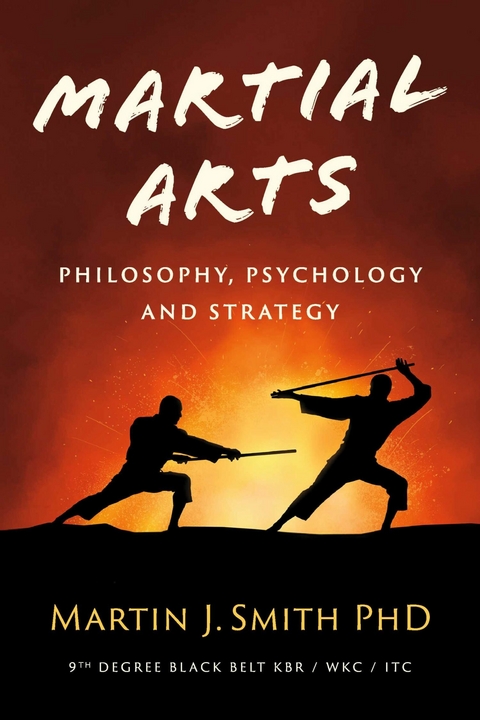
Martial Arts Philosophy, Psychology and Strategy (eBook)
304 Seiten
Bookbaby (Verlag)
979-8-3178-0359-9 (ISBN)
Martin Smith is a national (UK) and international martial arts instructor with over 50 years experience in the arts. He is currently ranked 9th Dan in the integrated martial arts system of FUSEKI, recognised and awarded by an International Panel through the Kodo Butoku Renmei (Old Ways Martial Virtues Federation). He holds senior Dan Grades in other arts, which includes Shotokan Karate, the Phillipino art of Eskrima, Combative Kickboxing and the original police self defence system of Taiho Jutsu. Martin Smith is a nationally qualified Personal Safety Trainer and senior Police Defensive tactics trainer. He is a member of the prestigious International Law Enforcement Educators and Trainers Association (ILEETA). In 1993 after many years of research and study he formed the Institute for Traditional Combatives, which has been affiliated and recognised through many National and International Governing bodies. The Fuseki Martial Arts System was officially recognised in July 1996. Throughout the past five decades Martin has trained and graded under some of the leading martial artists in their particular fields including such World class teachers as: Hirokazu Kanazawa / Shiro Asano (Shotokan), Kiyoshi Yamazaki (Shindo Jinen Ryu) Brain Jones / Abner Pasa (Eskrima), Dan Inosanto / Rick Young / Larry Hartsell (JKD), Brian Eustace (Taiho Jutsu) Marco Ruas (Ruas Vale Tudo). Martin also holds a PhD in Counselling Psychology and has been in clinical practice as a Psychotherapist for over 25 years.
Drawing on ideas and concepts from a series of articles and reflections written by the author and published in UK martial arts magazines over six decades as well as new material more recently developed. This book explores a range of concepts and ideas which span all aspects of the arts and bridge all disciplines and training methodologies. Regardless of your interest or approach you will find the principles and ideas discussed in this book both useful and thought provoking. Each chapter gives insight into the author's extensive experience within the martial arts which has lead to the development of this book. Having had the honour and privilege to meet, train and be taught by many leading martial artists from around the World. Some having become good friends the author has learnt a wealth of material from a 50-year journey which you will find enhances your path within the arts. In order to get good or do well in any chosen pursuit you need to look for the best, learn from them, and be open to opportunities and learning from wherever it may flow. With the martial arts it is not just about having world class instructors but also having an open mind, willing to learn from any source and also to appreciate those you may consider your students, for it is they that can expand your horizons and teach you. Ego, arrogance and an attitude of superiority should have no place in martial arts practice, but alas they most certainly do. In a professional career as a psychotherapist the author has studied many personality types and especially those in what is termed the Dark Triad (Psychopaths, Narcissists and Machiavellians) personality types seen only too often in the martial arts. There has however also been many great people, students, teachers, masters and friends who have helped shape the author's interest and overall personal development in a way of life he has embraced so fully. It all started for the author with Bruce Lee and went on from there. In these pages he seeks to give you insight into many aspects of the art which go beyond technique or physical skills and how to do them. This book is about martial strategies, philosophy, psychology and much more.
Introduction
Martin J Smith PhD
(a complex journey)
Background to the author’s journey through the arts over the past six decades. A look at some of the concepts and ideas which have developed through contact and interaction with many leading martial artists.
My interest in the subject matter of this book has been through a long and quite varied route. Interest in the whole world of martial arts goes back over fifty years and starts with my initial study of Shotokan Karate, beginning with my first Karate lesson at the local church hall on Tuesday 1st October 1974. My instructor was a gentleman and pioneer of Karate in the UK – Sensei Jack Warner. Jack was personal friends with Hirokazu Kanazawa an instructor I came to study and follow closely over my martial arts career.
In my early school days I was never, what I would consider, an athletic or physical type of person. I enjoyed reading and studying various subjects, I was never very good at languages but felt I excelled in sciences, geography and history. At the age of fourteen a craze swept the UK that had a significant affect on my life as it did on many young and impressionable teenagers of the time. I am a prodigy of the Bruce Lee era of the mid 1970’s - taken with the ideas and wonders of the eastern magic that was the martial arts.
The karate club at that time and through its following ten years existence boasted an incredible membership, I estimated at one point over 1500 people came through the doors of the local church hall and the club’s main dojo situated behind a pub down a long country lane next to a canal lock hence the club’s name - The Trent Lock Karate Club.
In the early to mid 1970’s the Kung Fu craze had arrived, most notably in the shape of Bruce Lee. I am more than happy to admit that I am a product of the “Kung Fu Craze” of the mid 1970’s. Like so many people at that time I was completely taken in by the sheer power, energy and charisma of the late, great Bruce Lee. From the first moments of watching this unique individual in action I was captured, not for the violence but by the many positive elements that the martial arts bring to; these include, greater self-confidence, control and focus in life. As more of a bookworm at school I started buying some books on Karate and reading up on the history and traditions of the arts.
Literally from the very start the martial arts were not just an interest, they were a way of life. I always remember asking my mother what having a talent meant. To try and get the meaning of the term across to me she used the example of drawing as something that some people have a natural and innate ability to do. Being unable to fully recognise the drawing analogy as merely an example I immediately set about finding my artistic talent, which I was convinced lay in drawing and art.
Needless to say my hidden talent was not in art and drawing as I quickly began to realise, certainly my interests in sciences and history were becoming apparent as was my desire to study. What was not apparent until that fateful evening in October 1974 was my talent and desire to follow the martial arts. From the first lesson on that Tuesday evening I knew that the martial arts were for me to the point of going home and telling my mother that I would someday have my own club and be a martial arts teacher, something I would achieve in the years to come.
The martial arts and Bruce Lee captured my imagination in such a way that it gave me my first taste of the power of emotional connection and the influence of our emotions can have on our lives both for the positive and negative. As my studies in the arts progressed, other core interests were being satisfied especially my interest in history, as the martial arts has a strong and varied history. I began to meet many martial arts practitioners, many of whom would go on to explain to me how their lives had been changed and how the arts had had such a positive and motivating impact on them. I would have the opportunity to meet some fascinating people with equally fascinating and interesting stories to tell.
As a yellow belt in the summer of 1975, I attended the first of many of the Shotokan Karate International - SKI Summer schools at Nottingham University and met an array of senior Shotokan Karate Instructors including Sensei Kanazawa and his resident UK Chief Instructor Shiro Asano who lived in Nottingham. There were over eight senior Japanese Karate Instructors at that summer school, all of whom had a significant impact on me and drove me to seek out the best martial arts instruction I could find.
I first started to move into other arts outside of Shotokan after attaining my second Dan in 1982. These days people are often too keen to have a go at many arts because they are so easily available in classes or via video and the internet. Nothing wrong with this but, studying a core system, whatever that is, is important before moving on. Developing other styles is also essential to give full appreciation to all that is out there but without the foundation of a core system, challenges can and will show up later in training.
Whilst continuing my studies in Shotokan I got interested in Bruce Lee’s philosophy and teachings which inevitably brought me to Dan Inosanto. My first seminar with Dan was in 1984 organised in London by another key figure and pioneering martial artist at the time – Bob Breen. I went on to study and work with other great Jeet Kune Do - JKD names including Larry Hartsell, Cass Magda and Rick Faye. Two of the most regular influential figures in my JKD training were Rick Young and Marc McFann, both of whom I had opportunity to train with privately as well as in regular seminars and classes.
From the JKD interest came my progression into Escrima and again I was very fortunate to find one of the top UK Eskrima instructors – Sifu Brian Jones. Brian was linked to Bill Newman and Rene Latosa and was a significant influence in my Escrima training. I later linked up with a senior UK Eskrima instructor, Krishna Godhania and through him was able to train with Grandmaster Abner Pasa from the Philippines.
My training moved on, and continued to evolve. A natural progression was the MMA or mixed martial arts and the UFC influence of the mid to late 1990’s. Through a good friend I was able to connect with a highly skilled MMA practitioner – Marco Ruas, who won UFC 7. Marco took my training to another level and helped develop my skills, and in turn add to the repertoire that would become my own system of FUSEKI.
When I started to train in MMA systems I quickly realised how top practitioners would stress the need for basics and the need for precision and focus in their training. Many who dive straight in to modern eclectic forms do not have the benefit of formal basic training that many traditional styles give, whether this is Karate, Kung Fu, Aikido or Judo. What seems, at first quite redundant practice, or impractical skills, is actually developing discipline, focus and appreciation of precision in application that can often be overlooked.
Another key impact the martial arts has had for me was the developing interest in the power and ability of the mind and this lead me to the study and teaching of self defence for those wishing to know how to protect themselves, but who did not have the desire to spend years studying a martial art. It was the study of conflict and managing difficult situations that drew me eventually to the psychology of conflict and how we react to situations within ourselves. At first the martial arts and self defence were all about personal development and how we can best physically defend us. Later it became apparent that there was much more to this than physical technique.
With my move into the Police Service in 1985 the importance of the psychology of conflict and the enhancement of interpersonal communication skills grew. Due to my already developed expertise in personal safety, by 1990 I was teaching Police Officers skills for personal safety in physically confrontational situations. However, it was not until 1995 that my interest in the psychological aspects of conflict really took off. The reason for this was a lecture I attended as part of a one-week instructor’s course to qualify to teach one of the new Police Batons that were coming in to the UK, the Monadnock PR24 side handle baton.
During this course, a lecture was given by one of the then leading personal safety instructors in the UK, an Inspector from Northamptonshire Police. The essence of this lecture was the stress reactions we undergo in conflict and the issues around high emotional arousal and the impact such arousal has on our cognitive thinking processes and our overall reaction times and ability to think rationally.
Just as the martial arts had done almost twenty years previously, this lecture fired my desire to learn more about the subject relating to our psychological reactions under stress and the need for greater understanding of these reactions. At this stage the interest was really geared to helping me gain more knowledge and enable me to teach better officer safety skills. It was not long before the interest in the psychology of conflict grew and my interest in psychology began to really develop.
Whilst in the Police I was able to train at the time in the current self defence system of Taiho Jutsu and was able to have the honour of training with one of the UK’s leading Aikido masters and the founder and developer of the police self defence system of Taiho Jutsu, this being Sensei Brian Eustace. I continued to...
| Erscheint lt. Verlag | 31.7.2025 |
|---|---|
| Sprache | englisch |
| Themenwelt | Sachbuch/Ratgeber ► Sport |
| ISBN-13 | 979-8-3178-0359-9 / 9798317803599 |
| Informationen gemäß Produktsicherheitsverordnung (GPSR) | |
| Haben Sie eine Frage zum Produkt? |
 EPUB (Ohne DRM)
Größe: 2,2 MB
Digital Rights Management: ohne DRM
Dieses eBook enthält kein DRM oder Kopierschutz. Eine Weitergabe an Dritte ist jedoch rechtlich nicht zulässig, weil Sie beim Kauf nur die Rechte an der persönlichen Nutzung erwerben.
Dateiformat: EPUB (Electronic Publication)
EPUB ist ein offener Standard für eBooks und eignet sich besonders zur Darstellung von Belletristik und Sachbüchern. Der Fließtext wird dynamisch an die Display- und Schriftgröße angepasst. Auch für mobile Lesegeräte ist EPUB daher gut geeignet.
Systemvoraussetzungen:
PC/Mac: Mit einem PC oder Mac können Sie dieses eBook lesen. Sie benötigen dafür die kostenlose Software Adobe Digital Editions.
eReader: Dieses eBook kann mit (fast) allen eBook-Readern gelesen werden. Mit dem amazon-Kindle ist es aber nicht kompatibel.
Smartphone/Tablet: Egal ob Apple oder Android, dieses eBook können Sie lesen. Sie benötigen dafür eine kostenlose App.
Geräteliste und zusätzliche Hinweise
Buying eBooks from abroad
For tax law reasons we can sell eBooks just within Germany and Switzerland. Regrettably we cannot fulfill eBook-orders from other countries.
aus dem Bereich