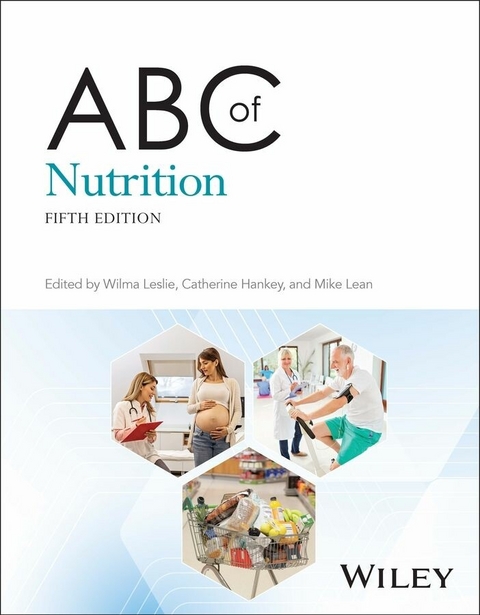
ABC of Nutrition (eBook)
345 Seiten
Wiley (Verlag)
978-1-118-66592-3 (ISBN)
ABC of Nutrition
A practical guide to nutrition and the health problems related to foods and diet, covering body composition, epidemiology, specific populations, and more
ABC of Nutrition is a comprehensive guide to nutrition as it relates to the causes, treatment and management of the symptoms and medical conditions frequently met by healthcare professionals. Beginning with a new introduction to principles of nutrition and definitions of terms, this revised and updated fifth edition includes new chapters on nutrition for special populations, such as pregnant women, children, and the elderly, and on the use of products marketed for sports and performance enhancement.
This new edition also features the latest National Institute for Health and Care Excellence guidelines on Nutrition Support for Adults, as well as guidance on Maternal and Child Nutrition. Written by a team of experts with a range of professional perspectives, ABC of Nutrition includes valuable, practical information based on clinical evidence, in an easily accessible way. Areas covered include:
- Vitamins and minerals, salt and sodium, fats, carbohydrates, and proteins
- Nutritional deficiencies in both developing and affluent countries, and the role of functional foods and nutrient fortification in addressing these deficiencies
- Nutrition's role in heart disease, blood pressure, chronic diseases such as diabetes, and some types of cancer
- Challenges of weight management, eating disorders, and obesity for individuals and in the sphere of public health
- Addressing the large amount of misinformation circulating in the media about foods and health
ABC of Nutrition is an essential, stimulating read, aimed at providing confidence when advising about diet and nutrition for healthcare professionals, practitioners, and students in many fields.
Dr Wilma Leslie, Honorary Research Fellow (Human Nutrition), School of Medicine, Dentistry and Nursing, University of Glasgow, UK.
Dr Catherine Hankey, Senior Honorary Research Fellow (Human Nutrition), School of Medicine, Dentistry and Nursing, University of Glasgow, UK.
Professor Mike Lean, Chair of Human Nutrition, School of Medicine, Dentistry and Nursing, University of Glasgow, Glasgow, UK.
ABC of Nutrition A practical guide to nutrition and the health problems related to foods and diet, covering body composition, epidemiology, specific populations, and more ABC of Nutrition is a comprehensive guide to nutrition as it relates to the causes, treatment and management of the symptoms and medical conditions frequently met by healthcare professionals. Beginning with a new introduction to principles of nutrition and definitions of terms, this revised and updated fifth edition includes new chapters on nutrition for special populations, such as pregnant women, children, and the elderly, and on the use of products marketed for sports and performance enhancement. This new edition also features the latest National Institute for Health and Care Excellence guidelines on Nutrition Support for Adults, as well as guidance on Maternal and Child Nutrition. Written by a team of experts with a range of professional perspectives, ABC of Nutrition includes valuable, practical information based on clinical evidence, in an easily accessible way. Areas covered include: Vitamins and minerals, salt and sodium, fats, carbohydrates, and proteins Nutritional deficiencies in both developing and affluent countries, and the role of functional foods and nutrient fortification in addressing these deficiencies Nutrition s role in heart disease, blood pressure, chronic diseases such as diabetes, and some types of cancer Challenges of weight management, eating disorders, and obesity for individuals and in the sphere of public health Addressing the large amount of misinformation circulating in the media about foods and health ABC of Nutrition is an essential, stimulating read, aimed at providing confidence when advising about diet and nutrition for healthcare professionals, practitioners, and students in many fields.
CHAPTER 1
Introduction: What Is ‘Nutrition’?
Mike Lean
University of Glasgow, Glasgow, UK
Introduction: nutritional status – ‘what we eat’, ‘what we are’ and ‘what we can do’
OVERVIEW
- Nutrition is a scientific discipline, addressing the supply and metabolism of nutrients.
- Nutrition can be considered at cell, organ, whole‐body or population level.
- The terminology of nutritional science includes terms whose meaning is different in lay language, which can cause confusion.
- The concept of nutritional status, at whole‐body level, is fundamental: it has three components – ‘what we eat’, ‘what we are’, and ‘what we can do’, i.e. diet, body composition and functions.
- The discovery of vitamins from the 1920s had the adverse effect of stimulating unfounded and sometimes hazardous marketing, and renewed beliefs about magical qualities of foods.
Introduction
Nutrition is a scientific discipline. It addresses the most important processes in all branches of biology, by which any population, or an organism, obtains the nutrients from their environment which allow it to live, to function, to grow, respond to injury and infection, to reproduce, and ultimately to compete and to adapt and mutate in order to survive as a species. Within a complex organism, and humans certainly qualify, the principles of nutrition apply to the growth, development and function of organs, cells and even subcellular bodies. All of this contributes to health. The principles can be applied at a whole body level to individuals, and to groups or populations. The clinical specialty of dietetics employs an understanding of nutritional science to define food‐based approaches which have health benefit, and psychological principles of behaviour changeto help people adopt a healthful diet.
Language and principles of nutrition
The principles of nutrition are fundamental to life, and the language often seems familiar. As an example, the most fundamental of all nutritional concepts is ‘energy’. There are many nuanced interpretations of the word among the general public, but within nutrition, energy has a very specific meaning, which is the capacity to do work (physical or biochemical), measured in calories or kilojoules.
A great deal of the science of nutrition has to do with the understanding of biochemical transformations of substrates which arrive into a system as nutrients to form new classes of molecules. Nutritional science actually pre‐dated biochemistry as a scientific speciality. It was known through the work of Atwater and colleagues well over 100 years ago in the late nineteenth century that energy from foods came from three ‘macronutrients’: protein (4 kcal/g), carbohydrate (also about 4 kcal/g) and fat (9 kcal/g). These ‘Atwater Factors’ or ‘proximate values’ of nutrients have only been very modestly adjusted since then.
Indeed most classical biochemistry is an extension of basic nutritional science based on the discovery of vitamins and certain minerals as ‘essential nutrients’. The concept of these factors being required from foods, in absolutely tiny amounts (hence ‘micronutrients’), to allow normal biochemical processes and avoid catastrophic deficiency diseases, was new and revolutionary for health sciences. But ever since Lind stumbled across citrus fruit as a cure for scurvy, there has been another commercial agenda, seeking a claim for profit of magical properties from obscure food derivatives. Modern ‘health food shops’ and supermarkets sell a vast plethora of scientific‐sounding preparations, claiming health benefits, to vulnerable customers eager for magic (‘… may help weight loss as part of a calorie‐controlled diet’). For every health problem that people have ever faced, someone has concocted a ‘nutritional treatment’, with no evidence whatever, which can be sold openly despite very clear legislation against unfair commercial practices to deceive consumers.
Thus a great deal of the modern work and expensive research in human nutrition, and to some extent veterinary, is taken up trying to debunk the non‐evidence‐based claims of millionaires who themselves never trouble to do any research before making lucrative health claims for their commercial products. As will be explained in later chapters, the essential micronutrients are cofactors in biochemical processes, so deficiency can be very serious, but consuming extra amounts has absolutely no value, in fact high‐dose vitamins and minerals can be very harmful.
The vitamins required by humans became ‘essential’ because they are present in plentiful amounts above what we actually need in almost all human diets. During our evolution, the capacity to synthesise these compounds was unnecessary, and somewhere along the line that capacity was dispensed with. With the exception of poor vitamin D and iron status, problems with micronutrient deficiency diseases are now only met with extremely unbalanced diets, for example in alcoholics, or in deficient regions where people still consume only locally grown traditional diets.
While the general public is familiar with the terms used for nutrients, for example carbohydrate, fat, protein and fibre, there are often large gulfs in their understanding. So a major task for nutrition is to improve education. For example, many people confuse carbohydrates and sugars or fail to recognise that dietary fibre is a form of carbohydrate. Many believe that high‐carbohydrate or high‐sugar foods are high in fat (they may confuse being ‘fattening’ with being high in fat). The fact that sugar contains only 3.75 kcal/g, whereas fat provides 9 kcal/g, is often hard for the general public to grasp.
Beyond this is the complexity of nutrition when it is used within food science. A common misconception is that there are foods which are ‘carbohydrates’ or ‘proteins’: with the exception of refined table sugar, all foods contain mixtures of carbohydrates, fats and proteins. The language of food science as used (and incorrectly called nutritional labelling) on food packaging, like home cookery, uses weights in grams. So the percentage of carbohydrate, fat or protein in a food refers to the percentage of the total weight. Nutritional science cannot consider individual nutrient functions in isolation from the others present, and so the composition of a food or diet is expressed as a percentage of total kcal for macronutrients, or per 100 kcal for micronutrients. The use of reference nutrient intakes on food – guideline for daily amounts – aims to clarify the understanding of nutrition information (https://www.nhs.uk/Livewell/Goodfood/Pages/reference‐intakes‐RI‐guideline‐daily‐amounts‐GDA.aspx).
It is sometimes helpful to consider the principles of nutrition to be analogous to those of economics, indeed the languages used are similar. We have consumption (income) and losses to define net gain and storage in various organs and tissues (or net losses, to be apportioned between organ and tissues). For some transactions, like consumption of carbohydrate or protein, there are obligatory losses as diet‐induced thermogenesis, similar to service changes. Banking systems are complicated: the human body can store huge amounts of fat, in adipose tissue, but very little carbohydrate as glycogen in liver and muscle – enough for about a day’s use – however, we cannot store protein. If one organ needs amino acids and none are being consumed, they can only be provided by breaking down protein from another organ.
The problem with nutrition is that our body’s metabolism functions continuously, varying according to our physical activity and other conditions, but we eat only intermittently, and sometimes very intermittently. There are prices to be paid for this mismatch between demand and supply, and there can be extreme cases, for example when demand is greatly increased by illness but consumption is halted for prolonged periods. There are some short‐term adaptations to conserve nutrients, for example reducing the activity of some organs, such as reducing physical activity, or turnover of cells in skin and gut mucosa, but an energy cost is incurred, which can only be provided by storing fat. It is remarkable that we function so well when our storage capacity varies so much between nutrients. We have no storage for oxygen, the most critical nutrient, and we die if deprived of oxygen for a few minutes. Our next most critical nutrient, water has very limited storage, in combination with glycogen in the liver and muscle, available as a result of glycogenolysis when there is a simultaneous need for glucose and water for physical exertion. We can survive water depletion of about 10%, with increasing discomfort, but dehydration will kill most people in four or five days.
Having little storage of carbohydrates or none for protein means that we are frequently depleted of these nutrients, but we can adapt, at a cost, to survive. When glycogen stores are depleted, we lack some capacity for high‐energy glycolytic physical activity and may feel tired, but life goes on. Dietary protein insufficiency, understood as essential amino acid insufficiency, has few measurable ill‐effects,...
| Erscheint lt. Verlag | 14.7.2025 |
|---|---|
| Reihe/Serie | ABC Series |
| Sprache | englisch |
| Themenwelt | Sachbuch/Ratgeber ► Gesundheit / Leben / Psychologie |
| Medizin / Pharmazie | |
| Schlagworte | dietary assessment • dietary guidelines • dietitian • essential nutrients • Food Groups • Medical nutrition • nutrition body composition • nutrition disease • nutrition epidemiology • nutrition health • nutritionist • primary care nutrition |
| ISBN-10 | 1-118-66592-9 / 1118665929 |
| ISBN-13 | 978-1-118-66592-3 / 9781118665923 |
| Informationen gemäß Produktsicherheitsverordnung (GPSR) | |
| Haben Sie eine Frage zum Produkt? |
 EPUB (Adobe DRM)
Kopierschutz: Adobe-DRM
Adobe-DRM ist ein Kopierschutz, der das eBook vor Mißbrauch schützen soll. Dabei wird das eBook bereits beim Download auf Ihre persönliche Adobe-ID autorisiert. Lesen können Sie das eBook dann nur auf den Geräten, welche ebenfalls auf Ihre Adobe-ID registriert sind.
Details zum Adobe-DRM
Dateiformat: EPUB (Electronic Publication)
EPUB ist ein offener Standard für eBooks und eignet sich besonders zur Darstellung von Belletristik und Sachbüchern. Der Fließtext wird dynamisch an die Display- und Schriftgröße angepasst. Auch für mobile Lesegeräte ist EPUB daher gut geeignet.
Systemvoraussetzungen:
PC/Mac: Mit einem PC oder Mac können Sie dieses eBook lesen. Sie benötigen eine
eReader: Dieses eBook kann mit (fast) allen eBook-Readern gelesen werden. Mit dem amazon-Kindle ist es aber nicht kompatibel.
Smartphone/Tablet: Egal ob Apple oder Android, dieses eBook können Sie lesen. Sie benötigen eine
Geräteliste und zusätzliche Hinweise
Buying eBooks from abroad
For tax law reasons we can sell eBooks just within Germany and Switzerland. Regrettably we cannot fulfill eBook-orders from other countries.
aus dem Bereich