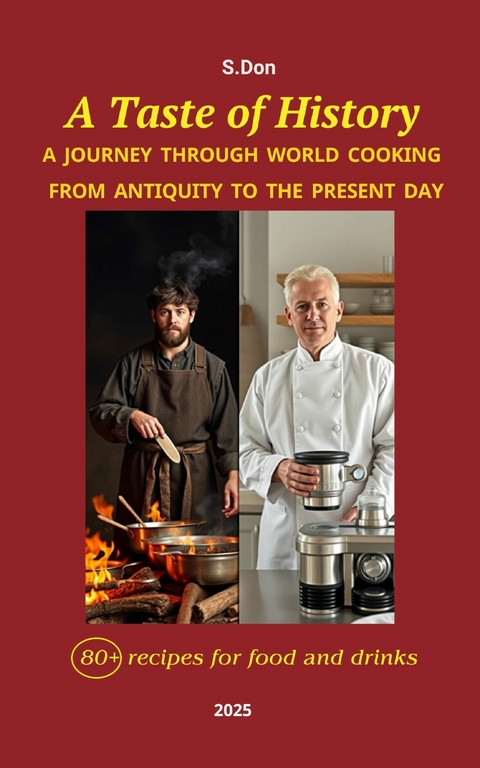
A Taste of History (eBook)
313 Seiten
Publishdrive (Verlag)
978-0-00-096275-1 (ISBN)
Discover the fascinating world of culinary art, inextricably linked with history, culture, creativity, and technological progress.
'A Taste of History' is not so much a collection of recipes, recommendations, and interesting stories as it is a fascinating journey through the evolution of cuisine from ancient civilizations to modern achievements and technologies.
Get acquainted with culinary traditions that have had a profound influence on the formation of culture, art, and human society as a whole at various stages of its development.
Discover the deep historical roots, stretching back thousands of years, of the culinary tools, techniques, and ingredients we use today.
Whether you are a beginner looking to learn the basics of the culinary arts or an experienced chef seeking to broaden your horizons, this book offers:
Practical advice on basic cooking methods and techniques.
Simple and healthy recipes from around the world.
Fascinating stories, myths, and legends associated with famous dishes, chefs, and restaurants.
An understanding of how gastronomy is inextricably linked to human progress.
Through the lens of food, you travel across continents and centuries, discovering the flavors, aromas, cultural and social connections that define our shared culinary heritage.
Enjoy the journey — and let your kitchen become a place of amazing discoveries!
Henry Hargreaves' Culinary Map of India
The following major legumes are grown in India: Lentils (Dal): Masur dal (red), tur dal (yellow), urad dal (black). Mung Dal (Mash): Green and yellow mung beans, used in soups and curries. Chickpea (Chana): Kabuli chana (white) and kala chana (black). Mot Dal: Greenish brown beans, popular in Rajasthan. Lobia: Black-eyed peas. Tur beans: Pigeon beans for curries.Rajma: A red bean popular in North India.
Chili pepper
Meat and fish. Meat and fish dishes are popular in different parts of India, including tandoori, butter chicken.
Milk and yogurt. Indian dishes often contain milk and yogurt, known in India as krysh,
Vegetables and fruits.. Potatoes, pumpkins, broccoli and many other vegetables are widely used in vegetarian dishes. Fruits such as mango and guava are used to make juices and desserts.
A rich selection of vegetarian dishes. Most of India's population is vegetarian and hence vegetarian dishes are an important element of Indian cuisine. For example, dal or paneer (hard cheese made from milk). Diversity unique regional specialties, from North Indian curries to South Indian dosas. Cooking Techniques: Indians use various cooking methods such as frying, stewing, steaming and baking, which makes their dishes varied and delicious.
Vegetarian Dal Soup
Legumes
In Indian cuisine, pulses are a major source of vegetable protein, especially for those following a vegetarian diet. Lentils, mung beans, chickpeas and other species are the main ingredients in popular dishes such as dal, sambhar and chana masala.
Vegetables in Indian Cooking
5.3. European cuisine: Italy, France, Germany.
5.3. 1. France
The pinnacle of culinary art
Known for its exquisite cuisine, France offers a wide variety of cheeses, wines, breads and, of course, the famous oysters. French cuisine is a combination of tradition and innovation, where each ingredient plays its own role.
The defining aspects are:
Sauces: complex, sophisticated, flavorful sauces are a hallmark of French cuisine.
Wine pairing: special attention is paid to the harmonization of dishes with wines served with these dishes.
Regional diversity: from hearty dishes in the southwest to seafood specialties in Provence.
Henry Hargreaves' Culinary Map of France
Regional cuisine reflects the local produce, climate and traditions of different regions of France. Dairy products, apples and seafood are popular in Normandy.
Thanks to the excellent local products, Norman cuisine is renowned for its excellence. Norman Camembert, Livarot, Neufchâtel, Pont-l'Eveque, scallops, oysters, cider, Calvados, Bénédictine liqueur... there is something for every taste.
Oysters of Normandy
y
Cheese from Normandy
Provence— olive oil, herbs and vegetables, cheeses.
The cuisine of Provence is characterized by the use of plenty of seafood, herbs, spices, tomatoes, peppers, eggplant, garlic and olive oil. The famous bouillabaisse soup served with a spicy garlic rouille sauce, aioli, the traditional Nicoise salad, as well as vegetable casseroles and stews originate from this area. Provence is also famous for its cheese and candied fruits. Popular here are sardines, sea bass, sea urchins and octopus, lamb and goat meat; chickpeas. And, of course, wonderful local fruits: grapes, peaches, apricots,
Cuisine of Provence: 10 most popular dishes. Bouillabaisse, Salade Nicoise, Olives, Aioli, Pistou, Pedestals, Ratatouille, Truffles, Daube, Tapenade
Cheeses of Provence
Burgundy. The most famous signature dishes are coq au vin, beef bourguignon, fondue bourguignon, escargot bourguignon, la matelote d'anguille à la bourguignonne (eels stewed in wine sauce) and gougères (cheese puffs).Red Burgundy wines have been considered by some to be among the finest wines since the Middle Ages; they are characterized by delicate tannins and mild flavors.
Burgundy wines
National cuisine It was shaped by the royal court, the aristocracy and famous chefs. It is characterized by the use of expensive and exquisite products, sophisticated cooking methods, elegant presentation and serving. French cuisine includes many delicacies such as snails, frog legs, truffles, foie gras and others.
Frog legs
Truffles
Typical dishes of French cuisine, which have become world classics. These are onion soup, salad niçoise, crème brûlée, croissants, baguette, ratatouille, quiche, bouillabaisse, coq au vin, confit de canard, cassoulet and many others. Cheeses (more than 200 varieties) and wines are the calling card of France.
The splendor of French cuisine
France is Europe's most famous wine-producing region. Wine production in France originated around the 6th century BC during the colonization of southern Gaul by Greek settlers. Soon winemaking began to flourish in the Greek colony near Marseille. In the south, the right to produce wine was granted by the Roman Empire. Modern France is a recognized world leader in wine production and export. More than 50 thousand wineries produce wines on this blessed land, which are in high demand on the international market because of its high quality. Italy (in terms of volume) and Spain (in terms of the scale of land allocated for vineyards) compete with it. The most popular French wines are Bordeaux, Champagne and Burgundy.
Champagne. Originates from the Champagne region of France. Lanson is one of the oldest Champagne houses. Lanson has its own authentic style, which combines bright fruitiness with exceptional freshness. The winery uses the traditional Champenois method (a method of classical fermentation in the bottle) to produce its high quality Champagne wines. It is usually made from three types of grapes: Chardonnay, Pinot Noir and Pinot Meunier. It is one of the most prestigious and expensive sparkling wines.
Crémant: A French sparkling wine produced outside the Champagne region, but using the same method.
France is the historical birthplace of cognac. By the early 17th century, the French had perfected the process of distilling white wines, which led to the creation of cognac spirit. Cognac is a grape brandy produced by double distillation according to strict rules, which are regulated at the legislative level. The strength of cognac cannot be lower than 40%. The base for cognac is grape brogue. About 90% of the grapes used are Fol Blanche, Unyi Blanc, Colombar and 10% are Semillon, Montille, Folignan.
Strict rules are applied to the aging of French cognac: the minimum period is 2 years, and barrels are made of oak grown in the forests of Limousin and Tronce. After the cognac is stored, the warehouses are sealed and access to them is usually restricted to the cellar master, the person who decides whether the spirits are ready for blending or not.
This is how the famous cognac is created, the fame of which quickly spread throughout Europe and the world. Today, there are a huge number of cognac producers - according to the latest estimates, 20 thousand cognac companies are registered in France. Of these, four great cognac houses stand out - Martell, Remy Martin, Hennessy and Courvoisie. It is the products of these brands that make up 80% of all sales of French cognac.
There is an international classification for quality cognacs.
- V.S., aged from two years. Young drinks with a democratic price;
- S.V.O., aged from three years. Budget cognacs;
- S.O.P. - from four years. Alcohol that can be categorized as elite. It has a pale color, because as it ages in barrels, it changes its bright hue to a more muted one;
- V.S.O.P. - from five years. Cognac of the primum category;
- X.O. - From six years and older. An elite drink that can be labeled as Napoleon. Cognacs with a longer maturation period are no longer classified, as they have their own names, which are well known all over the world.
Hennessy is the most famous brand in the world, producing the legendary...
| Erscheint lt. Verlag | 23.5.2025 |
|---|---|
| Sprache | englisch |
| Themenwelt | Sachbuch/Ratgeber ► Essen / Trinken |
| ISBN-10 | 0-00-096275-9 / 0000962759 |
| ISBN-13 | 978-0-00-096275-1 / 9780000962751 |
| Informationen gemäß Produktsicherheitsverordnung (GPSR) | |
| Haben Sie eine Frage zum Produkt? |
 EPUB (Adobe DRM)
Größe: 76,8 MB
Kopierschutz: Adobe-DRM
Adobe-DRM ist ein Kopierschutz, der das eBook vor Mißbrauch schützen soll. Dabei wird das eBook bereits beim Download auf Ihre persönliche Adobe-ID autorisiert. Lesen können Sie das eBook dann nur auf den Geräten, welche ebenfalls auf Ihre Adobe-ID registriert sind.
Details zum Adobe-DRM
Dateiformat: EPUB (Electronic Publication)
EPUB ist ein offener Standard für eBooks und eignet sich besonders zur Darstellung von Belletristik und Sachbüchern. Der Fließtext wird dynamisch an die Display- und Schriftgröße angepasst. Auch für mobile Lesegeräte ist EPUB daher gut geeignet.
Systemvoraussetzungen:
PC/Mac: Mit einem PC oder Mac können Sie dieses eBook lesen. Sie benötigen eine
eReader: Dieses eBook kann mit (fast) allen eBook-Readern gelesen werden. Mit dem amazon-Kindle ist es aber nicht kompatibel.
Smartphone/Tablet: Egal ob Apple oder Android, dieses eBook können Sie lesen. Sie benötigen eine
Geräteliste und zusätzliche Hinweise
Buying eBooks from abroad
For tax law reasons we can sell eBooks just within Germany and Switzerland. Regrettably we cannot fulfill eBook-orders from other countries.
aus dem Bereich