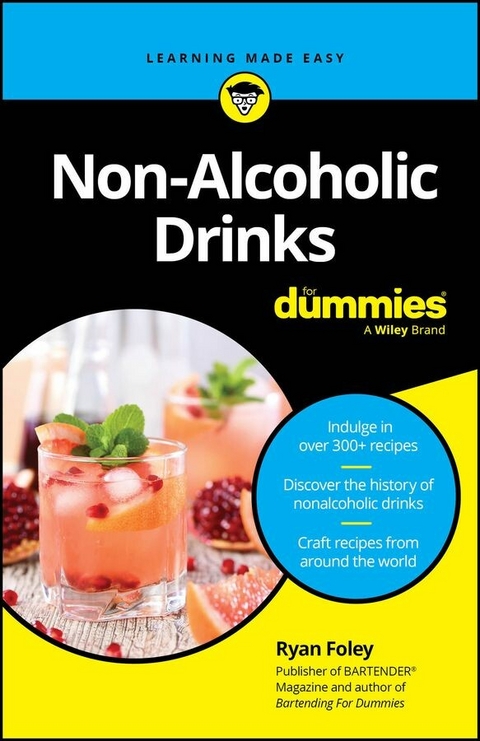
Non-Alcoholic Drinks For Dummies (eBook)
455 Seiten
For Dummies (Verlag)
978-1-394-34093-4 (ISBN)
Quench your thirst for zero-proof drinks
Non-Alcoholic Drinks For Dummies is full of recipes for non-alcoholic libations. With over 300 recipes for the home mixologist, this book is a great place to start learning how to make and serve tasty and satisfying alcohol-free drinks. You'll learn the history of non-alcoholic drinks, great zero-proof brands to try, and important tools and ingredients you'll need to strengthen your mixing skills. Plus, you'll get a handle on the concepts behind flavor profiles and balanced recipes, so you can start inventing your own alcohol-free creations. When you or your guests are looking to imbibe something classy and ethanol-free, Non-Alcoholic Drinks For Dummies is your go-to.
- Discover 300+ non-alcoholic cocktail recipes, plus a breakdown of ingredients and flavor profiles
- Stock up on shakers, mixing tools, glassware, and garnishes to up your mixology game
- Make fun drinks from around the world, and try recipes from famous bars and bartenders
- Enjoy all the fun of cocktail mixing, without all the side effects of alcohol
With Non-Alcoholic Drinks For Dummies, you and your sober-minded friends and family can skip the soda and seltzer water and instead enjoy fancy beverages full of flavor.
Ryan Foley has over a decade of experience working in the hospitality industry, is a longtime hospitality educator, and a supporter of the next generation of bartenders. He is the co-author of Bartending For Dummies and Running a Bar For Dummies.
Chapter 3
Methods to the Madness
IN THIS CHAPTER
Shaking, stirring, and muddling drinks with style
Making infusions and syrups
Coolin’ down with ice
Prepping some great garnishes
Popping the champagne
Making good cocktails takes more effort than just pouring ingredients into a glass. This chapter shows you the techniques for how to make drinks and pull off some of the little touches that make your drinks look and taste better, with the ultimate result of happier guests.
Shaking a Drink
You shake drinks mainly to chill a cocktail, to mix ingredients, or to put a head (froth) on the cocktail.
As a general rule, shake all cloudy drinks (cocktails that include citrus, milk, or cream) and stir all clear drinks. Never shake a cocktail that contains carbonated water or soda — that creates quite the mess!
To shake a cocktail in a Boston shaker (described in Chapter 2), follow these steps:
-
Following the drink recipe, put some ice cubes in the glass container.
Use ice cubes only if the recipe calls for them.
- Add the cocktail ingredients.
- Place the metal container over the glass container.
-
Hold the metal and glass containers together with both hands and shake with an up-and-down motion.
Always point the shaker away from your guests to avoid spilling anything on them if you don’t have the shaker sealed.
The two pieces of the shaker may stick together after you shake a drink. Never bang the shaker against the bar, kitchen counter, or any other surface or object; instead, gently tap it a few times with your palm at the point where the glass and metal containers come in contact to separate them. With the containers separated, now you can pour your cocktail.
When pouring or straining the cocktail, always pour from the glass container because it allows for better control and ensures a clean, professional presentation.
Stirring a Drink
The main reason for stirring cocktails is to mix, chill, and dilute.
As a general rule, stir drinks that contain only clear ingredients since the goal is to combine and chill the ingredients. To stir cocktails, follow these steps:
- Add the cocktail ingredients and ice into the mixing glass.
- Take your bar spoon and insert it into the mixing glass.
- Stir in a circular motion for around 30 to 45 seconds.
-
Use your julep strainer to strain the cocktail into a glass.
You can read about the julep strainer in Chapter 2.
Muddling
Muddling, which involves gently pressing ingredients like herbs, fruits, or sugar, helps release the flavors of fresh ingredients such as fruits and herbs. You often use this technique in making drinks such as a Caipirinha, Mint Julep, Mojito, or Smash.
To muddle a drink, follow these simple steps:
- Add the fresh ingredients into a glass or cocktail shaker.
- Press firmly into the ingredient by using your muddler, and then twist.
-
Repeat Step 2 a few times till you can smell the essences from the herbs or see the juices from the fruit being released.
Do your best to not over muddle, which could crush certain herbs that can release bitter and unpleasant flavors, throwing off the balance of your cocktail.
- Follow the post-muddling part of the recipe that you’re using.
Adding Flavor with Infusions
You can create infusions by soaking something in liquid to extract its flavor. For the liquid, you can use water or non-alcoholic spirits. Simple infusions involve adding in dried herbs or leaves in hot water to make teas or even adding lemon slices to water to make lemon water. Of course, you can do more complex infusions, such as adding in jalapenos to a bottle of non-alcoholic tequila to help create a spicy margarita.
When you create an infusion, allow the mixture to sit for a few hours — or, in some cases, overnight — to help extract the full flavor of whatever you want to infuse.
Making Simple Syrup
Several cocktail recipes call for simple syrup, a liquid sweetener made of sugar and water. To make simple syrup, follow these steps:
-
Boil water on a stove.
How much you boil depends on how much simple syrup you want to make. Use a one-to-one ratio of sugar to boiling water.
- Add the sugar to your boiling water and stir until it dissolves.
-
Turn the stove to low heat, stirring your sugar-water frequently, until it thickens.
You probably don’t have to stir more than a couple of minutes.
You can make a variety of flavored syrups by using the same one-to-one measurements. Add in fresh fruits or herbs to make unique syrups and test them in different cocktails to make your own twist. You can also use a variety of sugar sources, such as agave, demerara sugar, or maple syrup.
Ice, Ice, Baby
Ice is very important in cocktails because it makes the drinks cold and helps to dilute the drinks. Most bars and bartenders use a few types of ice; I explain the most common ones here:
- Standard (1 in. by 1 in.): The most common type of ice; used for almost everything in bartending, such as shaking, stirring, and adding to cocktails.
- Rocks ice: When you hear someone say “on the rocks” or “on one rock” they most likely mean this type of ice. This ice usually comes as a larger square, but it can be a circle as well.
- Crushed Ice: Smaller ice pieces that are ideal for frozen drinks. Pebble and julep ice fall into this category. Bartenders often use this ice in tiki, frozen, and julep cocktails.
You can find all types of ice, in addition to those in the preceding list, such as Collins spears and dry ice. Be very careful when using dry ice in cocktails because coming into direct contact with it can seriously harm a guest, employee, or yourself! Use dry ice only if you have the training on how to use it.
Stepping Up Your Garnish Game
Many drinks require fruit garnishes. Your guests expect the garnish, so you can’t forgo it — and you have to do it well. Presentation counts, big time. You may mix the best drinks on the planet, but if they don’t look good when you serve them, no one wants to drink them. Garnishes also help make the cocktail(s) stand out and look good on social media.
The following sections show you how to cut the most common garnishes.
Lemon and lime wedges
Figure 3-1 illustrates the following steps for cutting wedges:
-
Slice the lemon or lime in half the long way.
Cut from end to end.
- Lay the cut halves flat on a cutting board and halve them again in the same direction.
- Cut wedges from the lemon or lime quarters that you create in Step 2 by cutting perpendicular to your previous cuts, aiming for about ½-inch wide pieces.
Illustration by Elizabeth Kurtzman
FIGURE 3-1: Cutting lemon or lime wedges.
Lemon twists
Figure 3-2 illustrates the procedure for cutting lemon twists. Just follow these steps:
- Cut off both ends of the lemon.
- Insert a sharp knife or spoon between the rind and meat of the lemon and carefully separate them.
- Slice the rind into strips about ¼-inch wide — narrow enough to curl easily, but wide enough to hold their shape.
- Twist the strip around your finger or a bar spoon to make a spiral.
The flavor of a lemon really lies on the outside. When adding a lemon twist to a drink, slowly rim the glass — meaning gently run the outer peel along the edge — with the outside of the twist to release its aromatic oils. (I talk about this process in the section “Rimming a Cocktail Glass” later in this chapter.)
Illustration by Elizabeth Kurtzman
FIGURE 3-2: Cutting lemon twists.
Lime slices
Figure 3-3 shows you how to cut lime slices by following these steps:
- Cut off both ends of the lime.
- Slice the lime in half from end to end.
-
Lay each half flat on the cutting board and cut it into half-moon slices.
These slice cuts are perpendicular to the cut you make in Step 2.
-
Lay each half-moon slice down and cut into the flesh at the fruit’s middle point, being careful to slice only halfway into the wedge.
This small slit holds the garnish in place on the rim of your glass.
FIGURE 3-3: Cutting lime slices.
Lemon and orange slices/wheels
Follow these steps to cut lemon and orange slices (as shown in Figure 3-4):
- Cut off both ends by slicing off a small piece from both the top (stem) and bottom of the fruit to create flat surfaces.
- Place the fruit on one of the flat ends and cut it in half horizontally.
- Lay one half cut-side down on the cutting board. Cut across the fruit to create thin round...
| Erscheint lt. Verlag | 8.7.2025 |
|---|---|
| Sprache | englisch |
| Themenwelt | Sachbuch/Ratgeber ► Essen / Trinken |
| Schlagworte | alcohol-free cocktail recipes • alcohol-free drinks • drink recipes • mixology book • Mocktails • non-alcoholic cocktails • non-alcoholic drink recipes • Non-alcoholic Drinks • non-alcoholic mixology • sober lifestyle • sobriety • zero proof drink recipes • zero proof drinks |
| ISBN-10 | 1-394-34093-1 / 1394340931 |
| ISBN-13 | 978-1-394-34093-4 / 9781394340934 |
| Informationen gemäß Produktsicherheitsverordnung (GPSR) | |
| Haben Sie eine Frage zum Produkt? |
 EPUB (Adobe DRM)
Kopierschutz: Adobe-DRM
Adobe-DRM ist ein Kopierschutz, der das eBook vor Mißbrauch schützen soll. Dabei wird das eBook bereits beim Download auf Ihre persönliche Adobe-ID autorisiert. Lesen können Sie das eBook dann nur auf den Geräten, welche ebenfalls auf Ihre Adobe-ID registriert sind.
Details zum Adobe-DRM
Dateiformat: EPUB (Electronic Publication)
EPUB ist ein offener Standard für eBooks und eignet sich besonders zur Darstellung von Belletristik und Sachbüchern. Der Fließtext wird dynamisch an die Display- und Schriftgröße angepasst. Auch für mobile Lesegeräte ist EPUB daher gut geeignet.
Systemvoraussetzungen:
PC/Mac: Mit einem PC oder Mac können Sie dieses eBook lesen. Sie benötigen eine
eReader: Dieses eBook kann mit (fast) allen eBook-Readern gelesen werden. Mit dem amazon-Kindle ist es aber nicht kompatibel.
Smartphone/Tablet: Egal ob Apple oder Android, dieses eBook können Sie lesen. Sie benötigen eine
Geräteliste und zusätzliche Hinweise
Buying eBooks from abroad
For tax law reasons we can sell eBooks just within Germany and Switzerland. Regrettably we cannot fulfill eBook-orders from other countries.
aus dem Bereich