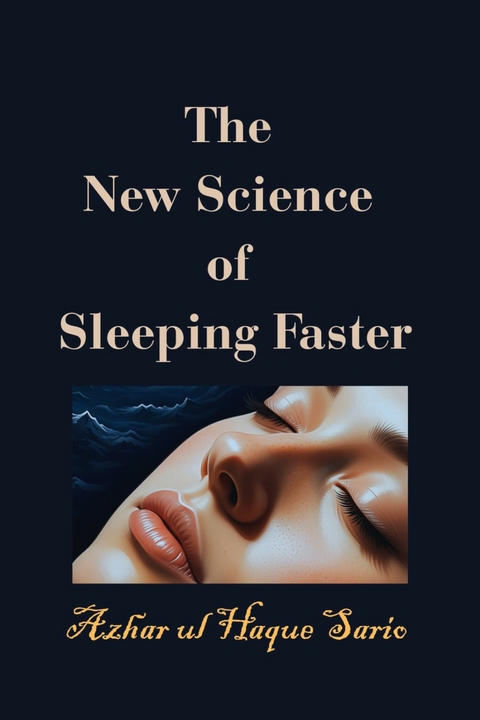
The New Science of Sleeping Faster (eBook)
204 Seiten
Azhar Sario Hungary (Verlag)
978-3-384-64875-4 (ISBN)
Stop fighting your sleepless nights and start outsmarting them.
Let's be honest, the old advice to 'just relax' isn't cutting it. You're lying in bed, your mind racing, watching the clock, and the harder you try to sleep, the more awake you feel. This isn't just a bad night; it's the new normal for millions. The New Science of Sleeping Faster is your definitive guide to breaking this cycle. This book moves beyond recycled sleep hygiene tips to give you a direct look at the engine of your sleep-and the modern forces working against it.
We'll start by deconstructing the #1 reason you're awake: sleep anxiety. You'll learn how our 'always-on' culture, digital habits, and even the pressure to get 'perfect' sleep are rewiring your brain for wakefulness. Then, we dive into the biology. You'll discover the brain's hidden waste-clearance crew, the glymphatic system, which only works when you're in deep sleep, and why a delay in falling asleep is a critical health issue. We'll unravel the secrets of the hypothalamic 'flip-flop switch' that controls your sleep, the surprising influence of your gut bacteria, and how your personal genetics dictate whether you're a lark or an owl.
What's Inside the Book
This book dissects the modern sleep crisis. It explores the rise of performance-based sleep anxiety. You will learn about the neurobiology of sleep disruption. We cover your brain's master sleep switch in the hypothalamus. The book explains the crucial glymphatic system for brain cleaning. The gut-brain connection and its impact on sleep are detailed. You will understand your genetic chronotype. We explore how to interpret data from wearables like Oura and Apple Watch. The guide covers advanced cognitive techniques from CBT-I. It explains Paradoxical Intention and Cognitive Shuffling. You will learn about Mindfulness-Based Therapy for Insomnia. The text details the rise of AI diagnostics and coaching. It reviews new FDA-cleared digital therapeutics like SleepioRx. Finally, it provides a clinician's guide to the latest DORA medications.
Other books offer generic sleep hygiene tips that barely scratch the surface. They tell you what to do but rarely explain the deep biological and psychological reasons why you're struggling. The New Science of Sleeping Faster provides a competitive advantage by translating complex, cutting-edge neuroscience into a practical, personalized action plan. It moves beyond 'turn off your phone' to explain precisely how blue light disrupts melatonin and how to use technology to your advantage. It doesn't just recommend a diet; it explains the science of chrononutrition and macronutrient timing. This book empowers you with a fundamental understanding of your own biology, providing advanced, evidence-based tools that address the root cause of your sleeplessness, not just the symptoms.
Copyright Disclaimer: The author of The New Science of Sleeping Faster is not affiliated, associated, authorized, endorsed by, or in any way officially connected with any of the companies, products, or regulatory bodies mentioned, including but not limited to Apple, Fitbit, Garmin, Oura, WHOOP, Withings, Eight Sleep, DeRUCCI, EnsoData, SleepioRx (Big Health), the U.S. Food and Drug Administration (FDA), or the Centers for Medicare & Medicaid Services (CMS). This work is independently produced. The use of any trade name or trademark is for identification and reference purposes only and does not imply any association with the trademark holder of their product or brand. This is an independent publication produced under nominative fair use.
Part II: The Biological Engine of Sleep
The Hypothalamic Command Center: Unraveling the Neural Circuits of the Sleep/Wake Switch
Once, we imagined our consciousness was a ship without a captain, its journey from the bright shores of wakefulness to the deep oceans of sleep guided by a scattered, bickering crew in the brainstem. For decades, science saw no single hand on the tiller. But history, in its often tragic way, reveals the deepest truths. The ghostly plague of encephalitis lethargica that swept the world in the early 20th century became an unexpected mapmaker for the mind. It was a sickness that stole the very rhythm of life, plunging some into a bottomless sleep and stranding others on the jagged coast of endless, agonizing wakefulness. These poor souls, trapped between states, were a living beacon, illuminating a tiny, powerful region that had been hiding in plain sight: the hypothalamus.
It was a revelation. Sleep and wakefulness weren’t a chaotic drift; they were a deliberate, orchestrated performance. This wasn't a mob; it was a monarchy.
Subsequent explorations, like ventures into an undiscovered country, confirmed it. When researchers gently quieted the front of this kingdom—the anterior hypothalamus and its preoptic area—the kingdom’s subjects lost the very ability to find rest. It was as if the royal lullaby had been silenced, leaving the realm in a state of perpetual, exhausting alertness. But when they nudged the kingdom’s rear guard, the posterior hypothalamus, the opposite occurred: a wave of profound sleepiness washed over, an irresistible drowsiness that blurred the edges of the day. Here, within this small kernel of brain tissue, was a throne room with two distinct edicts: one for light, and one for darkness. The old idea of a scattered network crumbled, and the hypothalamus took its place as the master regulator, the conductor-king of our conscious state.
As our tools became sharper, we moved from viewing the kingdom from a hilltop to walking its very streets, identifying the specific citizens responsible for its nightly peace. We found them in two key districts: the ventrolateral preoptic area (VLPO) and the median preoptic nucleus (MnPN). Here live the "ushers of slumber," the brain's "night watch." These are not ordinary neurons. While we work, play, and worry, they are silent, waiting. But as the day wanes and a heaviness settles in our bones, they awaken. They begin to sing, their chorus rising as we drift into dreamless, non-REM sleep. Their song is a powerful enchantment of inhibition.
Their magic comes in the form of two potent neurotransmitters: GABA, the brain's universal "hush," and galanin, its quietening partner. These are not sent out randomly; they are targeted missiles of tranquility, aimed directly at the brain’s centers of arousal—the roaring forges of wakefulness. They quiet the histamine-pumping tuberomammillary nucleus, the norepinephrine-fueled locus coeruleus, the serotonin-releasing raphe nuclei, and the acetylcholine-producing basal forebrain. These are the brain's "Day Guard," the boisterous, energetic soldiers of alertness, and the night watch of the VLPO and MnPN effectively commands them to stand down.
This relationship is a dramatic and elegant standoff, a biological "flip-flop switch." Think of it as the ultimate changing of the guard. The Day Guard and the Night Watch are mutually exclusive; they cannot both hold power. When the Night Watch is active, it suppresses the Day Guard, and the kingdom of the mind falls into the quiet of sleep. When the Day Guard is active, it silences the Night Watch, and we feel alert and engaged. This is why the transition is so swift. We don't just fade to black; the switch flips. A decision is made. One guard falls, the other rises, and our reality shifts in a heartbeat.
But what gives the order to flip the switch? The hypothalamus, our wise conductor-king, listens to two critical advisors.
The first is the Keeper of the Cosmic Clock, a tiny cluster of cells called the suprachiasmatic nucleus (SCN). The SCN has a direct line to the outside world through our eyes, sensing the sacred rhythm of light and dark. It is the royal astronomer, advising the throne on the appropriate time for sleep and wakefulness, ensuring the kingdom’s schedule is in harmony with the 24-hour cycle of the planet.
The second advisor is the Voice of the People, representing the homeostatic sleep drive. As the kingdom toils through the day, a kind of physical weariness, a chemical called adenosine, accumulates like a fine dust settling over everything. This is our "sleep debt." The rising levels of this dust are a growing petition from the citizens of the body, a plea for rest. The hypothalamus senses this mounting pressure, which lends strength to the Night Watch, making their takeover inevitable. The king is constantly balancing the celestial clock with the growing fatigue of its people.
The clinical importance of this beautifully governed kingdom is profound. When its mechanisms fail, the realm descends into chaos. Damage to the Night Watch in the VLPO can lead to chronic insomnia—a restless kingdom where the Day Guard refuses to cede control. Conversely, in conditions like narcolepsy, a key part of the Day Guard (the orexin neurons) perishes, leaving the throne unstable and prone to sudden, catastrophic collapses into sleep.
Our understanding has journeyed from a vague notion of scattered controls to a deep appreciation for this exquisite, centralized dynasty within our heads. The haunting whispers of an old epidemic led us to a throne room where a delicate, powerful balance is struck every moment of our lives. It is a biological ballet, a nightly coup, and a daily restoration, all masterfully conducted by the small, mighty, and mysterious hypothalamus.
The Midnight Brain: A Tale of Two Cities and the Flip of a Switch
Imagine your mind is a sprawling, vibrant metropolis that never truly sleeps. By day, it's a bustling hub of activity, with thoughts racing like downtown traffic and senses wide open, taking in the world like crowded city squares. This is the City of Wakefulness, a place of bright lights, sharp focus, and endless energy. But even the most vibrant city needs a period of rest and restoration. As twilight descends, a remarkable transformation begins, a quiet and deliberate handover of power to a sister city, the shadowy and tranquil Republic of Sleep.
This transition isn't a slow, gentle fade to black. It's not a dimmer switch gradually lowering the lights of the metropolis. Instead, picture it as the flick of a master switch, a definitive "flip-flop" that plunges the city into a state of quiet repose. This nightly event is orchestrated by a brilliant and elegant biological design, a delicate dance of power between two opposing forces.
The Two Mayors: A Tale of Wakefulness and Slumber
In the heart of this mental metropolis, in the old town hall known as the Hypothalamus, two rival mayors govern the sleep-wake cycle. On one side, you have the formidable "Wakefulness Watchmen," a coalition of brain centers that champion alertness. Think of them as the city's tireless day-shift, constantly pushing for productivity and engagement. Their headquarters include the Tuberomammillary Nucleus (TMN), which floods the city with histamine, the neurotransmitter of sharp focus; the Locus Coeruleus (LC), the source of norepinephrine, our internal alarm system for vigilance and quick reactions; and the Dorsal Raphe Nucleus (DRN), which provides serotonin to keep us aware and processing the world around us. Together, they are a powerful force, ensuring the city is ready for anything the day might bring.
On the other side of the aisle are the "Sleep Architects," the quiet night-shift managers who advocate for rest and repair. Their primary offices are two small but influential districts: the Ventrolateral Preoptic Nucleus (VLPO) and the Median Preoptic Nucleus (MnPN). These are not sleepy, passive neighborhoods; they are hubs of "sleep-active neurons" that come alive as the day winds down. Their power grows with the accumulation of a chemical called adenosine, a kind of "sleep dust" that builds up in the brain the longer we're awake, creating a mounting pressure for slumber. Guided by our internal 24-hour body clock, the circadian rhythm, these Sleep Architects prepare to take control as darkness falls.
The Great Silencer: GABA, the Keeper of the Quiet
The genius of this system lies in a mutually inhibitory relationship – a political seesaw where only one mayor can be in power at a time. When the Wakefulness Watchmen are in charge, they actively suppress the Sleep Architects, and vice versa. This ensures there's no messy, prolonged power struggle, no state of groggy indecision. You are either decisively awake or deeply asleep.
The key to this entire operation, the very messenger who carries out the will of the Sleep Architects, is a remarkable chemical called gamma-aminobutyric acid, or GABA. Think of GABA as the "Great Silencer," the brain's primary "off" switch. When the time is right, the VLPO and MnPN don't just politely ask the Wakefulness Watchmen to stand down; they dispatch a wave of GABA to enforce the transition.
These GABA signals are like a team of stealthy operatives sent to the headquarters of the TMN, LC, and DRN. Upon arrival, GABA doesn't just knock on the door; it expertly cuts the power. It hyperpolarizes the wake-promoting neurons,...
| Erscheint lt. Verlag | 7.7.2025 |
|---|---|
| Sprache | englisch |
| Themenwelt | Sachbuch/Ratgeber ► Gesundheit / Leben / Psychologie |
| Sachbuch/Ratgeber ► Sport ► Fitness / Aerobic / Bodybuilding | |
| Schlagworte | cognitive behavioral therapy for insomnia • gut health for sleep • insomnia treatment • mindfulness for sleep • neuroscience of sleep • sleep anxiety • sleep technology |
| ISBN-10 | 3-384-64875-7 / 3384648757 |
| ISBN-13 | 978-3-384-64875-4 / 9783384648754 |
| Informationen gemäß Produktsicherheitsverordnung (GPSR) | |
| Haben Sie eine Frage zum Produkt? |
 EPUB (Ohne DRM)
Digital Rights Management: ohne DRM
Dieses eBook enthält kein DRM oder Kopierschutz. Eine Weitergabe an Dritte ist jedoch rechtlich nicht zulässig, weil Sie beim Kauf nur die Rechte an der persönlichen Nutzung erwerben.
Dateiformat: EPUB (Electronic Publication)
EPUB ist ein offener Standard für eBooks und eignet sich besonders zur Darstellung von Belletristik und Sachbüchern. Der Fließtext wird dynamisch an die Display- und Schriftgröße angepasst. Auch für mobile Lesegeräte ist EPUB daher gut geeignet.
Systemvoraussetzungen:
PC/Mac: Mit einem PC oder Mac können Sie dieses eBook lesen. Sie benötigen dafür die kostenlose Software Adobe Digital Editions.
eReader: Dieses eBook kann mit (fast) allen eBook-Readern gelesen werden. Mit dem amazon-Kindle ist es aber nicht kompatibel.
Smartphone/Tablet: Egal ob Apple oder Android, dieses eBook können Sie lesen. Sie benötigen dafür eine kostenlose App.
Geräteliste und zusätzliche Hinweise
Buying eBooks from abroad
For tax law reasons we can sell eBooks just within Germany and Switzerland. Regrettably we cannot fulfill eBook-orders from other countries.
aus dem Bereich