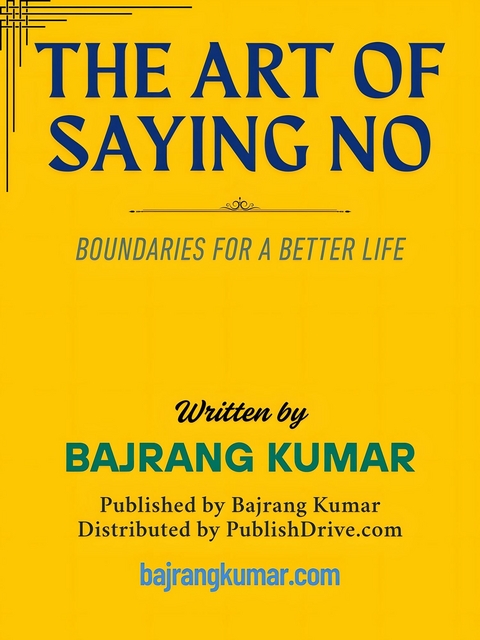
The Art of Saying No (eBook)
95 Seiten
Publishdrive (Verlag)
978-0-00-096006-1 (ISBN)
The art of saying no You should reead it. Transform your life by learning the power of saying no. This comprehensive guide provides practical strategies to break free from people-pleasing patterns and create healthy boundaries that protect your time, energy, and well-being.
CHAPTER 1: THE HIDDEN COST OF ALWAYS SAYING YES
Sarah looked at her calendar and felt a familiar wave of panic. Every slot was filled, color-coded commitments stretching from early morning to late evening. Work meetings, volunteer obligations, social events, family dinners, and committee responsibilities created a patchwork of busyness that left no room for breathing, let alone thinking.
She couldn't remember agreeing to half of these commitments, yet here they were, demanding her time and energy. More troubling, she couldn't identify which ones actually mattered to her. They all seemed to matter to someone else.
Sarah's story is more common than you might think. In our culture that celebrates busyness and equates availability with kindness, many people find themselves trapped in a cycle of over-commitment. They say yes reflexively, almost compulsively, without considering the true cost of their agreement.
But every yes carries a hidden price tag, and the costs compound over time in ways that can fundamentally undermine your well-being, relationships, and effectiveness.
The Time Cost
The most obvious cost of always saying yes is time—the one resource that's truly non-renewable. When you agree to attend a meeting you don't need to be in, volunteer for a project you're not passionate about, or accept a social invitation you don't want, you're not just spending those immediate hours. You're also spending:
Preparation time: Most commitments require advance planning, research, or preparation that extends well beyond the actual event.
Recovery time: Especially for introverts or highly sensitive people, social and professional commitments can be emotionally draining, requiring downtime to recover.
Opportunity cost: Every hour spent on one commitment is an hour not available for something else—including rest, family time, personal interests, or truly important work.
Mental overhead: Even when you're not actively working on a commitment, it occupies mental space. You worry about it, plan for it, and carry the stress of knowing it's coming.
Consider this: if you agree to serve on a committee that meets monthly for two hours, you might think you're committing four hours per month. In reality, you might spend an hour preparing for each meeting, thirty minutes traveling each way, and carry low-level stress about committee responsibilities throughout the month. That two-hour commitment suddenly becomes a six-hour investment with ongoing mental overhead.
The Energy Cost
Time and energy aren't the same thing, although we often treat them as if they were. You can have time available but lack the energy to use it effectively. This is why you can spend an entire weekend "relaxing" yet still feel exhausted on Monday morning.
When you say yes to commitments that don't align with your interests, values, or natural strengths, you don't just spend energy—you drain it. Activities that feel forced or obligatory are energy vampires, leaving you depleted in ways that affect everything else you do.
The energy cost is particularly high when your commitments involve:
Emotional labor: Managing other people's feelings, mediating conflicts, or maintaining relationships that feel one-sided.
Context switching: Jumping between different types of activities, especially when they require different mindsets or skill sets.
Value conflicts: Participating in activities that contradict your personal beliefs or priorities.
Skill mismatches: Taking on responsibilities that don't utilize your strengths or require you to work outside your areas of competence.
The Opportunity Cost
Perhaps the most devastating hidden cost of always saying yes is opportunity cost—the things you miss because your time and energy are already committed elsewhere.
When your calendar is full of obligations you never really wanted, you don't have space for:
Spontaneous opportunities: Last-minute invitations, unexpected chances to connect with people you care about, or spur-of-the-moment experiences that often become our most treasured memories.
Personal development: Time for reading, learning new skills, pursuing hobbies, or engaging in activities that help you grow as a person.
Deep work: Extended periods of focused attention that allow you to make meaningful progress on important projects or goals.
Rest and recovery: The downtime necessary for mental health, creativity, and physical well-being.
Relationship investment: Quality time with the people who matter most to you, building the deep connections that truly enrich life.
The Relationship Cost
Counterintuitively, always saying yes can actually damage your relationships, even though people-pleasers typically say yes because they want to maintain good relationships.
When you agree to commitments you don't want, several problematic dynamics emerge:
Resentment buildup: Over time, you begin to resent the people who make requests of you, even though you're the one choosing to say yes. This resentment can poison relationships, creating distance and tension.
Inauthentic interactions: When you're present but not really engaged, people can sense your lack of genuine enthusiasm. This creates superficial connections rather than meaningful relationships.
Enabling unhealthy patterns: By always being available, you may enable others to become overly dependent on you or to avoid taking responsibility for their own problems.
Boundary confusion: When you never say no, people don't know what you actually want or need. This makes it harder for them to support you effectively.
Burnout effects: When you're constantly exhausted and overwhelmed, you're less able to be fully present and engaged in your important relationships.
The Performance Cost
The quality of your work and contributions suffers when you're overcommitted. This creates a vicious cycle: because your performance in various areas becomes mediocre, you feel compelled to say yes to even more opportunities to "make up for" your lackluster contributions.
Overcommitment leads to:
Divided attention: When you're juggling too many responsibilities, you can't give any of them your full focus.
Deadline pressure: Having too many commitments creates time pressure that forces you to rush through important work.
Decision fatigue: Making constant choices about how to prioritize your overcrowded schedule depletes your mental resources for other decisions.
Stress-induced mistakes: The chronic stress of overcommitment impairs cognitive function, leading to errors and poor judgment.
Reputation damage: Ironically, trying to please everyone by saying yes to everything can damage your reputation when you inevitably can't deliver quality work across all commitments.
The Personal Cost
The most profound cost of always saying yes is the loss of yourself. When your life is filled with other people's priorities, you lose touch with your own. You begin to define yourself by your usefulness to others rather than your own intrinsic worth.
This manifests as:
Identity confusion: You become so focused on meeting others' expectations that you lose sight of your own interests, preferences, and goals.
Decision paralysis: Without practice in honoring your own preferences, you become less confident in making choices that serve your needs.
Chronic stress: The constant pressure of overcommitment creates a state of chronic stress that affects both mental and physical health.
Loss of purpose: When your time is consumed by activities you don't care about, you may feel like your life lacks meaning or direction.
Diminished self-worth: Paradoxically, always trying to please others often leads to feeling unvalued and taken for granted.
The Compound Effect
These costs don't exist in isolation—they compound and amplify each other. When you're exhausted from overcommitment, your relationships suffer. When your relationships are strained, you may feel compelled to say yes to even more requests to repair them. When your performance suffers due to overcommitment, you may take on additional responsibilities to prove your worth.
Breaking this cycle requires recognizing that saying no isn't selfish—it's strategic. It's about making conscious choices about how to invest your finite resources of time and energy.
The Hidden Benefits of Strategic No's
When you begin to say no strategically, you unlock benefits that extend far beyond simply having more time:
Increased quality: With fewer commitments, you can give your remaining obligations the attention they deserve.
Enhanced reputation: People begin to see you as someone who honors their commitments rather than someone who's always overwhelmed.
Improved relationships: By being more selective about your commitments, you can be more present and engaged in the ones you keep.
Greater opportunities: When you're not overcommitted, you have the flexibility to say yes to truly exciting opportunities when they arise.
Better health: Reduced stress and proper rest...
| Erscheint lt. Verlag | 12.6.2025 |
|---|---|
| Sprache | englisch |
| Themenwelt | Sachbuch/Ratgeber ► Gesundheit / Leben / Psychologie ► Lebenshilfe / Lebensführung |
| ISBN-10 | 0-00-096006-3 / 0000960063 |
| ISBN-13 | 978-0-00-096006-1 / 9780000960061 |
| Informationen gemäß Produktsicherheitsverordnung (GPSR) | |
| Haben Sie eine Frage zum Produkt? |
 EPUB (Adobe DRM)
Größe: 253 KB
Kopierschutz: Adobe-DRM
Adobe-DRM ist ein Kopierschutz, der das eBook vor Mißbrauch schützen soll. Dabei wird das eBook bereits beim Download auf Ihre persönliche Adobe-ID autorisiert. Lesen können Sie das eBook dann nur auf den Geräten, welche ebenfalls auf Ihre Adobe-ID registriert sind.
Details zum Adobe-DRM
Dateiformat: EPUB (Electronic Publication)
EPUB ist ein offener Standard für eBooks und eignet sich besonders zur Darstellung von Belletristik und Sachbüchern. Der Fließtext wird dynamisch an die Display- und Schriftgröße angepasst. Auch für mobile Lesegeräte ist EPUB daher gut geeignet.
Systemvoraussetzungen:
PC/Mac: Mit einem PC oder Mac können Sie dieses eBook lesen. Sie benötigen eine
eReader: Dieses eBook kann mit (fast) allen eBook-Readern gelesen werden. Mit dem amazon-Kindle ist es aber nicht kompatibel.
Smartphone/Tablet: Egal ob Apple oder Android, dieses eBook können Sie lesen. Sie benötigen eine
Geräteliste und zusätzliche Hinweise
Buying eBooks from abroad
For tax law reasons we can sell eBooks just within Germany and Switzerland. Regrettably we cannot fulfill eBook-orders from other countries.
aus dem Bereich