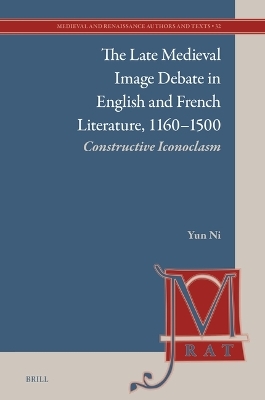
The Late Medieval Image Debate in English and French Literature, 1160–1500
Brill (Verlag)
978-90-04-74580-3 (ISBN)
Early modern reformers claimed to reject a superstitious, image-obsessed medieval past—but what if medieval thinkers had already begun to critique sacred images? This book reveals how late medieval literature reimagined breaking images as radical creation, not destruction. Step into the world of Arthurian legends, The Romance of the Rose, and saints’ lives, where shattered statues and broken relics generate new meaning. Explore the writings of Chaucer and Julian of Norwich, who grapple with divine truth not by preserving images, but by dismantling and remaking them. This book uncovers a literary self that is dynamic, assertive, and subversive centuries before the Renaissance claims to invent it.
Yun Ni, Ph.D. (2019), Harvard University, is currently an assistant professor of English at Peking University. Her research focuses on medieval English literature, political thought, and intellectual history.
Acknowledgements
Introduction
Part 1 Political Iconoclasm: Sainthood and Kingship
1 “The King’s Two Bodies” in Light of Twelfth-Century Neo-Platonism and Political Theory
1 “The King’s Two Bodies” and Twelfth-Century Political Theory
2 “The Queen’s Two Bodies” in Twelfth-Century Realpolitik
3 The Two Bodies Theory and Twelfth-Century Neo-Platonism
2 The Queen’s Two Bodies in Clemence of Barking’s Vie de Sainte Catherine
1 Introduction
2 The Sacred and the Secular in the Vie
3 The Vie in Sacred History: Thomas Becket and Catherine in Christ-Centered and Law-Centered Kingship
4 Torture and Separation of the Queen’s Two Bodies
5 Afterlife and Union of Bodies in Christ-Centered Rule
6 Conclusion
3 The Mutilated Two Bodies in Chrétien de Troyes’s Cligès
1 Introduction
2 The Queen’s Illusory Dynastic Body
3 Torture and the Merging of the Queen’s “Two” Bodies
4 Euhemerism and Idolatry: Semiotics of Entombment and Reliquary
5 Exhuming Fenice, Translating Relics
6 The King’s Body Idolized and Rendered Divine
7 The Vie and Cligès Compared
8 Conclusion
Part 2 Psychological Iconoclasm: Negative Theology and Interiority
4 Idols and Phantasms in Thirteenth- and Fourteenth-Century Philosophical Thought and Negative Theology
1 Phantasms as Idols of the Mind in Negative Theology
2 Aristotelian Fantasie in Thirteenth-Century Scholastic Thought
3 Rethinking Platonic Form and Matter with Aristotle
5 Form and Matter in Le Roman de la Rose
1 Introduction
2 Form and Matter in the Rose
3 Guillaume de Lorris, the Constructor of Idols: Enclosure and Symmetry
4 Jean de Meun’s Iconoclasm: Rewriting Narcissus’s Fountain
5 Pygmalion and Narcissus Are Alike
6 The Sack of the Castle and the Plucking of the Rose
7 Conclusion
6 “Gafe Me Space and Time to Behalde It”: Images and Words in Julian of Norwich’s A Revelation of Love
1 Introduction
2 The Apophatic, the Affective, and the Ascetic in Julian’s Intellectual Context
3 God’s Absolute Presence and Necessary Absence (Revelations 1–4)
4 Competition between Words and Images (Revelations 5–9)
5 Christ’s Infinite Body (Revelations 10–12)
6 Hermeneutics of the Flesh: Spatiality in the Lord-and-Servant Parable
7 Mutual Enclosure and Continuous Creation
8 God outside the Mutual Enclosure
9 Conclusion
Part 3 Cultic Iconoclasm: the “Body” of Christ
7 The Wycliffite Ideology of “Looking”
1 Words against Images: the Wycliffite Bible Translation
2 John Wycliffe against Himself: Tractatus de mandatis divinis
3 Transubstantiation, Consubstantiation, and the Lollards
4 Arundel’s Constitutions and Censorship
8 Iconography, Idolatry, and Iconoclasm in Geoffrey Chaucer’s “The Man of Law’s Tale” and “The Second Nun’s Tale”
1 Introduction
2 Idolatry under Control: “The Second Nun’s Tale”
3 The Iconographic Custance: from a Potential Idol to the Living Image of Christ
4 God’s Disembodied Hand as an Anti-Image
5 Custance and Cecilia Compared: the Living Image vs. the Dead Saint
6 Conclusion
9 Christ’s Real Presence: Signs and Referents in The Croxton Play of the Sacrament
1 Introduction
2 Sacrament and Theatre, Jews and Lollards, in the Croxton Play
3 Host Desecration: Negating the Real Presence of God
4 Unregulated Ritual and Unrestrained Divinity
5 Iconoclasm against the Arch-Image Reconsidered
6 Seeing, Believing, and Clerical Surveillance
7 Conclusion
Conclusion
Bibliography
Index
| Erscheinungsdatum | 21.10.2025 |
|---|---|
| Reihe/Serie | Medieval and Renaissance Authors and Texts ; 32 |
| Verlagsort | Leiden |
| Sprache | englisch |
| Maße | 155 x 235 mm |
| Gewicht | 577 g |
| Themenwelt | Literatur ► Biografien / Erfahrungsberichte |
| Sachbuch/Ratgeber ► Geschichte / Politik | |
| Geschichte ► Allgemeine Geschichte ► Mittelalter | |
| Geisteswissenschaften ► Geschichte ► Regional- / Ländergeschichte | |
| Geisteswissenschaften ► Sprach- / Literaturwissenschaft ► Anglistik / Amerikanistik | |
| Geisteswissenschaften ► Sprach- / Literaturwissenschaft ► Literaturwissenschaft | |
| ISBN-10 | 90-04-74580-7 / 9004745807 |
| ISBN-13 | 978-90-04-74580-3 / 9789004745803 |
| Zustand | Neuware |
| Informationen gemäß Produktsicherheitsverordnung (GPSR) | |
| Haben Sie eine Frage zum Produkt? |
aus dem Bereich