


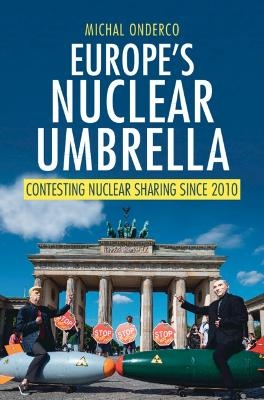
Europe's Nuclear Umbrella
Contesting Nuclear Sharing Since 2010
Seiten
2026
Cambridge University Press (Verlag)
978-1-009-69867-2 (ISBN)
Cambridge University Press (Verlag)
978-1-009-69867-2 (ISBN)
Explores domestic opposition to NATO's nuclear sharing since 2010, offering the first comparative analysis of this contestation. Michal Onderco introduces a new theory explaining how policy elites navigate the tension between public demands and their own views of responsible nuclear policy.
Since the mid-2010s, the collapse of key arms control treaties between great powers has unravelled the post–Cold War security architecture in Europe, heightening nuclear risks to Europe. At the same time, a fresh movement emerged, calling for the total abolition of nuclear weapons, due to their catastrophic humanitarian consequences. European policy-makers found themselves between a rock and a hard place – between the global strategic conundrum calling for growing attention to nuclear deterrence, and domestic audiences demanding just the opposite. Europe's Nuclear Umbrella is about how they navigated this balance. Building on combined insights from public administration, comparative politics, foreign policy analysis, and international relations, Michal Onderco offers a novel theory which reflects the complexity of democratic foreign policy-making in the twenty-first century.
Since the mid-2010s, the collapse of key arms control treaties between great powers has unravelled the post–Cold War security architecture in Europe, heightening nuclear risks to Europe. At the same time, a fresh movement emerged, calling for the total abolition of nuclear weapons, due to their catastrophic humanitarian consequences. European policy-makers found themselves between a rock and a hard place – between the global strategic conundrum calling for growing attention to nuclear deterrence, and domestic audiences demanding just the opposite. Europe's Nuclear Umbrella is about how they navigated this balance. Building on combined insights from public administration, comparative politics, foreign policy analysis, and international relations, Michal Onderco offers a novel theory which reflects the complexity of democratic foreign policy-making in the twenty-first century.
Michal Onderco is Professor of International Relations at Erasmus University Rotterdam, and an affiliate at Charles University, Prague. His research focuses on domestic roots of foreign policy, and politics of nuclear weapons in Europe and globally. He is the author of Networked Nonproliferation (2021) and Iran's Nuclear Programme and Global South (2015).
Introduction; 1. A (very) brief history of nuclear sharing; 2. Technocratic responsiveness and nuclear sharing; 3. Public opinion; 4. Political parties; 5. Civil society; 6. Allies; 7. Elites; 8. Conclusion.
| Erscheinungsdatum | 23.12.2025 |
|---|---|
| Zusatzinfo | Worked examples or Exercises |
| Verlagsort | Cambridge |
| Sprache | englisch |
| Gewicht | 513 g |
| Themenwelt | Natur / Technik ► Fahrzeuge / Flugzeuge / Schiffe ► Militärfahrzeuge / -flugzeuge / -schiffe |
| Sozialwissenschaften ► Politik / Verwaltung ► Europäische / Internationale Politik | |
| Sozialwissenschaften ► Politik / Verwaltung ► Staat / Verwaltung | |
| ISBN-10 | 1-009-69867-2 / 1009698672 |
| ISBN-13 | 978-1-009-69867-2 / 9781009698672 |
| Zustand | Neuware |
| Informationen gemäß Produktsicherheitsverordnung (GPSR) | |
| Haben Sie eine Frage zum Produkt? |
Mehr entdecken
aus dem Bereich
aus dem Bereich
von der frühen Neuzeit bis ins Computerzeitalter
Buch | Hardcover (2025)
De Gruyter (Verlag)
CHF 83,90
rockets, missiles, and drones as instruments of fear and coercion
Buch | Softcover (2025)
Oxford University Press Inc (Verlag)
CHF 34,90


