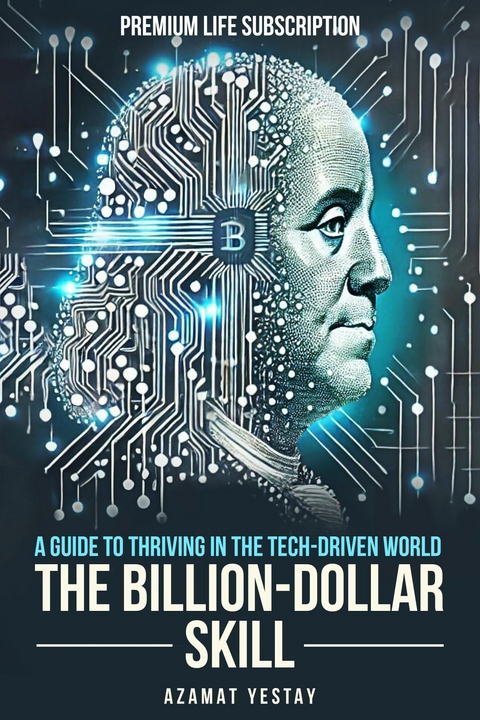
The Billion-Dollar Skill (eBook)
350 Seiten
Azamat Yestayev (Verlag)
978-0-00-080271-2 (ISBN)
In today's tech-driven world, success depends on your ability to adapt and leverage digital tools effectively. 'The Billion-Dollar Skill: A Guide to Thriving in the Tech-Driven World' is a practical roadmap for turning your expertise into real income using modern technology. Its primary goal is to simplify the use of technology by offering tools and step-by-step guidance that help you turn your professional knowledge into tangible income.
At its core, the book introduces the Billion-Dollar Skill-a structured approach to simplifying technology and applying it to your domain expertise. Whether you're an entrepreneur, a professional, or someone looking to gain more control over your career, this guide provides clear, actionable steps to help you stay competitive in the digital economy.
Whether you're an entrepreneur, a professional, or someone ready to take control of your future, 'The Billion-Dollar Skill' offers actionable insights, cutting-edge strategies, and transformative tools to help you thrive in a world shaped by technology.
You'll learn how to:
Turn your ideas into profitable projects without needing a large team or technical background;
Build a personal brand, market your skills, and create sustainable income streams;
Use AI, automation, and no-code platforms to streamline work and improve efficiency.
This book isn't about vague motivation-it's a hands-on guide to making technology work for you. If you're ready to take practical steps toward career growth and financial independence, The Billion-Dollar Skill will show you how.
Success isn't reserved for a select few - it's within reach for anyone willing to take the first step. Your future is waiting. The only question is: will you take the leap?
Chapter 1. In the Beginning Was the Word

Even if you're not familiar with this opening line from the Christian Holy Scriptures, or the fact that the very first revelation to the Prophet of Islam was the word: ‘‘Read!’’ — the weight and significance of these words are immense. There's something profound and mysterious hidden within them, something both elusive and filled with meaning.
It seems we've lost touch with the significance of words, somehow elevating technological achievements above the importance of the meanings they carry. There was a time when the word was the driving force behind scientific progress, valued more than any contract.
Today, in our digital era, we often overlook the fact that ChatGPT and any other artificial intelligence are, at their core, about words — they are nothing more than text prompts. It's people, not robots, who create text and imbue it with meaning. We forget that code in development is primarily a language before it's programming. Information Technology is, above all, text — a description of how we model system behaviors, user tasks, and turn all of that into tangible results.
The IT industry advances thanks to millions of people who, even before the internet, were creating and continue to create processes, crafting new meanings, laws, jobs, and so much more. That's how it was, and that's how it will always be.
Before creating anything, we need to design it. An idea must be described and modeled. The technical execution is a secondary step — implementing the idea according to the outlined requirements. Let me offer a couple of analogies:
- Before sowing a seed, you need fundamental knowledge about how to grow it. Only then do you seek labor, engineers, and acquire or rent equipment. All of this is the organizational part of the process.
- Before extracting oil, you need to find it. Bringing oil to the surface requires knowledge of extraction methods, technology, equipment, and transportation.
In essence, I'm highlighting that modern technologies are often presented to us as more complicated than they truly are. It's time to wake up and return to the basics. People have lost faith in the fact that they are the ones who make history — not someone else.
The skill you'll learn about in this book is reminiscent of playing with Lego® bricks. The examples you'll see will amaze you with their simplicity and logic. If you've never tried building houses out of toy building blocks, this book will give you that opportunity. Imagine that each Lego® brick is a noun — a fundamental part of speech that names a person, place, or thing, answering the questions ‘who' or ‘what?’ I'm sure you remember this from school. If this concept was easy for you as a child, it won't pose any problems now.
We're going to deconstruct complex ideas into simple, understandable components. Just like building with Lego®, where each brick connects to another to create something magnificent, you'll learn how to piece together concepts to build systems, processes, and products.
This approach demystifies technology and returns the power to you. You'll realize that the barriers to entry in the tech world are not as insurmountable as they seem. It's not about knowing every programming language or mastering every new tool — it's about understanding the foundational building blocks and how to assemble them.
By the end of this journey, you'll see that creating with technology is not reserved for an elite few. It's accessible to anyone willing to understand the basics and apply them creatively. So let's pick up those Lego® bricks and start building your future, one piece at a time.
We often rely on results created by others, rather than building our own. But it doesn't have to be this way.
Today, it’s crucial to realize that seemingly complex things are often only intimidating at first glance. They can be broken down and explained through fundamental principles — a structured approach to thinking that relies on modeling meanings using text, visual elements, and clear diagrams, without delving into numbers, code, or complex mathematics.
By understanding a single, simple concept, you will learn to decompose (break things into manageable components), model, document, and automate (transform into systems).
The skill we will discuss in this book lies at the foundation of all technologies. We will examine it in the context of information technology (IT) because this industry is the most integrated into our daily lives. While we could explore foundational disciplines like biology, space exploration, or food production, IT remains the most accessible and relatable discipline, second only to jurisprudence in its ubiquity and utility.
For centuries, jurisprudence stood as one of humanity’s greatest achievements. Laws and legal frameworks maintained order and fairness, governing relationships between individuals and states. They provided the foundation for civilized coexistence, resolving conflicts, protecting rights, and setting standards of behavior. With the advent of information technology, humanity has gained the ability to enhance these societal relationships, automating and refining processes for greater efficiency and equity.
Laws have always played a pivotal role in establishing societal order and justice. Historical examples like the Code of Hammurabi in Babylon, Roman law, and the Magna Carta in England showcase humanity's efforts to codify rules that regulate life and interactions. These legal frameworks laid the groundwork for functioning societies, fostering fairness and facilitating social and economic growth.
Take, for example, labor laws. Regulations governing labor relations establish minimum standards for working conditions — such as maximum work hours, minimum wages, and vacation rights. These laws protect workers from exploitation while ensuring fairness in the workplace. By defining rights and responsibilities, labor laws build trust and productivity, creating environments where both employers and employees thrive.
When we consider these principles in conjunction with technology, the implications become even more profound. Imagine laws and policies not only written but also implemented and upheld through IT systems. This convergence of legal traditions with technological advancements ushers in a new era — one where processes are not only more efficient but also more equitable and accessible to everyone.
With IT’s ability to automate repetitive tasks, enhance transparency, and optimize systems, it becomes clear that these technologies are not just tools but extensions of the fundamental frameworks of human interaction. They enable us to build better societies, enhance economic stability, and ensure fair treatment for all — echoing the principles that have guided humanity for millennia.
Public Sector Automation
Automation has revolutionized both business and public administration, streamlining operations and making processes more transparent and efficient. Let’s delve into how these transformations occur and why they’re so impactful.
In the business world, automation tools like ‘ERP (Enterprise Resource Planning)’, ‘CRM (Customer Relationship Management)’, and automated accounting systems have fundamentally changed how companies operate. These tools take over routine tasks, improve customer interactions, and enhance operational efficiency.
For example, a large retail chain might use an automated inventory management system. This system tracks stock levels in real time and automatically places orders with suppliers when inventory reaches a predefined threshold. Such automation ensures products are always available, optimizes procurement, reduces manual errors, and ultimately leads to higher customer satisfaction and increased profitability.
Another accessible example of systemization and automation is traffic regulation. Traffic laws, essentially a set of textual rules, govern how road users behave. These rules encompass everything from speed limits to vehicle safety standards and penalties for violations. By providing clear guidelines, these laws ensure order on the roads, prevent accidents, and promote safety for all users.
Modern technology has further improved these systems. Automated traffic cameras now monitor compliance with traffic laws, record violations, and process penalties without human intervention. This automation increases enforcement efficiency, reduces human bias, and enhances the transparency of the system.
In the realm of public administration, countries like Estonia have set a global benchmark with their highly digitized government services. In Estonia, nearly all government services are available online. Citizens can:
- Vote in elections.
- Register companies and manage their legal documents.
- File taxes in just minutes.
- Register births and other vital records.
- Apply for permits and licenses.
- Access healthcare services, such as e-prescriptions.
The e-Justice system in Estonia allows citizens to file lawsuits, monitor case progress, and receive court decisions online. Automation extends even to traffic enforcement, where surveillance systems detect violations and issue fines automatically. These systems save administrative costs, accelerate service delivery, and make processes more transparent and accessible.
Estonia is not alone in leveraging automation for public services. Countries like Kazakhstan and South Korea have implemented e-Gov platforms offering a wide range of online services. From issuing passports to filing tax returns, these platforms empower citizens by simplifying their interactions with government...
| Erscheint lt. Verlag | 21.3.2025 |
|---|---|
| Übersetzer | Azamat Yestay |
| Sprache | englisch |
| Themenwelt | Sachbuch/Ratgeber ► Beruf / Finanzen / Recht / Wirtschaft ► Bewerbung / Karriere |
| ISBN-10 | 0-00-080271-9 / 0000802719 |
| ISBN-13 | 978-0-00-080271-2 / 9780000802712 |
| Informationen gemäß Produktsicherheitsverordnung (GPSR) | |
| Haben Sie eine Frage zum Produkt? |
 EPUB (Adobe DRM)
Größe: 8,3 MB
Kopierschutz: Adobe-DRM
Adobe-DRM ist ein Kopierschutz, der das eBook vor Mißbrauch schützen soll. Dabei wird das eBook bereits beim Download auf Ihre persönliche Adobe-ID autorisiert. Lesen können Sie das eBook dann nur auf den Geräten, welche ebenfalls auf Ihre Adobe-ID registriert sind.
Details zum Adobe-DRM
Dateiformat: EPUB (Electronic Publication)
EPUB ist ein offener Standard für eBooks und eignet sich besonders zur Darstellung von Belletristik und Sachbüchern. Der Fließtext wird dynamisch an die Display- und Schriftgröße angepasst. Auch für mobile Lesegeräte ist EPUB daher gut geeignet.
Systemvoraussetzungen:
PC/Mac: Mit einem PC oder Mac können Sie dieses eBook lesen. Sie benötigen eine
eReader: Dieses eBook kann mit (fast) allen eBook-Readern gelesen werden. Mit dem amazon-Kindle ist es aber nicht kompatibel.
Smartphone/Tablet: Egal ob Apple oder Android, dieses eBook können Sie lesen. Sie benötigen eine
Geräteliste und zusätzliche Hinweise
Buying eBooks from abroad
For tax law reasons we can sell eBooks just within Germany and Switzerland. Regrettably we cannot fulfill eBook-orders from other countries.
aus dem Bereich