


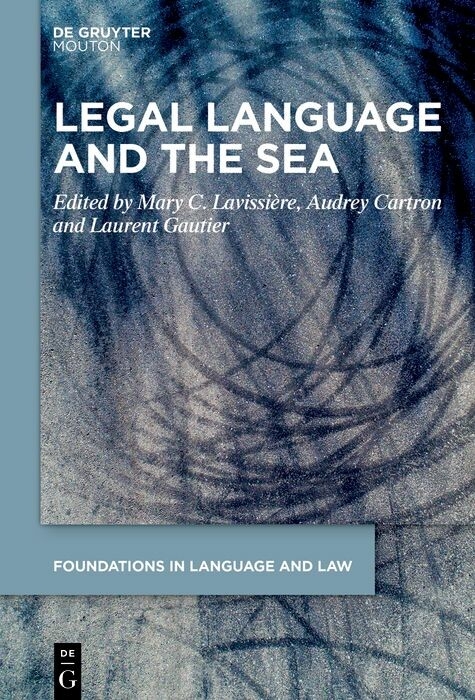
Legal Language and the Sea (eBook)
240 Seiten
De Gruyter (Verlag)
978-3-11-133262-8 (ISBN)
While maritime law and law of the sea are highly-researched domains of law, there are few studies about the language associated with these fields. In a global society that is increasingly impacted by environmental, health, social, humanitarian, and political crises that partly unfold on the sea, this volume unites legal scholars and linguists who work on the language of these fields. The book includes chapters that focus on macro levels of linguistic analyses (e.g., discourse and genre analysis) and micro levels (e.g., terminology) as well as translation. Several languages for maritime legal purposes are studied, including English, French, and Chinese.
Towards an integration of law and linguistics into the blue humanities
1 Language and law in ocean contexts – a maritime linguist’s perspective
This volume represents an effort to unite scholarly work at the intersection of linguistics, maritime law, and the law of the sea. It also aims to be a first step towards integrating law and legal linguistics into what have been called the blue humanities or coastal studies. In his seminal introduction to the field, Mentz (2023: 17) describes these fields as comprising “a current of scholarly and artistic discourses that foreground human relationships with water in all its forms”. As an essential resource for sustaining life, water is one of the most ancient objects represented by language and regulated by customs and law. This volume focuses on specialized language, legal language, and the relationships it creates with sea water, its life forms, and human maritime activities.
In his essay for the National Endowment for the Humanities, Gillis (2013) points out that the sea was long represented in the context of human activities such as fishing, trade, and travel where the “focus was almost entirely on the ships and the skills of the men who manned them, with the sea itself almost as afterthought” (Gillis 2013). Alternatively, the sea itself was represented as an “unfathomable abyss, impenetrable and unknowable, a dark dead zone that trapped all that sank below the surface” (Gillis 2013). This representation changed in the eighteenth century, when the widespread representation of “the sea as a place of work” gave way to Western artistic and literary representations of the sea as a place of leisure and well-being. The relationship and representation of humans and water also became an object for academic study. Gillis (2013) traces interest in the sea in the fields of history, geography, literature, archaeology, anthropology, as well as the life and earth sciences. Recent scholarly work also underlines the need to integrate non-Western artists, writers, and scholars who work on blue humanities (Mentz 2023), often in cultures with a historically intimate relationship to the sea.
Reading through Mentz’s chapter, which retraces the path of how blue humanities scholars created an academic community, the disciplines of law and linguistics are strangely missing. The works referenced are almost exclusively literary and artistic. Similarly, in the blue humanities bibliography curated by Schaumberg and Maas (2024), no works in law or in linguistics are cited. Yet, we would argue, to fully understand the dynamics of the relationship between humans and earthly forms of water, blue humanities must have a broader base than literary and historical works. The study of the sea and other forms of water includes social sciences that go beyond literature, geography, and history. Here we make the case for the importance of law and linguistics in blue humanities, specifically the intersection of these fields in our focus on legal language.
Legal language and its evolution seem essential to understanding the relationship between the sea and humans. This is perhaps because the English-speaking world represents law as relatively distant from the academic fields of literature and history. Not all academic traditions isolate law in this way. In France, home to the three editors of this collective volume, law is firmly placed in the domain of the social sciences and is seen as a near cousin to the humanities. Through this volume, we undertake the formal entry of legal linguistics into water and ocean research, taking up Mentz’s own agenda for blue humanities: “[…] the project of expanding the discourse beyond the Atlantic, beyond the traditional canon, beyond English, beyond literature as such – seems exactly what the blue humanities should be undertaking in the 2020s” (Mentz 2023: 31).
Beyond Mentz’s agenda for the blue humanities, a central place for studies of law and legal language in relation to the sea is supported by the long history of maritime law and the law of the sea. Indeed, legal sources may be some of the earliest discursive representations of human relationships with ocean and ocean environments. Many scholars of maritime law focus on the influence of ancient Greek city-states on the creation of early codes of law applied to maritime trade. Evidence of maritime trade in non-Western regions, however, points to much earlier maritime exchanges. In his effort to reintegrate non-European regions into the history of maritime law, Anand (1983) cites evidence dating from 600 B.C. for trade between the port of Gujarat in what is now India and ancient Babylon. The author highlights the creation of the board of admiralty during the reign of Chandragupta Maurya (321–291 B.C.) as well as a chapter of the Arthasastra dedicated to shipping and other maritime commercial matters (Anand 1983). Anand (1983) also traces the early trade relationships among what are now India, Indonesia, and China, highlighting the fact that the legal doctrines of freedom of navigation and commerce are not essentially Western concepts, but are also present in Eastern law and history since ancient times. In other words, in both Western and Eastern cultures, legal discourse about the sea witnesses to the evolving relationship of humans and the oceans.
2 Language in maritime law – a maritime lawyer’s perspective
In addition to the importance of the integration of legal documents into the effort to better understand the historical and current relationship between humans and the sea, there are applied aspects to the study of maritime law and the law of the sea from a language perspective. Water is a meeting place for cultures. This is especially true of the ocean. Domains of law that deal with ocean water are inherently multilingual and call for translation and comparison across legal systems. In the following paragraphs, we offer some examples from the experience of a practicing lawyer in maritime law in France, particularly in reference to the work of the Comité Maritime International (CMI – International Maritime Commission), which was founded in 1897.
2.1 The CMI: A brief history
The CMI’s purpose is to promote the uniformity of maritime law. It is a non-governmental not-for-profit international organization established in Antwerp in 1897, whose object is to contribute, by all appropriate means and activities, to the unification of maritime law in all its aspects (Comité Maritime International 2018). The CMI is incorporated in Belgium as an association internationale sans but lucratif (AISBL – nonprofit group with an international focus) and national maritime law associations are members, such as the Association Française du Droit Maritime (AFDM – French Maritime Law Association). Many of the most important treaties related to maritime law were first drafted and discussed at CMI conferences. The work of the CMI is also a work of compromise between common law and civil law.
Total uniformity in maritime law is difficult to achieve, however. International treaties, once adopted, have to be interpreted by national judges, leading to different approaches that are sometimes amplified by differences in wording between the French and the English versions of the conventions. In addition, shipping has also changed substantially since most of the conventions came into force. This means that some of the terms used to reflect the reality of the shipping economy in the 1950s are no longer adapted to modern shipping. How can courts cope with this? How can a convention adopted some 50 years ago be interpreted using modern shipping concepts? The examples below seek to explore how the wording of a convention influences the law and how the initial meaning of a legal term might cause unanticipated situations at the time of the drafting of an international treaty or convention.
All the conventions proposed by the CMI were drafted in French and English, both official languages of the CMI. The conventions are applied in many countries, even outside Europe, and some uniformity is achieved through their rules. However, the conventions are also a compromise between two systems: common law and civil law. National interpretations of the conventions may be different, and this can be amplified according to whether it is the English or French version of the conventions that is interpreted, as the two examples below illustrate.
2.2 Is a “maritime claim” the same as a “créance maritime”?
As mentioned above, different interpretations may stem from the English and French versions of the 1952 International Convention Relating to the Arrest of Sea-Going Ships (1952). In general, an English-speaking country will refer to the English text and a French-speaking country to the French version. However, the terms in each version may lead to different interpretations. This is the case of “maritime claim” (English) and...
| Erscheint lt. Verlag | 15.8.2025 |
|---|---|
| Reihe/Serie | Foundations in Language and Law [FLL] |
| Zusatzinfo | 3 b/w and 1 col. ill., 17 b/w tbl. |
| Sprache | englisch |
| Themenwelt | Sachbuch/Ratgeber ► Gesundheit / Leben / Psychologie |
| Geisteswissenschaften ► Sprach- / Literaturwissenschaft ► Anglistik / Amerikanistik | |
| Geisteswissenschaften ► Sprach- / Literaturwissenschaft ► Sprachwissenschaft | |
| Sozialwissenschaften ► Politik / Verwaltung | |
| Technik | |
| Schlagworte | Discourse analysis • Diskursanalyse • Fachsprache • Language for Specific Purposes • Law of the Sea • Maritime Law • Seerecht • Terminologie • Terminology • Translation • Übersetzung |
| ISBN-10 | 3-11-133262-4 / 3111332624 |
| ISBN-13 | 978-3-11-133262-8 / 9783111332628 |
| Informationen gemäß Produktsicherheitsverordnung (GPSR) | |
| Haben Sie eine Frage zum Produkt? |
 EPUB (Wasserzeichen)
Größe: 1,9 MB
DRM: Digitales Wasserzeichen
Dieses eBook enthält ein digitales Wasserzeichen und ist damit für Sie personalisiert. Bei einer missbräuchlichen Weitergabe des eBooks an Dritte ist eine Rückverfolgung an die Quelle möglich.
Dateiformat: EPUB (Electronic Publication)
EPUB ist ein offener Standard für eBooks und eignet sich besonders zur Darstellung von Belletristik und Sachbüchern. Der Fließtext wird dynamisch an die Display- und Schriftgröße angepasst. Auch für mobile Lesegeräte ist EPUB daher gut geeignet.
Systemvoraussetzungen:
PC/Mac: Mit einem PC oder Mac können Sie dieses eBook lesen. Sie benötigen dafür die kostenlose Software Adobe Digital Editions.
eReader: Dieses eBook kann mit (fast) allen eBook-Readern gelesen werden. Mit dem amazon-Kindle ist es aber nicht kompatibel.
Smartphone/Tablet: Egal ob Apple oder Android, dieses eBook können Sie lesen. Sie benötigen dafür eine kostenlose App.
Geräteliste und zusätzliche Hinweise
Buying eBooks from abroad
For tax law reasons we can sell eBooks just within Germany and Switzerland. Regrettably we cannot fulfill eBook-orders from other countries.
aus dem Bereich


