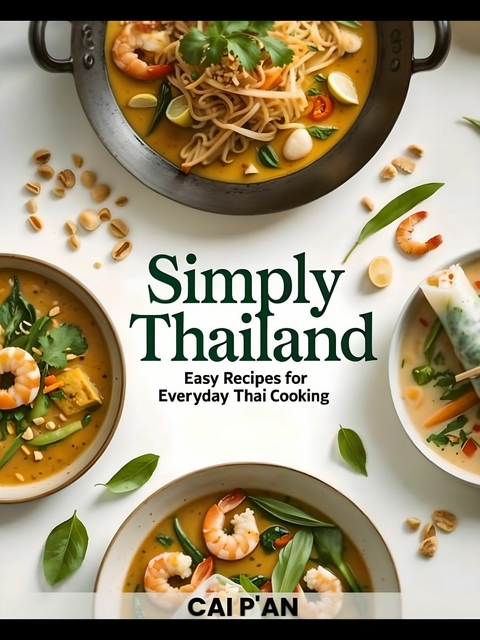
Simply Thailand (eBook)
124 Seiten
Seahorse Pub (Verlag)
978-0-00-095623-1 (ISBN)
Discover the Flavors of Thailand Right in Your Own Kitchen!
Are you ready to embark on a culinary adventure that will bring the vibrant, bold, and fragrant dishes of Thailand to your home? This Thai cookbook is more than just a collection of recipes-it's your guide to unlocking the heart of Thai cuisine, one dish at a time. Whether you're craving the creamy richness of Green Curry, the sweet-and-sour punch of Pad Thai, or the irresistible crunch of Thai Spring Rolls, this book has everything you need to create authentic Thai meals with confidence.
Inside, you'll find:
Easy-to-follow recipes that take the mystery out of Thai cooking, with helpful substitutions for Western kitchens.
Step-by-step guides for mastering essential Thai techniques, from perfecting curry pastes to achieving that smoky 'wok hei' flavor.
Personal stories that transport you to the bustling markets and vibrant street food stalls of Thailand, offering a deeper connection to the dishes you'll create.
Tips on balancing Thai flavors for different tastes, so you can customize each meal to suit your family and friends.
Whether you're a novice cook or a seasoned food lover, this cookbook will inspire you to explore new ingredients, experiment with exotic flavors, and bring the magic of Thailand to your dinner table. From quick weeknight stir-fries to showstopping curries, this is your passport to discovering the soul of Thai cuisine-no plane ticket required.
Experience the warmth and excitement of Thai food at home-one delicious bite at a time.
Chapter 2
The Origins of Thai Food
Thailand’s diverse geography and cultural heritage have shaped a food tradition as varied as its landscapes. Known for its bold yet balanced flavors—sweet, salty, sour, and spicy—Thai food reflects the history, creativity, and resourcefulness of its people. This chapter explores the roots of Thai food and how it has evolved over time.
At the heart of Thai cooking lies adaptability, a trait shaped by Thailand’s location and the movement of people and cultures across Southeast Asia.
Chinese settlers began arriving in what is now Thailand as early as the 13th century, bringing techniques like stir-frying, noodles, and rice-based meals. Dishes such as Pad Thai (stir-fried noodles) and Khao Man Gai (chicken rice) show this influence. The Chinese also introduced methods like drying and fermenting, which remain central to Thai food today. Soy sauce, another Chinese contribution, enhances the flavor of stir-fries and soups.
India’s long history of spice use left a lasting mark on Thai curries. Buddhism, which originated in India, brought not only religion but also spices like cumin, coriander, and turmeric. Massaman Curry, a slow-cooked dish made with beef or chicken, reflects Indian influence through its use of spices and coconut milk.
Trade routes connecting Thailand with Cambodia, Laos, Vietnam, and Malaysia introduced new ideas, tastes, and cooking styles. From Malaysia, southern Thailand adopted the use of coconut milk, especially in seafood dishes. Lao influence is evident in northeastern Isaan cuisine, where sticky rice and fermented fish are dietary staples.
Northern Thai food shares similarities with Burmese and Laotian cuisines due to the region’s mountainous terrain. Flavors here are milder compared to other parts of Thailand, with an emphasis on bitter herbs and fermented ingredients. Khao Soi, a curry noodle soup with Burmese roots, is a standout dish. Pickled mustard greens and coconut milk highlight the region’s culinary connections with its neighbors. Sticky rice is the staple, often served with chili dips (nam prik) and grilled meats, reflecting the agricultural lifestyle.
The southern region, with its long coastline, relies heavily on seafood and bold spices. The Muslim population has influenced dishes like Khao Mok (Thai-style biryani) and Massaman Curry. Food here is rich, fiery, and aromatic, with generous use of chilies, turmeric, and coconut milk. Sour curries like Gaeng Som, made with tamarind and fish, are common, thanks to the region’s coastal location and hot, humid climate.
The central region of Thailand, home to Bangkok and the royal palace, is the heart of modern Thai food. Sweet, salty, sour, and spicy flavors define this area’s dishes, which are often complex and intricate due to their origins as food for royalty. Central Thai cuisine is also the most familiar to people outside Thailand, featuring iconic dishes like Tom Yum Goong, Pad Thai, and Green Curry. The region’s flatlands and favorable climate make it ideal for growing rice, vegetables, and fruits, providing all the ingredients needed for its rich culinary tradition.
The northeastern region of Thailand, known as Isaan, is the most traditional and least developed part of the country. Its food is simple yet rustic, closely resembling Lao cuisine. Sticky rice is a staple, often served with Som Tum (papaya salad) or Larb (spicy minced meat salad), both of which highlight Isaan’s love for bold, tangy, and fiery flavors. Fermented fish sauce, or *Pla Ra*, is another essential ingredient, used to enhance taste and prepare various dishes. Grilled meats, rice, and sauces are common in an Isaan meal, which tends to be spicier than food from other parts of Thailand.
These regional differences reflect Thailand’s diverse geography and the adaptability of its food. Each region has developed its own identity based on its landscape, history, and available produce. Whether you’re in the hills of Chiang Mai or along the coast of Phuket, food always mirrors the geography and culture of a place.
Royal Palace Influence on Thai Food
While traditional Thai food is rooted in rural and regional styles, food prepared in the royal kitchens was expected to not only taste good but also look beautiful and involve intricate preparation. During the reign of King Rama V in the 19th century, the royal kitchen had a profound impact on how Thais presented and prepared their meals.
In the royal court, food became a form of art. Dishes were elaborately decorated, and appearance was considered as important as taste. Ingredients were sculpted into intricate designs, and presentation became a key aspect of dining. This tradition continues today, with many Thai dishes featuring artistic garnishes and carefully arranged ingredients.
Royal chefs paid meticulous attention to flavor balance, ensuring dishes were delicate and subtle. They mastered the five flavors that define Thai cuisine: sweet, sour, salty, spicy, and bitter. Meals were less fiery and more refined, using expensive and rare ingredients unavailable to the average person.
A prime example is Miang Kham, a royal snack made from roasted coconut, peanuts, lime, ginger, chili, and dried shrimp, all wrapped in a betel leaf. This dish perfectly encapsulates the balance of sweet, salty, sour, bitter, and spicy flavors in a single bite.
The influence of the royal court extended beyond palace walls. Many royal dishes made their way into the homes of aristocrats and eventually into everyday Thai cooking. Over time, these dishes were adapted to use locally available ingredients, becoming part of mainstream Thai cuisine. Today, the legacy of royal influence can still be seen in the emphasis on balance and presentation, whether in high-end restaurants or street food stalls.
Thai Food and Celebrations
Food is deeply woven into Thai culture. It’s not just about sustenance—it’s a way of connecting, preserving traditions, and celebrating life. From daily meals to special ceremonies, food defines social relationships, spiritual practices, and even business interactions. Thai cuisine, much like the Thai people themselves, is complex, adaptable, and shaped by history and geography.
No celebration in Thailand is complete without food. From bustling Bangkok to quiet villages, food serves as a symbol of hospitality, gratitude, and community. Each month in Thailand brings a festival tied to specific food traditions.
Songkran (Thai New Year)
Celebrated in mid-April, Songkran marks the start of the new year. People return to their hometowns to reunite with family, pay respects to elders, and visit temples to make merit. Homes are filled with the aroma of special dishes prepared for the occasion. One such dish is Khao Chae, a traditional meal where rice is soaked in jasmine-scented water, designed to cool diners during the hot season. Regional variations exist, but the focus is on fresh, seasonal produce like tropical fruits, herbs, and coconut milk.
Loy Krathong
Held on the full moon of November, Loy Krathong is a water festival where people release floating baskets called krathongs into rivers to honor the water goddess. Food plays a central role in the celebrations, with barbecues, seafood, fruits, and sweets enjoyed among family and friends. A popular treat is Khanom Tom, sweet coconut balls.
In Thailand, food is more than nourishment—it’s a way to express care and affection. During religious ceremonies or offerings to Buddhist monks, people prepare abundant meals as a way to earn merit. Families wake early to cook fresh meals, ensuring the food is warm and freshly prepared. Desserts like Khao Niew Ma Muang (sticky rice with mango) often accompany these meals, symbolizing prosperity and gratitude.
Thai culture revolves around food, making it central to daily interactions. Instead of asking “How are you?” Thais commonly greet each other with “*Kin khao ruu yang?*” meaning “Have you eaten yet?” This isn’t just about hunger—it reflects how deeply food is tied to health, hospitality, and relationships. Eating is a communal activity, with meals shared among friends, family, or even strangers at the table.
Markets—both rural and urban—are the lifeblood of Thailand. From dawn, when vendors sell fresh fruits, vegetables, fish, and meat, to night, when streets come alive with food stalls, markets are hubs of connection. Street vendors often stick to the same menu for years, honing their skills over time. A typical street market might offer dishes like Tom Yum soup, grilled pork skewers (Moo Ping), or Som Tum (papaya salad), cooked to order and served with enthusiasm.
Thai Street Food
Street food is a cornerstone of Thai culture. Nearly every street in Thailand has a food stall offering delicious and quick meals at any time of day. For many Thais, eating from street vendors isn’t just about satisfying hunger—it’s a daily tradition. Thai street food is incredibly diverse, ranging from noodle soups to grilled satay skewers.
For many people, the process of preparing food begins early in the morning and continues into the evening. A typical meal might include curries, stir-fries, soups, salads, and grilled meats, all served together on one plate for a balanced diet. Traditionally, Thais eat family-style, placing dishes on the table for everyone to share. This style of dining fosters conversation, as everyone gets to taste a bit of everything and enjoy the variety of flavors and textures.
Geography and Ingredients
Thailand’s diverse geography—featuring beaches, mountains, and plains—has shaped its...
| Erscheint lt. Verlag | 29.6.2025 |
|---|---|
| Sprache | englisch |
| Themenwelt | Sachbuch/Ratgeber ► Essen / Trinken |
| ISBN-10 | 0-00-095623-6 / 0000956236 |
| ISBN-13 | 978-0-00-095623-1 / 9780000956231 |
| Informationen gemäß Produktsicherheitsverordnung (GPSR) | |
| Haben Sie eine Frage zum Produkt? |
 EPUB (Adobe DRM)
Kopierschutz: Adobe-DRM
Adobe-DRM ist ein Kopierschutz, der das eBook vor Mißbrauch schützen soll. Dabei wird das eBook bereits beim Download auf Ihre persönliche Adobe-ID autorisiert. Lesen können Sie das eBook dann nur auf den Geräten, welche ebenfalls auf Ihre Adobe-ID registriert sind.
Details zum Adobe-DRM
Dateiformat: EPUB (Electronic Publication)
EPUB ist ein offener Standard für eBooks und eignet sich besonders zur Darstellung von Belletristik und Sachbüchern. Der Fließtext wird dynamisch an die Display- und Schriftgröße angepasst. Auch für mobile Lesegeräte ist EPUB daher gut geeignet.
Systemvoraussetzungen:
PC/Mac: Mit einem PC oder Mac können Sie dieses eBook lesen. Sie benötigen eine
eReader: Dieses eBook kann mit (fast) allen eBook-Readern gelesen werden. Mit dem amazon-Kindle ist es aber nicht kompatibel.
Smartphone/Tablet: Egal ob Apple oder Android, dieses eBook können Sie lesen. Sie benötigen eine
Geräteliste und zusätzliche Hinweise
Buying eBooks from abroad
For tax law reasons we can sell eBooks just within Germany and Switzerland. Regrettably we cannot fulfill eBook-orders from other countries.
aus dem Bereich