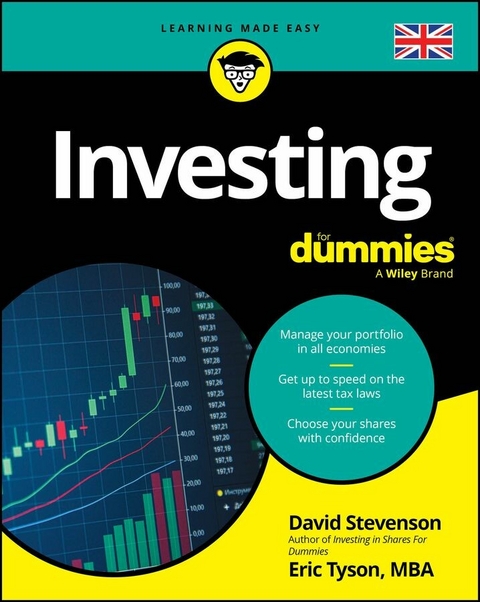
Investing For Dummies, UK Edition (eBook)
413 Seiten
For Dummies (Verlag)
978-1-394-35116-9 (ISBN)
Upgrade your financial future and stay ahead of the economic curve
This latest UK edition of Investing For Dummies is packed with up-to-date financial insights, covering the newest trends and developments that are reshaping the investment landscape. This comprehensive and beginner-friendly guidebook will help you build a robust investment portfolio in all economies and monitor its ongoing performance, for financial security you can rely upon. Even if you're on a limited budget, you can make smart, informed investment decisions. In this latest edition, investors will find up-to-date tax laws, and the latest trends and developments
- Assess risks and returns as you weigh different investment options
- Learn techniques and tools to make sound choices and achieve your financial goals
- Understand how UK investing differs from investing in other parts of the world
- Equip yourself with tax and regulatory knowledge to boost your profits
Even if you're completely new to investing, this Dummies guide will teach you to build a portfolio that works for you.
David Stevenson is a financial journalist and commentator for leading publications including The Financial Times, Citywire, and MoneyWeek. He is also the founder and director of both www.altfi.com, a leading fintech website, and www.etfstream.com, a site focused on exchange traded funds space and global asset allocation.
Eric Tyson, MBA has shared his financial expertise in bestselling books like Personal Finance For Dummies and Real Estate Investing For Dummies.
Chapter 1
Exploring Your Investment Choices
IN THIS CHAPTER
Defining investing
Seeing how stocks, bonds, and property ownership build long-term wealth
Understanding the role of lending and other investments
Knowing where not to invest your money
If you want to accomplish important personal and financial goals, such as owning a home, starting your own business, helping your kids through college (and spending more time with them when they’re young), retiring comfortably, and so on, you must know how to invest well.
It’s been said, and too often quoted, that the only certainties in life are death and taxes. To these two certainties we add one more: being confused by and ignorant about investing. Because investing is a confounding activity, you may be tempted to look with envious eyes at those people in the world who appear to be savvy with money and investing. Remember that everyone starts with the same level of financial knowledge: none! No one was born knowing this stuff! The only difference between those who know and those who don’t is that those who know have either devoted their time and energy to acquiring useful knowledge about the investment world or had parents who instilled in them a good base of investing knowledge.
Getting Started with Investing
Before we discuss the major investing alternatives in the rest of this chapter, we want to start with something that’s quite basic yet important. What exactly do we mean when we say “investing”? Simply stated, investing means you have money put away for future use.
You can choose from tens of thousands of stocks, bonds, mutual funds, exchange-traded funds, and other investments. Unfortunately for the novice, and even for the experts who are honest with you, knowing the name of the investment is just the tip of the iceberg. Underneath each of these investments lurks a veritable mountain of details.
If you wanted to and had the ability to quit your day job, you could make a full-time endeavour out of analysing economic trends and financial statements and talking to business employees, customers, suppliers, and so on. However, we don’t want to scare you away from investing just because some people do it on a full-time basis. Making wise investments need not take a lot of your time. If you know where to get high-quality information and you purchase well-managed investments, you can leave the investment management to the best experts. Then you can do the work that you’re best at and have more free time for the things you really enjoy doing.
An important part of making wise investments is knowing when you have enough information to do things well on your own versus when you should hire others. For example, European and many international stock markets are generally more difficult to research and understand than domestic markets. Thus, when investing overseas, hiring a good money manager, such as through a mutual or exchange-traded fund, makes more sense than going to all the time, trouble, and expense of picking individual international stocks.
We’re here to give you the information you need to make your way through the complex investment world. In the rest of this chapter, we clear a path so you can identify the major investments and understand the strengths and weaknesses of each.
Building Wealth with Ownership Investments
If you want your money to produce returns higher than the rate of inflation over the long term and you don’t mind a bit of a roller-coaster ride from time to time in your investments’ values, ownership investments are for you. Ownership investments are those investments where you own an interest in some company or other asset (such as stock or property) that has the ability to generate revenue and profits.
Observing how the world’s richest have built their wealth is enlightening. Not surprisingly, many of the champions of wealth around the globe gained their fortunes largely through owning a piece (or all) of a successful company that they (or others) built.
In addition to owning their own businesses, many well-to-do people have built their nest eggs by investing in real estate and the stock market. With softening housing prices in many regions in the late 2000s, some folks newer to the real estate world incorrectly thought that real estate was a loser, not a long-term winner. Likewise, the stock market goes through down periods but does well over the long term. (See Chapter 2 for the scoop on investment risks and returns.)
And, of course, some people come into wealth through an inheritance. Even if your parents are among the rare wealthy ones and you expect them to direct big bucks to you, you need to know how to invest that money intelligently.
If you understand and are comfortable with the risks and take sensible steps to diversify (you don’t put all your investment eggs in the same basket), ownership investments are the key to building wealth. For most folks to accomplish typical longer-term financial goals, such as retiring, the money that they save and invest needs to grow at a healthy clip. If you dump all your money in bank accounts that pay little if any interest, you’re more likely to fall short of your goals.
Not everyone needs to make their money grow, of course. Suppose that you inherit a significant sum and/or maintain a restrained standard of living and work well into your old age simply because you enjoy doing so. In this situation, you may not need to take the risks involved with a potentially faster-growth investment. You may be more comfortable with safer investments, such as paying off your mortgage faster than necessary. (Chapter 3 helps you think through such issues.)
Entering the stock market
Stocks, which are shares of ownership in a company, are an example of an ownership investment. If you want to share in the growth and profits of companies like Skechers (footwear), you can! You simply buy shares of their stock through an investment firm. However, even if Skechers makes money in the future, you can’t guarantee that the value of its stock will increase.
You don’t need an MBA or a PhD to make money in the stock market. If you can practice some simple lessons, such as making regular and systematic investments and investing in proven companies and funds while minimising your investment expenses and taxes, you should make decent returns in the long term.
However, we don’t think you should expect that you can “beat the markets,” and you certainly are not likely to beat the best professional money managers at their own full-time game. This book shows you time-proven, non-gimmicky methods to make your money grow in the stock market as well as in other financial markets. We explain more about stocks and mutual and exchange-traded funds in Part 2.
Owning property
People of varying economic means build wealth by investing in property. Owning and managing property is like running a small business. You need to satisfy customers (tenants), manage your costs, keep an eye on the competition, and so on. Some methods of property investing require more time than others, but many are proven ways to build wealth.
John, who works for a local government, and his wife, Linda, a computer analyst, have built several million pounds in investment property equity (the difference between the property’s market value and debts owed) over the decades. “Our parents owned rental property, and we could see what it could do for you by providing income and building wealth,” says John. Investing in property also appealed to John and Linda because they didn’t know anything about the stock market, so they wanted to stay away from that. The idea of leverage — making money with borrowed money — on real estate also appealed to them.
John and Linda bought their first property, a flat, when their combined annual income (decades ago) was just £35,000. Every time they moved to a new home, they kept the prior one and converted it to a rental. Now in their 60s, John and Linda own seven pieces of investment real estate and are multimillionaires. “It’s like a second retirement, having thousands in monthly income from the real estate,” says John.
WHO WANTS TO INVEST LIKE A MILLIONAIRE?
Having a million pounds isn’t nearly as rare as it used to be. In fact, according to the government numbers organisation, the Office for National Statistics (ONS), around 3.6 million households in Britain had wealth in excess of £1 million, according to the latest data (collected in 2016). This was up 29 per cent on the figures collected two years before. Interestingly, households with wealth of at least £1 million rarely let financial advisors direct their investments. The UK is like the US where surveys show that only one of ten such households allows advisors to call the shots and make the moves, whereas 30 per cent don’t use any advisors at all. The remaining 60 per cent consult an advisor on an as-needed basis and then make their own moves.
As in past surveys, recent wealth surveys show that affluent investors achieved and built on their wealth with ownership investments, such as their own small businesses, property, and stocks.
John readily admits that rental real estate has its hassles. “We haven’t enjoyed getting...
| Erscheint lt. Verlag | 26.6.2025 |
|---|---|
| Sprache | englisch |
| Themenwelt | Sachbuch/Ratgeber ► Beruf / Finanzen / Recht / Wirtschaft ► Geld / Bank / Börse |
| Schlagworte | bonds investing • british investing • England investing • footsie investing • FTSE 100 • how to invest uk • investing beginner • investing book • investing for brits • stock trading beginner • stock trading uk • UK investing • UK stock market • UK stocks |
| ISBN-10 | 1-394-35116-X / 139435116X |
| ISBN-13 | 978-1-394-35116-9 / 9781394351169 |
| Informationen gemäß Produktsicherheitsverordnung (GPSR) | |
| Haben Sie eine Frage zum Produkt? |
 EPUB (Adobe DRM)
Kopierschutz: Adobe-DRM
Adobe-DRM ist ein Kopierschutz, der das eBook vor Mißbrauch schützen soll. Dabei wird das eBook bereits beim Download auf Ihre persönliche Adobe-ID autorisiert. Lesen können Sie das eBook dann nur auf den Geräten, welche ebenfalls auf Ihre Adobe-ID registriert sind.
Details zum Adobe-DRM
Dateiformat: EPUB (Electronic Publication)
EPUB ist ein offener Standard für eBooks und eignet sich besonders zur Darstellung von Belletristik und Sachbüchern. Der Fließtext wird dynamisch an die Display- und Schriftgröße angepasst. Auch für mobile Lesegeräte ist EPUB daher gut geeignet.
Systemvoraussetzungen:
PC/Mac: Mit einem PC oder Mac können Sie dieses eBook lesen. Sie benötigen eine
eReader: Dieses eBook kann mit (fast) allen eBook-Readern gelesen werden. Mit dem amazon-Kindle ist es aber nicht kompatibel.
Smartphone/Tablet: Egal ob Apple oder Android, dieses eBook können Sie lesen. Sie benötigen eine
Geräteliste und zusätzliche Hinweise
Buying eBooks from abroad
For tax law reasons we can sell eBooks just within Germany and Switzerland. Regrettably we cannot fulfill eBook-orders from other countries.
aus dem Bereich