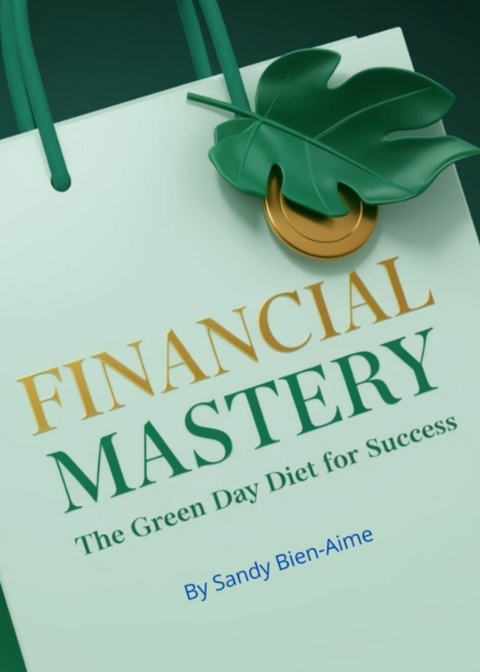
Financial Mastery (eBook)
208 Seiten
Publishdrive (Verlag)
978-0-00-093885-5 (ISBN)
Do you dream of a life where you are on top of your financial management and money becomes a tool for freedom, not stress?
Are you tired of feeling trapped in the endless cycle of paycheck-to-paycheck living?
Do you wish you could break free from debt, build financial security, and finally gain control over your future?
You're not alone.
Financial struggles, debt, and the constant pressure to 'do better' with money affect millions. Most people want financial security, yet few feel equipped to achieve it. But what if there were a way to transform your financial habits, mindset, and future-starting today? Financial Mastery: The Green Day Diet for Success is your guide to personal finance management.
In a world where 60% of people live paycheck to paycheck, financial literacy isn't just a skill-it's a lifeline. Despite the availability of financial information, many still feel lost in a maze of debt, savings plans, and investment jargon. Financial Mastery is here to cut through that confusion and offer a clear, guided path toward financial independence.
Sandy Bien-Aimé, having been there and done that, combines proven financial strategies with the power of mindset transformation, making this book an essential toolkit for anyone ready for ultimate financial control.
This book doesn't just tell you what to do with your money; it shows you how to change your relationship with it for good.
In this financial independence guide, you will find:
Self-Reflection Exercises: Gain self-awareness by assessing your financial habits, strengths, and areas for improvement.
Mindset Shifts for Success: Uncover and reshape your subconscious beliefs about money to develop a positive, empowered outlook on your financial journey.
SMART Financial Goal Setting: Learn to set and achieve realistic goals that align with both your present needs and future dreams.
Budgeting Techniques that Work: Find budgeting strategies that fit your lifestyle, from the 50/30/20 rule to zero-based budgeting and values-based spending.
Debt Elimination Tactics: Discover effective methods to manage and eliminate debt, building a foundation of financial independence.
Frugal Living and Lifestyle Choices: Embrace frugal strategies that cut costs without sacrificing your quality of life, including the cash envelope system.
Income Growth Opportunities: Explore avenues for maximizing your income, including side hustles and investments in personal growth.
Investment Essentials: Gain a clear understanding of investment basics, from stocks and bonds to building a diversified portfolio.
Planning for Life's Major Events: Prepare financially for key milestones, including marriage, home ownership, and retirement.
...and much more!
This book is for you even if you:
ü Have no prior financial knowledge
ü Are weighed down by debt
ü Have tried budgeting before and failed
ü Just want to get a handle on your money management
No matter where you are on your financial journey, Financial Mastery will meet you there. Are you ready to take control of your finances and change your life?
Grab your copy to get started today!
Chapter 1
What are your financial goals?
I. The Financial Mirror
Sarah found herself in the bathroom in front of the mirror, toothbrush in hand, looking at her reflection. Looking at the blackened color under her eyes, proof of another sleepless night spent worrying about money, she wished that it would form part of her past. She brushed her teeth and wondered: When was the last time she had really looked at her financial reflection?
If we can stand in front of a mirror to check our looks, we need to build a mirror in finances to check our monetary health. This chapter is that mirror— a tool for honestly and sometimes uncomfortably but ultimately empowering looking at oneself.
Taking Stock: The Financial Selfie
Revenue: The Lifeblood of the Economy
In most cases, income is the fuel that feeds the financial engine for most of us. For most people, of course, this seems simple—like Sarah, they get a paycheck every two weeks for working their 9-5 job. But the contemporary financial landscape is rarely so simple.
Take Tom, a graphic designer balancing a part-time office job with freelance gigs: His income is a patchwork of steady paychecks, irregular project fees, and the occasional windfall from a big client. And Maria is a teacher who supplements her pay with summer tutoring and the sale of online courses.
To adequately understand your income, you need to capture all these streams:
- Design Your Own Emoji
- Casual employment
- Income made by being a freelancer or working gigs
- Income from investments, via dividends and interest
- Earning enough in
- Any order for alimony or child support
- Surviving the government
Practice: Earning Inventory
- List of all forms of income for the past year
- Determine the monthly average for irregular income.
- Find trends: Are there fluctuations by season or is there only a general income.
Money isn't just about the amount; it is stability and the potential for growth. A poor-paying job with steadiness in working hours and grand benefits could be far more secure than a high-paying, but erratic, gig.
Expense: Where Does It All Go?
But now, this is most dreaded: we face the facts of our expenditure. With tap- and-go options and easy subscriptions to delivery services, it is quite easy to lose track of our money.
Meet Alex, who swore he was being fabulous but couldn't figure out why his account always seemed to be empty. Then, when he finally sat down and started looking at his expenses, he was shocked. The daily coffee runs, unused gym memberships, and impulse buys on Amazon turned out to be a very large amount.
To know what your real expenses are, you need to track your expenses for everything:
- Fixed costs like rent, utility bills, and loan repayments
- discretionary needs hobbies. Variable Costs: food, bus
- Other types of expenditures relate to entertainment, eating out, and hobbies.
- Ongoing costs (annual subscriptions, car maintenance)
- Hidden Costs (included bank charges, unused subscriptions)
Practice: The 30-Day Money Journal
- Keep a record of every expenditure for one month.
- Identify each cost as
- Tally each category at the end of the month.
It is amazing just how much this exercise can be eye-opening—all the way to uncomfortable. Maybe you will find, as Alex did, that your spending doesn't represent your values or goals. But hey, as they say, knowledge is power. You can't change what you don't acknowledge.
Debt: The Ball and Chain of Finance
Debt is the elephant in every room; it never leaves, casting a shadow on financial decisions and dreams.
Enter Lisa, who is fairly fresh from graduate school with that JURIS doctor. In so many ways, most of her future seemed pretty great, but the student loans held her down. When it came time to think about buying a house or starting a family, the debt always said, "Not yet."
To assess your debt situation, consider:
- Total amount of the debt
- Types of debts: student loans, credit cards minimum monthly, mortgages
- Interest rates on each debt
- Submit minimum monthly.
- Debt-to-income ratio
Exercise: The Deep-Dive Debt
- List All Debts: Balance, Interest Rate, and Minimum Payment
- To calculate your debt-to-income ratio, which is your total monthly debt payments divided by your monthly income,
- Identify your highest-interest debt-oriented
The first step to managing your debt is understanding it. It's not about shame or regret—it's about clarity and action.
II. Identifying financial strengths and weaknesses
Now that we've taken stock of the basic elements of our financial situation, it's time for some analysis. Think of this as your personal SWOT analysis— Strengths, Weaknesses, Opportunities, Threats—but for your money.
Strengths: Your Financial Superpowers
Financial strengths are the highlight of financial management, where all is right, be it the habits, skills, or circumstances that are favorable.
Where Sarah was the wizard at finding incredible deals and taking maximum advantage of her company's generous 401(k) match, her counterpart Tom had a more diversified income approach—the type that could help protect him against job loss. Here, Maria did not have much strength except in her frugal lifestyle, which was large enough to save a good part of the modest salary of a teacher.
General Common Financial Strengths:
- Savings rate
- Multiple sources of income
- It's rare to have low or no
- Great credit rating
- In-demand Skills that Increase Earning Potential
- Developed spending habits
- Benefits provided by employers (health insurance, retirement contributions)
Identifying your financial strengths is not bragging. It is identifying what works, allowing you to build on those strengths.
Weakness: The Chinks in Your Financial Armor
Financial weaknesses are those areas where you are really struggling, or habits that you have that impair your ability to get ahead. They are uncomfortable to face a majority of the time, but identification is required for growth.
Alex's area of weakness was impulse buying, especially tech gadgets and eating out. For Lisa, it was her lack of an emergency fund, leaving her at the mercy of any surprise expense. For Tom, it was irregular income, making it hard for him to keep a budget.
Common financial weaknesses are:
- High levels of high-interest debt
- Earning just enough to get by;
- No Emergency Fund
- Overspending in some categories
- Lack of insurance coverage
- Lacks of retirement savings
- Poor credit score
Remember, a weakness is not a forgone flaw in character. It is an area to develop, an opportunity to grow.
Now, plot your strengths and weaknesses. Write
- List down your 3 top financial strengths.
- List your top 3 financial weaknesses.
- For each weakness, list one small step you could take to improve on this.
III. The Significance of Being Financially Self-Aware
Why on earth would you put yourself through all this potentially uncomfortable kind of self-examination? Why? Because financial self-awareness is where all money management comes truly and essentially from.
One should put it in this scenario: you would not venture out for a road trip without knowing your current location. You have to start from somewhere in order to draw a path. That's your current financial situation.
Another One of the Dangers of Financial Blindness
It is mostly, however, that people work in financial blindness due to fear, shame, or neglect. They have a vague sense that something isn't right but can't put a finger on what it is or how to turn it around.
This fiscal myopia may lead to:
- Chronic financial stress and anxiety
- missed opportunities to save or invest
- incurring debt inadvertently
- Unable to make realistic financial goals
- The act of decision-making with incomplete information
Sarah lived that way, blind to the realities, with a feeling that something was hard but not having the guts to face facts. It was only after she finally sat down and looked at her financial situation that she could bring about meaningful change.
The Power of Financial Clarity
On the other hand, a monetary self is aware of numerous benefits:
- Reduced stress: knowledge, even of hard truths, is less unsettling than fear of the unknown.
- Improved Decision Making: When you know where you stand, you make informed choices.
- Ability to set realistic goals: This helps one set meaningful, feasible, and realistic goals.
- There can be nothing more motivating for change than the realization of how bad the situation is.
- Better Relationships: Clarity around finances can reduce money fights with a spouse, or any other family member for that matter.
For Tom, it was financial self-awareness that proved to be the game-changer. Once he fully understood the patterns of his income, he could make a budget that accounted for both fat and lean months. This really reduced the stress in his life and made it possible to start saving.
The Unending Pursuit of Financial Self-Discovery
One correct level of financial self-awareness is not a once-in-a-lifetime event; rather, it...
| Erscheint lt. Verlag | 21.11.2024 |
|---|---|
| Sprache | englisch |
| Themenwelt | Sachbuch/Ratgeber ► Beruf / Finanzen / Recht / Wirtschaft ► Geld / Bank / Börse |
| ISBN-10 | 0-00-093885-8 / 0000938858 |
| ISBN-13 | 978-0-00-093885-5 / 9780000938855 |
| Informationen gemäß Produktsicherheitsverordnung (GPSR) | |
| Haben Sie eine Frage zum Produkt? |
 EPUB (Adobe DRM)
Größe: 944 KB
Kopierschutz: Adobe-DRM
Adobe-DRM ist ein Kopierschutz, der das eBook vor Mißbrauch schützen soll. Dabei wird das eBook bereits beim Download auf Ihre persönliche Adobe-ID autorisiert. Lesen können Sie das eBook dann nur auf den Geräten, welche ebenfalls auf Ihre Adobe-ID registriert sind.
Details zum Adobe-DRM
Dateiformat: EPUB (Electronic Publication)
EPUB ist ein offener Standard für eBooks und eignet sich besonders zur Darstellung von Belletristik und Sachbüchern. Der Fließtext wird dynamisch an die Display- und Schriftgröße angepasst. Auch für mobile Lesegeräte ist EPUB daher gut geeignet.
Systemvoraussetzungen:
PC/Mac: Mit einem PC oder Mac können Sie dieses eBook lesen. Sie benötigen eine
eReader: Dieses eBook kann mit (fast) allen eBook-Readern gelesen werden. Mit dem amazon-Kindle ist es aber nicht kompatibel.
Smartphone/Tablet: Egal ob Apple oder Android, dieses eBook können Sie lesen. Sie benötigen eine
Geräteliste und zusätzliche Hinweise
Buying eBooks from abroad
For tax law reasons we can sell eBooks just within Germany and Switzerland. Regrettably we cannot fulfill eBook-orders from other countries.
aus dem Bereich