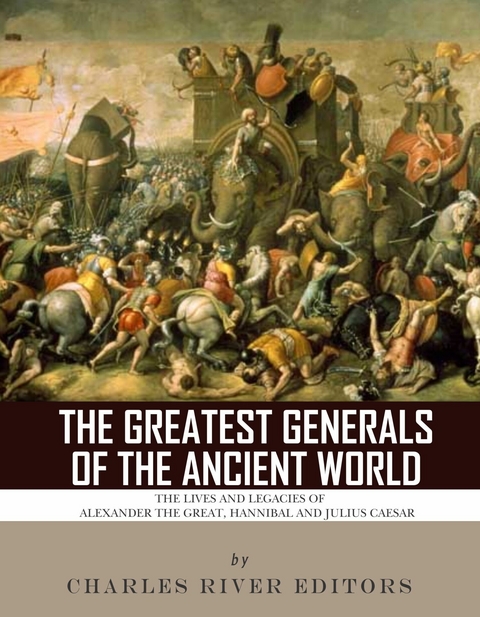
Greatest Generals of the Ancient World (eBook)
87 Seiten
Charles River Editors (Verlag)
978-1-4753-2916-2 (ISBN)
Over the last 2,000 years, ambitious men have dreamed of forging vast empires and attaining eternal glory in battle, but of all the conquerors who took steps toward such dreams, none were ever as successful as antiquity's first great conqueror. Leaders of the 20th century hoped to rival Napoleon's accomplishments, while Napoleon aimed to emulate the accomplishments of Julius Caesar. But Caesar himself found inspiration in Alexander the Great (356-323 B.C.), the Macedonian King who managed to stretch an empire from Greece to the Himalayas in Asia at just 30 years old. It took less than 15 years for Alexander to conquer much of the known world.
As fate would have it, Alexander died of still unknown causes at the height of his conquests, when he was still in his early 30s. Although his empire was quickly divided, his legacy only grew, and Alexander became the stuff of legends even in his own time. Alexander was responsible for establishing 20 cities in his name across the world, most notably Alexandria in Egypt, and he was directly responsible for spreading Ancient Greek culture as far east as modern day India and other parts of Asia. For the ancient world, Alexander became the emblem of military greatness and accomplishment; it was reported that many of Rome's greatest leaders, including Pompey the Great, Augustus, and Caesar himself all visited Alexander's tomb in Alexandria, a mecca of sorts for antiquity's other leaders.
In the history of war, only a select few men always make the list of greatest generals. Napoleon. Caesar. Alexander. They are always joined by Hannibal, who has the distinction of being the only man who nearly brought Rome to its knees before its decline almost 700 years later. Rome never suffered a more horrifying defeat in its history than at Cannae, and indeed, Hannibal nearly rewrote the course of Western history during the Second Punic War. Even today there remains great debate on just how he accomplished his masterful invasion of Italy across the Alps. Since his army included war elephants, historians still argue over exactly where and how he crossed over 2,000 years after he managed that incredible feat.
Hannibal will always be listed among history's greatest generals, and his military campaign in Italy during the Second Punic War will always be studied, but part of the aura and mystique surrounding the Carthaginian legend is that there is still a lot of mystery. Since Carthage was destroyed by Rome a generation after Hannibal, most of what is known about Hannibal came from the very people he tormented in the late 2nd century B.C., and thus much of his background and life story is unknown. Moreover, while military historians are still amazed that he was able to maintain his army in Italy near Rome for nearly 15 years, scholars are still puzzled over some of his decisions, including why he never attempted to march on Rome in the first place.
Possibly the most important man of antiquity, and even all of history, was Julius Caesar. Alexander Hamilton, the famous American patriot, once remarked that 'the greatest man who ever lived was Julius Caesar'. Such a tribute, coming from one of the Founding Fathers of the quintessential modern democracy in reference to a man who destroyed the Roman Republic, is testament to the enduring mark that Caesar left upon the world. The ultimate conqueror, statesman, dictator, visionary, and opportunist, during his time in power Caesar expanded the borders of Rome to almost twice their previous size, revolutionized the infrastructure of the Roman state, and destroyed the Roman Republic for good, leaving a line of emperors in its place. His legacy is so strong that his name has become, in many languages, synonymous with power: the Emperors of Austria and Germany bore the title Kaiser, and the Czars of Russia also owe the etymology of their title to Caesar.
Over the last 2,000 years, ambitious men have dreamed of forging vast empires and attaining eternal glory in battle, but of all the conquerors who took steps toward such dreams, none were ever as successful as antiquity's first great conqueror. Leaders of the 20th century hoped to rival Napoleon's accomplishments, while Napoleon aimed to emulate the accomplishments of Julius Caesar. But Caesar himself found inspiration in Alexander the Great (356-323 B.C.), the Macedonian King who managed to stretch an empire from Greece to the Himalayas in Asia at just 30 years old. It took less than 15 years for Alexander to conquer much of the known world.As fate would have it, Alexander died of still unknown causes at the height of his conquests, when he was still in his early 30s. Although his empire was quickly divided, his legacy only grew, and Alexander became the stuff of legends even in his own time. Alexander was responsible for establishing 20 cities in his name across the world, most notably Alexandria in Egypt, and he was directly responsible for spreading Ancient Greek culture as far east as modern day India and other parts of Asia. For the ancient world, Alexander became the emblem of military greatness and accomplishment; it was reported that many of Rome s greatest leaders, including Pompey the Great, Augustus, and Caesar himself all visited Alexander s tomb in Alexandria, a mecca of sorts for antiquity s other leaders.In the history of war, only a select few men always make the list of greatest generals. Napoleon. Caesar. Alexander. They are always joined by Hannibal, who has the distinction of being the only man who nearly brought Rome to its knees before its decline almost 700 years later. Rome never suffered a more horrifying defeat in its history than at Cannae, and indeed, Hannibal nearly rewrote the course of Western history during the Second Punic War. Even today there remains great debate on just how he accomplished his masterful invasion of Italy across the Alps. Since his army included war elephants, historians still argue over exactly where and how he crossed over 2,000 years after he managed that incredible feat.Hannibal will always be listed among history s greatest generals, and his military campaign in Italy during the Second Punic War will always be studied, but part of the aura and mystique surrounding the Carthaginian legend is that there is still a lot of mystery. Since Carthage was destroyed by Rome a generation after Hannibal, most of what is known about Hannibal came from the very people he tormented in the late 2nd century B.C., and thus much of his background and life story is unknown. Moreover, while military historians are still amazed that he was able to maintain his army in Italy near Rome for nearly 15 years, scholars are still puzzled over some of his decisions, including why he never attempted to march on Rome in the first place.Possibly the most important man of antiquity, and even all of history, was Julius Caesar. Alexander Hamilton, the famous American patriot, once remarked that the greatest man who ever lived was Julius Caesar . Such a tribute, coming from one of the Founding Fathers of the quintessential modern democracy in reference to a man who destroyed the Roman Republic, is testament to the enduring mark that Caesar left upon the world. The ultimate conqueror, statesman, dictator, visionary, and opportunist, during his time in power Caesar expanded the borders of Rome to almost twice their previous size, revolutionized the infrastructure of the Roman state, and destroyed the Roman Republic for good, leaving a line of emperors in its place. His legacy is so strong that his name has become, in many languages, synonymous with power: the Emperors of Austria and Germany bore the title Kaiser, and the Czars of Russia also owe the etymology of their title to Caesar.
Hannibal
Depiction of Hannibal crossing the Alps
Chapter 1: Early Life and Military Distinction, 247-218 B.C.
The classical age has given us some of History’s greatest generals. The battles, tactics and campaigns of the likes of Alcibiades, Alexander, Caesar and Lysander are still studied at staff colleges and military academies throughout the world today, long after military equipment and doctrine have far outstripped those of their period, and with good reason. For speed of march, efficiency of supply and logistics, and sheer battlefield acumen, they are in many ways unmatched today, and there is no doubt that even among such exalted company Hannibal of Carthage, son of Hamilcar, stood supreme. In a little over two decades of near-continuous warfare, the man who would become known as the Scourge of Rome would come within a hair’s breadth of destroying the mightiest empire of his age, almost altering the course of history forever.
Most of what the histories have to say about Hannibal came to us from his greatest enemies, for shortly after his death Carthage was utterly annihilated by the Roman legions, and they left no annals behind to tell us what the Carthaginians may have thought of their greatest soldier. That said, it is known that Hannibal was disliked by many of the most prominent Carthaginian factions, who were always loath to support him even in the hour of his greatest success, but their dislike was nothing compared to the utter hatred – largely born of fear – that the Romans felt for him. They could not belittle his achievements, so they attacked the only thing that was open to question – his character. Roman historians named him arrogant, ruthless, vicious, hedonistic, and cruel, and though some of his actions do bear out these labels, others seem to contradict them entirely.
Thus, a fine controversy has raged over the years, with some historians arguing that Hannibal’s character was beyond reproach, like his generalship, while others argue that he was everything his Roman detractors suggested, and more. The truth, as always, is likely to lie somewhere in the middle. Like many classical figures on whom much has been written, but almost always second-hand, Hannibal remains something of a mystery. He never left any personal documents behind, or if he did they did not survive antiquity, so today we are left to confine ourselves to examining his public persona and his achievements, and catching the occasional glimpse of the man behind the mask.
Hannibal was born in Carthage in 247 BC, the first-born son of Hamilcar “The Thunderbolt” Barca, a prominent Carthaginian nobleman and a successful general who had distinguished himself leading Carthage’s forces during the First Punic War against Rome (“Punic” being the adjective the Romans reserved for all things Carthaginian). Though Hamilcar used the cognomen Barca (meaning “thunderbolt”), it’s unclear whether that was passed down to his sons, though historians still generally refer to Hannibal as Hannibal Barca. Regardless, with such a fine martial tradition in his family, it naturally followed that Hannibal too would join the Carthaginian army, rather than engage in the other great pastime of the city’s nobility, trade.
With the state of the Mediterranean basin being what it was in 247 BC, it followed that there would be plenty of employment for soldiers. Indeed, Hannibal was born into a world of strife. Carthage, the northern African superpower, had grown rich on trade and the intelligent use of force, but their position of supremacy was being challenged by the rising star of Rome, which by this time was also aggressive, expansionistic, and heavily slanted towards conquest and the military rather than peaceable trade. Given that, it was inevitable that Rome would come into conflict with Carthage, and had already done so during the first Punic War, a brutal and bitter conflict which had lasted for over two decades and resulted in a Roman victory and the loss of large swaths of Carthaginian land across the Mediterranean. While the two great powers were at war, other factions, such as Syracuse and the Seleukids, had also attempted to carve out a larger piece of the Mediterranean pie.
Rome and Carthage after the First Punic War
Carthage’s struggles with Rome in the first Punic War, and their overreliance on mercenary forces, had left them so bankrupt they were unable to pay off their surviving veterans, leading to widespread uprisings by their mercenary contingents that turned into a war in their own right. This further impoverished Carthage and caused the loss of even more territories as they were forced to scrape the barrel of their manpower dry to crush the rebellions. Rome, however, was in no position to take full advantage of Carthage’s weakness: 23 years of war had virtually annihilated her army and navy, and both factions needed time to draw breath, re-arm, and levy new armies and taxes. It was in this uncertain time, the breathless calm before the inevitable storm, that Hannibal grew to boyhood.
When Hannibal was 11, and proceeding with the typical education of a Carthaginian military nobleman’s child (by all accounts he excelled at horsemanship, wrestling, and other martial pursuits), his father Hamilcar, who was desperate to find Carthage a new source of revenue to replace the lost territories of Sardinia and Corsica, managed to persuade the Carthaginian ruling elite of the desirability of the military conquest of the Iberian peninsula, the riches of which, he argued, could fund Carthage’s re-armament for the next war. The Carthaginian rulers consented, and in 236 B.C. Hamilcar went about preparing the invasion of Spain, which at the time was a loose collection of tribes with no ambitions beyond their local territory. Furthermore, annexation of land on the Iberian Peninsula was unlikely to anger Rome unduly, even though the Republic’s forces were also pursuing their own interests in the north of the Peninsula. In fact, containment of Roman expansion may also have been part of Hamilcar’s strategy.
Hannibal, though barely 11 at the time, begged his father for leave to accompany the expedition. At first, it appears as though Hamilcar was reluctant to let someone so young join him on his campaign, but due to repeated pleas by Hannibal, he seems to have relented. Whatever his reasons, the young Hannibal was certainly with the Carthaginian army when it marched along the coast of North Africa to the strait of Gibraltar, where, under Hamilcar’s supervision, the troops were ferried across the narrow strait and onto Spanish soil. The journey took Hamilcar’s army some months, but at the time the Carthaginian navy was in such a parlous state that there were simply not enough ships available to transport the army by sea from Carthage itself, leading Hamilcar to take the longer coastal route.
Once there, however, Hamilcar’s army was vastly successful in prosecuting war on the peninsula itself. The Iberian tribes, inferior in equipment and training, could not hope to resist the Carthaginian troops, and despite stiff fighting they were defeated piecemeal and annexed, a process which, though relatively rapid, nonetheless took several years. During this time, Hannibal grew to adolescence, tutored in warfare by Greek instructors who instructed him by detailing the conquests of Alexander, Alcibiades, and Pyrrhus of Epirus, all of whom he would come to greatly admire and hold in high esteem. Of course, Hannibal also witnessed his father Hamilcar’s successes as a commander first-hand. It is likely that Hamilcar himself, when campaign matters permitted, would have taken time to instruct his son himself, for they appear to have been close. Indeed, Hamilcar was determined that Hannibal himself, when the time came, should take up his mantle and proceed with the crusade that had occupied most of his military life: the destruction of Rome. Hamilcar had never recovered from the humiliation of being defeated by the Republic’s forces, and longed for the day when he might lead Carthage’s troops against Rome once again, and to this end he spent much time instilling in his son an implacable hatred of Carthage’s sworn enemy. Such was Hamilcar’s zeal for his cause, and his desire to bind his son to it, that he had Hannibal accompany him to a shrine in the town of Peniscola (near modern Valencia) and bid him swear upon the altar that he would be Rome’s enemy for evermore. Hannibal duly did so, adding, “As soon as I have come of age, I swear that I will bring Rome low by fire and the sword”.
Hamilcar’s campaigns continued successfully, and he even began to consolidate his gains by founding a string of cities, including, popular legend has it, the port city of Barcino (from Barca, his family name), on the site of modern-day Barcelona. However, Hamilcar’s success came to an abrupt end in 228 B.C. when, leading his army across a river against an army of Iberian tribesmen, he fell from his horse and, dragged down by his armour, drowned. Hannibal was 19 at the time, and already a proven battlefield commander, having taken command of a detachment of Carthaginian troops at some point during Hamilcar’s campaigns and already displaying a glimmer of the military genius that would characterise his later career in his handling of his soldiers.
Hannibal grieved deeply for his father’s death, but his sorrow was somewhat lessened by the appointment of his older brother-in-law, general Hasdrubal, to overall command of the army. Having another family member commanding in Iberia, rather than an unknown quantity, meant more opportunity for advancement, and Hannibal was pleased to accept a position on Hasdrubal’s staff, where he had ample opportunity to prove his mettle. Meanwhile,...
| Erscheint lt. Verlag | 20.6.2025 |
|---|---|
| Sprache | englisch |
| Themenwelt | Sachbuch/Ratgeber ► Geschichte / Politik ► Vor- und Frühgeschichte / Antike |
| Geschichte ► Allgemeine Geschichte ► Altertum / Antike | |
| Schlagworte | Athens • Cleopatra • Egypt • Greece • Punic • Rome • Sparta |
| ISBN-10 | 1-4753-2916-4 / 1475329164 |
| ISBN-13 | 978-1-4753-2916-2 / 9781475329162 |
| Informationen gemäß Produktsicherheitsverordnung (GPSR) | |
| Haben Sie eine Frage zum Produkt? |
 EPUB (Ohne DRM)
Digital Rights Management: ohne DRM
Dieses eBook enthält kein DRM oder Kopierschutz. Eine Weitergabe an Dritte ist jedoch rechtlich nicht zulässig, weil Sie beim Kauf nur die Rechte an der persönlichen Nutzung erwerben.
Dateiformat: EPUB (Electronic Publication)
EPUB ist ein offener Standard für eBooks und eignet sich besonders zur Darstellung von Belletristik und Sachbüchern. Der Fließtext wird dynamisch an die Display- und Schriftgröße angepasst. Auch für mobile Lesegeräte ist EPUB daher gut geeignet.
Systemvoraussetzungen:
PC/Mac: Mit einem PC oder Mac können Sie dieses eBook lesen. Sie benötigen dafür die kostenlose Software Adobe Digital Editions.
eReader: Dieses eBook kann mit (fast) allen eBook-Readern gelesen werden. Mit dem amazon-Kindle ist es aber nicht kompatibel.
Smartphone/Tablet: Egal ob Apple oder Android, dieses eBook können Sie lesen. Sie benötigen dafür eine kostenlose App.
Geräteliste und zusätzliche Hinweise
Buying eBooks from abroad
For tax law reasons we can sell eBooks just within Germany and Switzerland. Regrettably we cannot fulfill eBook-orders from other countries.
aus dem Bereich