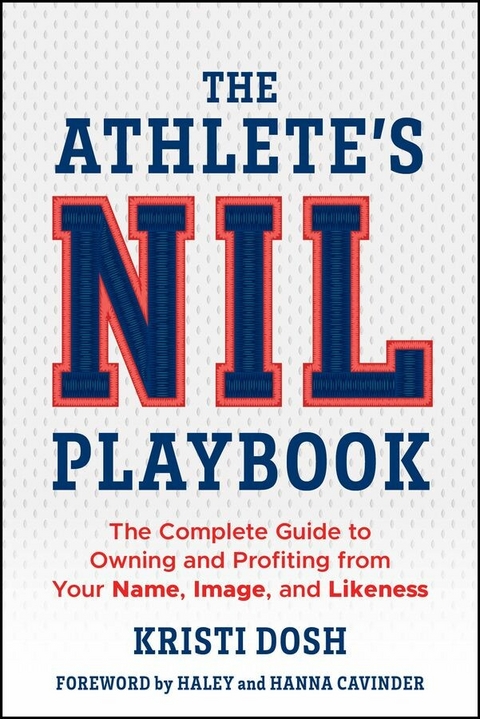
The Athlete's NIL Playbook (eBook)
310 Seiten
Wiley (Verlag)
978-1-394-35406-1 (ISBN)
The definitive guide for athletes to understand and earn from name, image, and likeness (NIL) rights
The first comprehensive guide designed to help college, high school, and youth athletes navigate the name, image, and likeness (NIL) rights they've gained since 2021, The Athlete's NIL Playbook walks readers through NIL rules, opportunities, and red flags, showing them how to build a personal brand, find deals, reach out to companies, and negotiate terms. Along with real-life examples, exercises, and pitch templates, this book includes case studies from college and high school athletes who have successfully navigated this burgeoning market: the Cavinder Twins, Olivia Dunne, Travis Hunter, Chase Griffin, Emily Cole, and many more.
Written by Kristi Dosh, a seasoned sports business reporter and founder of a nationally-recognized news platform covering the business of college sports, this book covers aspects of NIL including:
- The types of opportunities available (social media marketing, lessons, camps/clinics, merchandise, personal appearances, and more)
- Whether you need an agent or not, and how to find the right one if you do
- Working with third parties like collectives and marketplaces and protecting/registering your own intellectual property
A true playbook for leveraging and capitalizing on NIL monetization opportunities, The Athlete's NIL Playbook is an essential read for athletes and parents seeking to ensure athletic success is matched with lucrative financial and career opportunities that can go far beyond graduation.
Kristi Dosh has reported on the business of college sports for Forbes and ESPN for more than 14 years. She is a nationally recognized expert on NIL and teaches multiple courses on NIL at the University of Florida. She has spoken on NIL for the NCAA and multiple NCAA conferences.
The definitive guide for athletes to understand and earn from name, image, and likeness (NIL) rights The first comprehensive guide designed to help college, high school, and youth athletes navigate the name, image, and likeness (NIL) rights they've gained since 2021, The Athlete's NIL Playbook walks readers through NIL rules, opportunities, and red flags, showing them how to build a personal brand, find deals, reach out to companies, and negotiate terms. Along with real-life examples, exercises, and pitch templates, this book includes case studies from college and high school athletes who have successfully navigated this burgeoning market: the Cavinder Twins, Olivia Dunne, Travis Hunter, Chase Griffin, Emily Cole, and many more. Written by Kristi Dosh, a seasoned sports business reporter and founder of a nationally-recognized news platform covering the business of college sports, this book covers aspects of NIL including: The types of opportunities available (social media marketing, lessons, camps/clinics, merchandise, personal appearances, and more) Whether you need an agent or not, and how to find the right one if you do Working with third parties like collectives and marketplaces and protecting/registering your own intellectual property A true playbook for leveraging and capitalizing on NIL monetization opportunities, The Athlete's NIL Playbook is an essential read for athletes and parents seeking to ensure athletic success is matched with lucrative financial and career opportunities that can go far beyond graduation.
Chapter 2
NIL Activities and Opportunities
I've written about, and served on panels with, athletes from every division who were able to leverage their NIL even with moderately sized social media platforms. One of my favorite stories is Division III women's volleyball athlete Laney Higgins.
When I first met Higgins, she had just become the first female high school athlete in Florida to sign an NIL deal. At the time, Florida's state high school association didn't allow NIL deals, but she had finished her high school eligibility and signed a deal with Q30 Innovations, a company that produces devices to reduce brain injuries.
It didn't matter that Higgins's following hovered around 1,300 at the time, or that she wasn't a household name committed to a Division I institution. Higgins was then, and is now, proactive about reaching out to companies and working her connections.
Higgins has now worked with multiple brand partners, including local businesses near the Brookhaven, Georgia, campus of Oglethorpe University and national companies like Champs, Outback, Quest Nutrition, and CeraVe. Perhaps her most exciting deal to date, however, is with Lululemon, a brand at the top of many athletes' wish lists, which we'll talk about later on in this chapter.
The point is that many myths circulate about NIL, but some of the most damaging write off the market as only existing for a few:
- NIL is only for male athletes.
- Only Division I athletes get NIL deals.
- You need a big social media following to take advantage of NIL.
Fortunately for the athletes (and parents) reading this, none of this is true.
So, now that we've dispensed with the falsehoods, let's look at all the different ways athletes can monetize their NIL.
Social Media Marketing
The most popular type of NIL deal is social media marketing. When new NIL rules went into effect in 2020 (NAIA) and 2021 (NCAA and NJCAA), most of the deals announced on the first day were brands compensating athletes in exchange for social media posts on Instagram, Snapchat, TikTok, Twitter (now X), and YouTube.
As mentioned in the introduction, former NAIA volleyball athlete Chloe Mitchell has the distinction of being the first college athlete ever to monetize her NIL due to the NAIA's rule change in 2020 ahead of the NCAA. Growing her following from double digits to more than two million during the pandemic allowed her to work with brands already sliding into her DMs.
Mitchell was able to work with brands like Target, Walmart, and Ford for social media content in her first year of NIL. When she realized she was learning more about business firsthand through her brand partnerships than she was in classes – and was making six figures – Mitchell made the decision to become a full-time creator and entrepreneur, roles she's still thriving in today as she continues to work with brands from the brand new house she bought with her NIL money at just 20 years old.
When we talk about NCAA athletes and NIL, two of the most visible college athletes on July 1, 2021, when new NCAA NIL rules became effective, were basketball-playing identical twins Haley and Hanna Cavinder, who've since built an empire around their joint brand as the “Cavinder Twins.” Not only were they among the first to announce deals on that monumental day in college sports history, but they did so in grand fashion on a billboard in Times Square.
From there, the Cavinder Twins went on to earn more than $2 million from NIL deals in the first year of exercising their new rights, which included social media posts, merchandise, and even equity stakes.
Then there's the most-followed college athlete at the beginning of the NIL era: LSU gymnast Olivia Dunne. I had the pleasure of reporting on her first NIL deal in September 2021 with Vuori activewear brand, and at the time she had a combined 5.7 million followers on TikTok and Instagram. Not surprisingly, she easily became a seven-figure earner, with many of her deals relying on social media content.
Enough about the stars. I'm sure it's no surprise they can make money. But what about the athlete with 5,000 followers? Or 2,500?
Let's get back to Higgins. How did a DIII athlete with a moderate following attract a national brand that was doing very little in the NIL space despite the number of athletes who would line up to work with them? It's all thanks to her weekly W4alking & T4lking series on Instagram Live, where Higgins talks to another college athlete while they walk across campus to class. She created the series as a result of her experience in Meta's Empower 2.0 program (where she was the only DIII athlete selected from hundreds of applicants), thanks to an educational session that suggested developing a weekly Instagram Live series.
I was a coach in the program during the same cohort as Higgins, and I have to applaud her not only for taking the advice but also for sticking with it even though I'm sure her watching audience was small in the beginning. Most of the athletes in the cohort gave up on it, but Higgins persisted. It would take more than a year for Lululemon to come calling, but Higgins says it was worth it:
My dream brand to collaborate with has always been Lululemon, so to have them partner with me on what has been their first national female NIL campaign has been amazing. I'm so grateful that Lululemon not only sees the value in working with a small school student-athlete like myself, but that they're so ultra supportive of W4lking and T4lking's mission of showcasing other female student-athletes from around the country, who are doing great things both in and out of their sport.
Thanks to her ongoing efforts to grow her brand and engagement, Higgins now has more than 30,000 followers across her social media channels.
Although the details of Higgins's story are unique, her ability to monetize her NIL even as a small school athlete with a modest following is not. In later chapters, you'll meet a Division III football athlete with a four-figure following who did nearly 40 deals in his first year of NIL, a DII track athlete who put off a pro career to learn how to leverage his NIL, and many more who've successfully landed social media marketing deals with modest followings.
Important: FTC Requirements
Federal law requires that you disclose any financial, employment, personal, or family relationship with a brand. The Federal Trade Commission requires that this disclosure be placed within the endorsement message, meaning it needs to be in your caption on social media.
The FTC's guidance says your disclosure shouldn't be mixed into a group of hashtags or links, “on an ABOUT ME or a profile page, at the end of posts or videos, or anywhere that requires a person to click MORE.”
If your endorsement is in a picture or video, the FTC advises that you superimpose the disclosure over the picture or video and give viewers enough time to read it. For videos, the guidance is to include it not only in the description of the video but also in the video itself in both audio and visual formats. In a livestream, you should make the disclosure repeatedly.
Here are some ways the FTC says you can disclose your relationship with a brand:
- Thanking the brand for giving you free product
- Using terms like “advertisement,” “ad,” “sponsored,” “[brand name] partner,” and “[brand name] ambassador”
- Using hashtags like #ad or #sponsored, but remember the advisement above that it shouldn't be in a big group of hashtags
The FTC says you shouldn't use abbreviations or shorthand like “sp,” “spon,” “collab,” or “ambassador.”
You also can't talk about your experience with a product you haven't tried or say something was great just because you got paid to talk about it. This goes beyond FTC advice; it's good advice for ensuring your audience can trust you and continues to take your recommendations.
Last, steer clear of any claims that a product can do something you or the brand can't prove, such as saying it's proven to treat a health condition.
Affiliate and Ambassador Roles
Intricately tied in with social media marketing are affiliate and ambassador roles. Although they may look similar in your Instagram feed, they're not exactly the same.
An ambassador is someone who serves as the face of the brand. They're likely to post behind-the-scenes-type content, and there will be storytelling around the brand. The athletes are typically paid at least some cash in addition to product.
Affiliates are a little different, especially in terms of the way they are compensated. Generally, affiliates are given a personalized link or code to share with their followers. The athlete then receives a commission when someone makes a purchase using their link or code.
Unfortunately, some brands use these terms interchangeably. I've seen many NIL programs by brands labeled as “ambassador” programs when they're really just affiliate structures. And I find that for many athletes, affiliate programs don't make sense.
That's because making impactful money with affiliate programs requires a lot of time and content. There are influencers out...
| Erscheint lt. Verlag | 19.6.2025 |
|---|---|
| Sprache | englisch |
| Themenwelt | Sachbuch/Ratgeber ► Sport |
| Schlagworte | athlete agent • Athlete branding • athlete deals • athlete marketing • athlete personal brand • college sports • high school sports • make money athlete • name image likeness rights • nil college • nil high school • nil rights • sports sponsorship |
| ISBN-10 | 1-394-35406-1 / 1394354061 |
| ISBN-13 | 978-1-394-35406-1 / 9781394354061 |
| Informationen gemäß Produktsicherheitsverordnung (GPSR) | |
| Haben Sie eine Frage zum Produkt? |
 EPUB (Adobe DRM)
Kopierschutz: Adobe-DRM
Adobe-DRM ist ein Kopierschutz, der das eBook vor Mißbrauch schützen soll. Dabei wird das eBook bereits beim Download auf Ihre persönliche Adobe-ID autorisiert. Lesen können Sie das eBook dann nur auf den Geräten, welche ebenfalls auf Ihre Adobe-ID registriert sind.
Details zum Adobe-DRM
Dateiformat: EPUB (Electronic Publication)
EPUB ist ein offener Standard für eBooks und eignet sich besonders zur Darstellung von Belletristik und Sachbüchern. Der Fließtext wird dynamisch an die Display- und Schriftgröße angepasst. Auch für mobile Lesegeräte ist EPUB daher gut geeignet.
Systemvoraussetzungen:
PC/Mac: Mit einem PC oder Mac können Sie dieses eBook lesen. Sie benötigen eine
eReader: Dieses eBook kann mit (fast) allen eBook-Readern gelesen werden. Mit dem amazon-Kindle ist es aber nicht kompatibel.
Smartphone/Tablet: Egal ob Apple oder Android, dieses eBook können Sie lesen. Sie benötigen eine
Geräteliste und zusätzliche Hinweise
Buying eBooks from abroad
For tax law reasons we can sell eBooks just within Germany and Switzerland. Regrettably we cannot fulfill eBook-orders from other countries.
aus dem Bereich