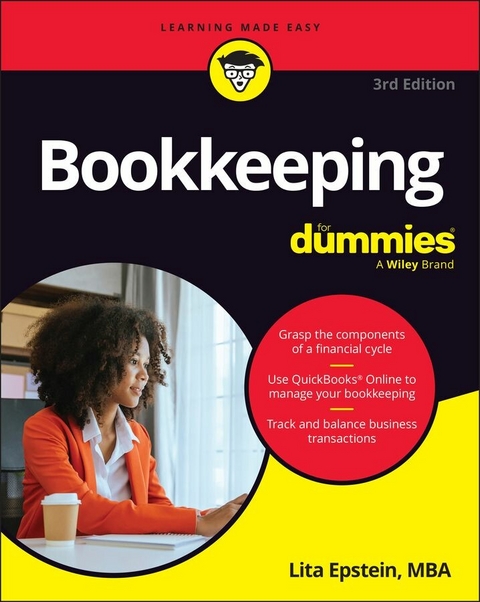
Bookkeeping For Dummies (eBook)
477 Seiten
For Dummies (Verlag)
978-1-394-34980-7 (ISBN)
Concise, easy-to-understand information on every aspect of bookkeeping
Bookkeeping For Dummies is a clear guide to tracking transactions, figuring out balance sheets, keeping ledgers or journals, creating financial statements, and operating accounts for businesses. This necessary resource offers relevant, up-to-date tax information and small business laws, so you'll have everything you need to conquer small business bookkeeping tasks. Looking for the latest on QuickBooks Online software, government reporting requirements, and keeping your data secure on the cloud? This new edition has you covered. Make sure your financial records and plans are accurate and complete-without taking too much time away from your business.
- Understand all components of a financial cycle
- Track business transactions and prepare financial reports correctly
- Save time and money by simplifying tax preparation
- Keep your data secure with QuickBooks Online and other cloud-based tools
Bookkeeping For Dummies is the perfect crash course for small business owners or employees who are tasked with bookkeeping duties.
Lita Epstein, MBA, is a financial writer who focuses on career growth and business topics. She earned her MBA from Emory University and her BA from Rutgers University. Lita has written more than 50 books, including Reading Financial Reports For Dummies.
Concise, easy-to-understand information on every aspect of bookkeeping Bookkeeping For Dummies is a clear guide to tracking transactions, figuring out balance sheets, keeping ledgers or journals, creating financial statements, and operating accounts for businesses. This necessary resource offers relevant, up-to-date tax information and small business laws, so you'll have everything you need to conquer small business bookkeeping tasks. Looking for the latest on QuickBooks Online software, government reporting requirements, and keeping your data secure on the cloud? This new edition has you covered. Make sure your financial records and plans are accurate and complete without taking too much time away from your business. Understand all components of a financial cycle Track business transactions and prepare financial reports correctly Save time and money by simplifying tax preparation Keep your data secure with QuickBooks Online and other cloud-based tools Bookkeeping For Dummies is the perfect crash course for small business owners or employees who are tasked with bookkeeping duties.
Chapter 1
So, You Want to Do the Books
IN THIS CHAPTER
Introducing bookkeeping and its basic purpose
Maintaining a paper trail
Managing daily business finances
Making sure everything is accurate
Putting on a financial show
Few small business owners actually hire accountants to work full time for them. For many small businesses, that expense is probably too great, so instead, the owner hires a bookkeeper to keep track of the business’s month-to-month financials. In return, the accountant helps the bookkeeper develop good bookkeeping practices and reviews their work periodically (usually monthly).
In this chapter, I provide an overview of a bookkeeper’s work. If you’re just starting a business, you may be your own bookkeeper for a while until you can afford to hire one, so think of this chapter as your to-do list.
Delving into Bookkeeping Basics
Like most businesspeople, you probably have great ideas for running your own business and just want to get started. You don’t want to sweat the small stuff, like keeping detailed records of every penny spent; you just want to quickly build a business in which you can make lots of money.
Well, slow down there — this isn’t a race! If you don’t carefully plan your bookkeeping operation and figure out exactly how and what financial detail you want to track, you’ll have absolutely no way to measure the success (or failure, unfortunately) of your business efforts. And keeping close track of cash flow is key to the success of small businesses.
Bookkeeping, when done properly, gives you an excellent gauge of how well you’re doing. It also provides you with lots of information throughout the year so you can test the financial success of your business strategies and make course corrections early in the year, if necessary, to ensure that you reach your year-end profit goals.
Bookkeeping can become your best friend for managing your financial assets and testing your business strategies, so don’t shortchange it. Take the time to develop your bookkeeping system with your accountant before you even open your business’s doors and make your first sale.
Picking your accounting method
You can’t keep books unless you know how you want to go about doing so. The two basic accounting methods you have to choose from are cash-basis accounting and accrual accounting. The key difference between these two accounting methods is the point at which you record sales and purchases in your books. If you choose cash-basis accounting, you only record transactions when cash changes hands. If you use accrual accounting, you record a transaction when it’s completed, even if cash doesn’t change hands.
For example, suppose your company buys products to sell from a vendor but doesn’t actually pay for those products for 30 days. If you’re using cash-basis accounting, you don’t record the purchase until you actually lay out the cash to the vendor. If you’re using accrual accounting, you record the purchase when you receive the products, and you also record the future debt in an account called Accounts Payable.
I talk about the pros and cons of each type of accounting method in Chapter 2.
Understanding assets, liabilities, and equity
Every business has three key financial parts that must be kept in balance: assets, liabilities, and equity. Assets include everything the company owns, such as cash, inventory, buildings, equipment, and vehicles. Liabilities include everything the company owes to others, such as vendor bills, credit card balances, and bank loans. Equity includes the claims owners have on the assets based on their portion of ownership in the company.
The formula for keeping your books in balance involves these three elements:
Assets = Liabilities + Equity
Because it’s so important, I talk a lot about how to keep your books in balance throughout this book. You can find an initial introduction to this concept in Chapter 2.
Introducing debits and credits
To keep the books, you need to revise your thinking about two common financial terms: debits and credits. Most non-bookkeepers and non-accountants think of debits as subtractions from their bank accounts. The opposite is true with credits — people usually see these as additions to their accounts, in most cases in the form of refunds or corrections in favor of the account holders.
Well, forget all you thought you knew about debits and credits. Debits and credits are totally different animals in the world of bookkeeping. Because keeping the books involves a method called double-entry bookkeeping, you have to make a least two entries — a debit and a credit — into your bookkeeping system for every transaction. Whether that debit or credit adds or subtracts from an account depends solely upon the type of account.
I know all this debit, credit, and double-entry stuff sounds confusing, but I promise it will become much clearer as you work through this book. I start explaining this critical yet somewhat confusing concept in Chapter 2.
Charting your bookkeeping course
You can’t just enter transactions in the books willy-nilly. You need to know where exactly those transactions fit into the larger bookkeeping system. That’s where your Chart of Accounts comes in; it’s essentially a list of all the accounts your business has and what types of transactions go into each one.
I talk more about the Chart of Accounts in Chapter 3.
Recognizing the Importance of an Accurate Paper Trail
Keeping the books is all about creating an accurate paper trail. You want to track all of your company’s financial transactions, so if a question comes up at a later date, you can turn to the books to figure out what went wrong.
An accurate paper trail is the only way to track your financial successes and review your financial failures, a task that’s vitally important in order to grow your business. You need to know what works successfully so you can repeat it in the future and build on your success. On the other hand, you need to know what failed so you can correct it and avoid making the same mistake again.
All your business’s financial transactions are summarized in the General Ledger, and journals keep track of the tiniest details of each transaction. You can make your information gathering more effective by using a computerized accounting system, which gives you access to your financial information in many different formats. Controlling who enters this financial information into your books and who can access it afterward is smart business and involves critical planning on your part. I address all these concepts in the following sections.
Maintaining a ledger
The granddaddy of your bookkeeping system is the General Ledger. In this ledger, you keep a summary of all your accounts and the financial activities that took place involving those accounts throughout the year.
You draw upon the General Ledger’s account summaries to develop your financial reports on a monthly, quarterly, or annual basis. You can also use these account summaries to develop internal reports that help you make key business decisions. I talk more about developing and maintaining the General Ledger in Chapter 4.
Keeping journals
Small companies conduct hundreds, if not thousands, of transactions each year. If every transaction were kept in the General Ledger, that record would become unwieldy and difficult to use. Instead, most companies keep a series of journals that detail activity in their most active accounts.
For example, almost every company has a Cash Receipts Journal in which to keep the details for all incoming cash and a Cash Disbursements Journal in which to keep the details for all outgoing cash. Other journals can detail sales, purchases, customer accounts, vendor accounts, and any other key accounts that see significant activity.
You decide which accounts you want to create journals for based on your business operation and your need for information about key financial transactions. I talk more about the importance of journals, the accounts commonly journalized, and the process of maintaining journals in Chapter 5.
Computerizing
Most companies today use computerized accounting systems to keep their books. You should consider using one of these systems rather than trying to keep your books on paper. You’ll find your bookkeeping takes less time and is probably more accurate with a computerized system.
In addition to increasing accuracy and cutting the time it takes to do your bookkeeping, computerized accounting also makes designing reports easier. These reports can then be used to help make business decisions. Your computerized accounting system stores detailed information about every transaction, so you can group that detail in any way that may assist your decision-making. I will talk more about computerized accounting systems in Chapter 6. I also discuss how to protect your financial records kept online in Chapter 8.
Instituting internal controls
Every business owner needs to be concerned with keeping tight controls on company cash and how it’s used. One way to...
| Erscheint lt. Verlag | 19.6.2025 |
|---|---|
| Sprache | englisch |
| Themenwelt | Sachbuch/Ratgeber ► Beruf / Finanzen / Recht / Wirtschaft ► Wirtschaft |
| Wirtschaft ► Betriebswirtschaft / Management | |
| Schlagworte | accounting templates • Bookkeeper • bookkeeping • bookkeeping guide • nonprofit bookkeeping • online bookkeeping • QuickBooks Online • small business accounting • small business bookkeeping • Small Business Finance • starting a business |
| ISBN-10 | 1-394-34980-7 / 1394349807 |
| ISBN-13 | 978-1-394-34980-7 / 9781394349807 |
| Informationen gemäß Produktsicherheitsverordnung (GPSR) | |
| Haben Sie eine Frage zum Produkt? |
 EPUB (Adobe DRM)
Kopierschutz: Adobe-DRM
Adobe-DRM ist ein Kopierschutz, der das eBook vor Mißbrauch schützen soll. Dabei wird das eBook bereits beim Download auf Ihre persönliche Adobe-ID autorisiert. Lesen können Sie das eBook dann nur auf den Geräten, welche ebenfalls auf Ihre Adobe-ID registriert sind.
Details zum Adobe-DRM
Dateiformat: EPUB (Electronic Publication)
EPUB ist ein offener Standard für eBooks und eignet sich besonders zur Darstellung von Belletristik und Sachbüchern. Der Fließtext wird dynamisch an die Display- und Schriftgröße angepasst. Auch für mobile Lesegeräte ist EPUB daher gut geeignet.
Systemvoraussetzungen:
PC/Mac: Mit einem PC oder Mac können Sie dieses eBook lesen. Sie benötigen eine
eReader: Dieses eBook kann mit (fast) allen eBook-Readern gelesen werden. Mit dem amazon-Kindle ist es aber nicht kompatibel.
Smartphone/Tablet: Egal ob Apple oder Android, dieses eBook können Sie lesen. Sie benötigen eine
Geräteliste und zusätzliche Hinweise
Buying eBooks from abroad
For tax law reasons we can sell eBooks just within Germany and Switzerland. Regrettably we cannot fulfill eBook-orders from other countries.
aus dem Bereich