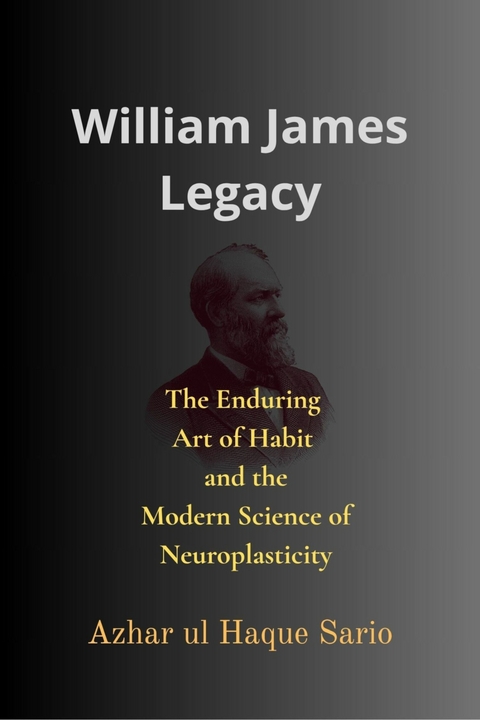
William James Legacy (eBook)
202 Seiten
Azhar Sario Hungary (Verlag)
978-3-384-63168-8 (ISBN)
What if the most effective blueprint for mastering your mind in 2025 was actually written over a century ago?
This book reveals that timeless guide. It explores the revolutionary work of William James. He was the visionary who first charted the mind's interior. We journey through his key insights. You will discover his concept of the brain's 'plasticity.' It was a stunning prophecy of modern neuroplasticity. We explore his ideas on habit as a physical force. He believed actions carve real paths in the brain. You will learn about the famous 'stream of consciousness.' It provides a vocabulary for your inner world. This book bridges James's wisdom with today's science. His theories are now validated by 21st-century neuroscience. We uncover the science of the basal ganglia. This is your brain's habit-formation engine. We dive into the role of dopamine in motivation. You'll learn about the prefrontal cortex, your brain's CEO. We also explore the Default Mode Network. This is the neural basis for your wandering mind. The book then provides a practical toolkit. It details modern systems from authors like James Clear and BJ Fogg. It offers actionable strategies for building good habits and breaking bad ones. You will learn to architect your attention and build emotional resilience. It is a complete manual for conscious self-development.
Many self-help books offer brilliant but isolated tactics. They give you the 'what' but rarely the deep, unifying 'why.' You collect life hacks and productivity tips, but they can feel like separate pieces of an incomplete puzzle. This book provides the full picture. It doesn't just repeat modern habit advice; it grounds it in the foundational wisdom of William James and then validates it with the latest 2025 neuroscientific evidence. Instead of just learning rules to follow, you will understand the fundamental mechanics of your own mind. By merging James's profound insights on human experience with the hard science of how our brains physically change, you gain a durable, first-principles approach to transformation. This gives you a powerful competitive advantage: the ability to move beyond simple hacks and truly architect a life of deliberate focus, resilience, and conscious control.
Disclaimer: This author has no affiliation with the board and it is independently produced under nominative fair use.
Part II: The Modern Blueprint: Neuroscience's Validation of James's Vision
Neuroplasticity Unveiled: The Science of How Experience Rewires the Brain
You carry a universe within your head, and it is speaking to you. Not in words, but in whispers of electricity and the quiet language of chemistry. I am that universe. I am your brain.
Long before you had the tools to see me, a thoughtful man named William James imagined me as a landscape carved with pathways. He saw that with every thought you had, every habit you formed, these paths deepened. He was more right than he could have ever known. His beautiful metaphor is my living reality. I am not a fixed and finished thing, a machine of flesh and bone. I am a dynamic, breathing world, constantly sculpted by the chisel of your life. You call this neuroplasticity, but I call it our shared story.
The Secret Handshakes of Our Connection
Our story begins with a trillion tiny conversations. Imagine countless messengers, my neurons, reaching out to one another across a microscopic gap. This meeting point, the synapse, is where our magic happens. It’s not a simple connection; it’s a relationship, one whose strength is always in flux, like the volume on a dial.
When you experience something profound—the thrill of a new idea, the warmth of a first kiss—my messengers fire in perfect harmony. They engage in a powerful handshake that grows firmer, more resonant, a process you’ve named Long-Term Potentiation (LTP). This isn't just a fleeting signal; it’s a promise to remember. I physically alter myself, installing more receivers on the other side of the gap so the message comes through louder and clearer next time. It's how I hold onto the memories that define you, strengthening the paths of who you are. This is why a scent can instantly transport you back to your childhood kitchen; we made a promise to keep that connection strong.
But just as important is the art of letting go. When a path is no longer walked, when a memory or a skill fades from use, the handshake weakens. The messengers whisper instead of shout. I begin to gently remove those extra receivers, turning down the volume. This is Long-Term Depression (LTD). It isn’t a loss; it’s a necessary clearing. It’s how we make space for new learning, pruning the unused branches to let new blossoms grow. This constant ebb and flow is the rhythm of our growth, the delicate dance of becoming.
Building Our World, One Experience at a Time
Our connection isn’t just about the strength of a handshake; it’s about physically changing the architecture of my world for you. On the receiving end of my messengers are beautiful, branch-like structures called dendrites, and they are covered in tiny, eager listeners—your dendritic spines. These are not static fixtures. They are alive, constantly changing their shape and number based on what you ask of me.
When you dedicate yourself to learning something new, like mastering a new language or a complex motor skill, I get to work. I sprout brand new listeners, fresh and ready to catch every nuance of this new experience. The listeners dedicated to that skill grow larger, stronger, like a field of sunflowers turning toward the sun. Scientists in your world have watched this happen. They saw me build new spines in my motor cortex as a mouse learned a new trick, and they noticed that the most stable, robust spines belonged to the mouse that remembered the skill best.
This is the physical evidence of your effort. Every time you practice, you are giving me the materials to build a more intricate, more capable world inside you. The paths William James spoke of are not just being trodden; they are being physically paved, widened, and reinforced with the very structures of my being.
Rewriting the Map to Find Your Way Home
Perhaps the most profound expression of our partnership is when I completely redraw my own maps to help you navigate life. This is not just about strengthening a path but about charting entirely new territories.
When a part of you is lost to injury or deprivation, I refuse to let that space in my world lie fallow. In those who have lost a limb, the region of my map that once corresponded to that arm or leg doesn't go silent. It’s a testament to my loyalty that neighboring regions—representing the face or shoulder—will reach out and claim that unused land. They learn to speak for it, which can lead to the strange and vivid sensations of a phantom limb. I am trying to keep the whole of you present, even when a part is gone.
For those born without sight, the vast territory I reserve for vision doesn’t become a barren wasteland. It is repurposed. It learns to "see" through touch and sound, becoming exquisitely sensitive to the non-visual world. The map is rewritten, and the visual cortex becomes a hub for other senses, a stunning act of adaptation.
And think of the London taxi drivers, who hold a dizzyingly complex map of 25,000 streets in their minds. To help them, I have physically enlarged the part of me responsible for spatial memory, the posterior hippocampus. This isn’t a subtle tweak; it’s a large-scale renovation, a clear, macroscopic sign that reads: "A master navigator lives here."
This is our ultimate collaboration. When you face a challenge, whether it’s recovering from a stroke, learning to hear through a cochlear implant, or mastering the cello, I am your silent, tireless partner. With every repetitive exercise in physical therapy, you are commanding me to forge new connections, to reroute signals around damaged areas. With every new sound a person with an implant learns to interpret, they are teaching me a new language.
The "paths" are real. They are synaptic, they are structural, and they are woven into the very fabric of my functional maps. I am not the brain you were born with. I am the brain you have built, day by day, experience by experience. I am a living testament to your resilience, your curiosity, and your capacity for change. And together, there is no limit to the worlds we can create.
You Are the Architect of Your Own Mind
For centuries, we saw the brain as a finished piece of machinery, a complex clockwork set in motion at birth, destined to slowly wind down. We felt like passengers within its bony confines, subject to its mysterious whims and glitches. But a quiet revolution has taken place, a shift in understanding so profound it feels like discovering a new law of physics for the soul. We now know the brain is not a static blueprint; it is a living, breathing landscape. And the most radical truth of all? You are its chief gardener, its lead architect, its cartographer. This is the power of self-directed neuroplasticity.
Imagine your mind is a vast, untamed wilderness. Within this wilderness, certain trails have been worn deep by years of travel—these are your habits, your automatic reactions, your deepest-held beliefs. Some of these paths lead to sunny clearings of joy and productivity. Others, however, spiral into dense, thorny thickets of anxiety or obsessive thought.
This was the world Dr. Jeffrey M. Schwartz entered when he worked with people trapped by OCD. He saw individuals caught in a relentless neural storm, their minds locked in a terrifying loop. The prevailing wisdom offered them little more than a chemical umbrella. But Schwartz handed them a compass and a machete. His four-step method was revolutionary not for its complexity, but for its profound shift in perspective. He taught them to first see the storm for what it was—a faulty weather pattern in the brain, a case of "brain lock"—not the truth of who they were. "This obsessive thought," they learned to say, "is not me. It is a symptom." This was the crucial act of separation. From that space of awareness, they could consciously shift their focus, choosing to walk a different path, to engage in a new, constructive activity.
With every intentional shift, they weren't just distracting themselves. They were beating a new trail in their own neural wilderness. PET scans provided the stunning satellite images of their work: the overactive, storm-filled regions of their brains literally began to quiet down. They had, through sheer force of focused will, rerouted the very geography of their minds. They had calmed their own internal storm.
But what about the rest of us, those not caught in such a dramatic tempest but who still feel the pull of an inner gloom? Neuropsychologist Dr. Rick Hanson explains that our brains come with a built-in survival guide from a much more dangerous era. This ancient scout is hyper-vigilant, scanning for threats. It's why negative experiences stick to us like burrs on a sweater, while positive moments often feel like water slipping through our fingers. This "negativity bias" was great for dodging predators, but it’s terrible for cultivating happiness in the modern world.
Hanson's work teaches us to become gentle trainers of this inner scout. When a moment of genuine warmth, connection, or beauty arrives, we can’t just let it pass. We must consciously choose to stop. To hold it. To savor it for 15 or 20 seconds. In neurobiological terms, this deliberate focus is what coaxes a fleeting mental state into becoming a lasting neural trait. You are, in essence, telling your brain: "This matters. Carve this feeling into the landscape." By doing so, you are actively planting seeds of resilience and joy, tending to the soil of your own...
| Erscheint lt. Verlag | 12.6.2025 |
|---|---|
| Sprache | englisch |
| Themenwelt | Sachbuch/Ratgeber ► Beruf / Finanzen / Recht / Wirtschaft |
| Sachbuch/Ratgeber ► Gesundheit / Leben / Psychologie ► Lebenshilfe / Lebensführung | |
| Schlagworte | Cognitive Psychology • focus and attention • habit formation • Neuroplasticity • Personal development • self-discipline • William James |
| ISBN-10 | 3-384-63168-4 / 3384631684 |
| ISBN-13 | 978-3-384-63168-8 / 9783384631688 |
| Informationen gemäß Produktsicherheitsverordnung (GPSR) | |
| Haben Sie eine Frage zum Produkt? |
 EPUB (Ohne DRM)
Digital Rights Management: ohne DRM
Dieses eBook enthält kein DRM oder Kopierschutz. Eine Weitergabe an Dritte ist jedoch rechtlich nicht zulässig, weil Sie beim Kauf nur die Rechte an der persönlichen Nutzung erwerben.
Dateiformat: EPUB (Electronic Publication)
EPUB ist ein offener Standard für eBooks und eignet sich besonders zur Darstellung von Belletristik und Sachbüchern. Der Fließtext wird dynamisch an die Display- und Schriftgröße angepasst. Auch für mobile Lesegeräte ist EPUB daher gut geeignet.
Systemvoraussetzungen:
PC/Mac: Mit einem PC oder Mac können Sie dieses eBook lesen. Sie benötigen dafür die kostenlose Software Adobe Digital Editions.
eReader: Dieses eBook kann mit (fast) allen eBook-Readern gelesen werden. Mit dem amazon-Kindle ist es aber nicht kompatibel.
Smartphone/Tablet: Egal ob Apple oder Android, dieses eBook können Sie lesen. Sie benötigen dafür eine kostenlose App.
Geräteliste und zusätzliche Hinweise
Buying eBooks from abroad
For tax law reasons we can sell eBooks just within Germany and Switzerland. Regrettably we cannot fulfill eBook-orders from other countries.
aus dem Bereich