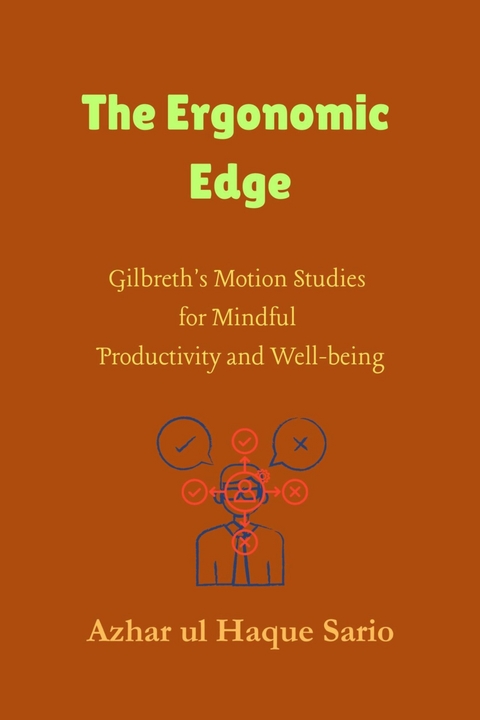
The Ergonomic Edge (eBook)
206 Seiten
Azhar Sario Hungary (Verlag)
978-3-384-63159-6 (ISBN)
Hey, want to work smarter and feel better doing it? Meet the Gilbreths-Frank and Lillian-who cracked the code on making life easier way back when, and now their ideas are here to save your 2025 vibe.
This book's a total game-changer. It digs into the Gilbreths' genius-think motion studies and fatigue fixes-and brings them straight into today's world. You'll get how to cut the chaos of remote work. It's got tips for setting up a killer home office. Digital clutter driving you nuts? It's covered. Burnout creeping in? Yep, it's got your back there too. From tweaking your desk to mastering your inbox, it's all here. The book breaks down their 'Therbligs'-cool little motion units-to make your day smoother. It's split into three parts: Foundations kicks off with their story, The Ergonomic Edge in Action applies it to now, and The Ergonomic Mindset looks ahead with stuff like AI and wearables. You'll even learn to streamline chores or hobbies-like, who knew vacuuming could feel less awful? By the end, you've got a manifesto to rethink work and life, all human-first.
Now, here's why this book's a cut above. Most productivity guides just yell 'do more!' or push fancy apps-lame, right? This one's different. It mixes the Gilbreths' old-school smarts with new brain science and tech tricks. It's not about grinding harder; it's about living better. You'll feel like your own life coach, spotting what's bogging you down and fixing it. Other books miss the big picture-this one ties your desk, your mind, and even your downtime into one neat package. It's practical, personal, and actually cares about you-not just your to-do list. That's the edge you won't find anywhere else.
Oh, and one quick note: Disclaimer: The author's not tied to any Gilbreth-related boards or groups. This book's a solo project, built from scratch, and uses their ideas under fair use rules. All original, all for you.
So, ready to ditch the stress and make work (and life) feel human again? This is your guide.
Part 1: Foundations – Rediscovering the Gilbreths' Wisdom
The Forgotten Humanists: Reintroducing the Gilbreths and Their Ergonomic Vision
The Clockwork Man vs. The Human Blueprint: A Tale of Two Efficiencies
In the dawn of the 20th century, amidst the clatter and smoke of a new industrial age, a revolution was quietly brewing. It wasn't a war of nations, but a battle of ideas, fought on the factory floors and in the minds of two visionary camps. At stake was the very soul of work itself. On one side stood Frederick Winslow Taylor, the maestro of the stopwatch, who saw the worker as a cog in a perfectly calibrated machine. On the other, the husband-and-wife duo, Frank and Lillian Gilbreth, who saw the worker not as an instrument, but as the heart of the entire enterprise, believing that the truest efficiency was born from human well-being.
Taylor, the undisputed "father of scientific management," approached the world of work with an engineer's precision and a zeal for absolute order. His 1911 treatise, "The Principles of Scientific Management," became the gospel for a generation of managers hungry for optimization. Armed with a stopwatch and an unyielding belief in the "one best way," Taylor dissected every task into its most granular components. He famously descended upon the Bethlehem Steel Works, transforming the back-breaking labor of loading pig iron into a science. By meticulously selecting workers, dictating their every movement, and prescribing precise rest periods, he astonishingly tripled a man's daily output. For Taylor, the formula was simple: management was the brain, the worker was the hand. Thought and action were to be forever separate. While this method undeniably supercharged productivity, it often bled the humanity from the workplace, creating a landscape of monotonous, repetitive tasks that treated people as little more than flesh-and-blood automatons. The silent critique of Taylorism was etched in the weary faces and strained bodies of the very workers who made its spectacular results possible.
In vibrant contrast stood Frank and Lillian Gilbreth, pioneers of "Motion Study." They saw the same inefficiencies as Taylor, but diagnosed a different disease. For them, the great enemy wasn't wasted time, but wasted life. They viewed unnecessary motion as a thief of human potential, a drain on the finite energy that fuels not just a workday, but a lifetime. Frank, a former bricklayer who had personally experienced the exhaustion of poorly designed work, and Lillian, a groundbreaking psychologist, brought a unique synergy to their studies. They were the original work-life integrators, and their laboratory was the world around them—from the factory floor to their own bustling kitchen, where they raised twelve children.
The Gilbreths harnessed the new magic of motion pictures, using early 35mm cameras to film workers. In the flickering silence of the film, they found a language of movement. They broke down actions into 18 fundamental motions they whimsically named "therbligs" (a playful anagram of their surname). Their goal was not just to make work faster, but to make it easier. They sought to eliminate the frustrating, fatiguing, and often invisible movements that wore a worker down. "There is no waste of any kind in the world that equals the waste from needless, ill-directed, and ineffective motions," they declared. This wasn't a business slogan; it was a humanitarian creed. They saw fatigue as "humanity's greatest unnecessary waste," a sentiment that resonates powerfully today.
Modern science has overwhelmingly vindicated the Gilbreths' focus. We now know that fatigue is a saboteur of both productivity and safety. A staggering 63% of manufacturing workers report feeling tired on the job, a condition that employers link directly to lower output and a 44% increase in safety incidents. Fatigue is the ghost in the machine, dulling concentration, slowing reactions, and leading to costly errors. The Gilbreths were fighting this ghost a century ago, not just with better processes, but with a deeper respect for the human body and mind.
The legacies of these two philosophies are woven into the fabric of our modern world, often in surprising ways. Taylor's ghost still haunts the hyper-standardized aisles of fast-food chains, where the assembly of a burger is a ballet of prescribed, timed movements. It echoes in the scripts of call center agents and the regimented tasks of large retail operations. The efficiency is undeniable, but so too is the lingering shadow of dehumanization and high employee turnover.
Meanwhile, the Gilbreths' human-centered design philosophy flourishes in fields they could have only imagined. Every time a surgeon seamlessly receives the correct instrument from a nurse, minimizing their own movement to maintain focus on the delicate task at hand, the Gilbreths' principles are at play. This elegant efficiency, born from reducing extraneous motion, is a direct application of their work. The ergonomic chairs we sit in, the keyboards designed to reduce strain on our wrists, and the intuitive software interfaces that minimize clicks are all descendants of their motion studies. In a cutting-edge example, engineers at Northwestern have developed wearable sensors that use machine learning to predict worker fatigue in real-time. This allows for proactive interventions, like adaptive rest cycles, creating a workplace that responds to the individual's needs—a goal the Gilbreths would have championed.
While Taylor erected the scaffolding of industrial efficiency, it was the Gilbreths who insisted that a human heart must beat within it. They understood a profound truth that we are still rediscovering: sustainable productivity is not about pushing people to their limits, but about designing work that respects those limits. In their quest to eliminate "humanity's greatest unnecessary waste," they championed a future where efficiency and empathy are not competing ideals, but two sides of the same coin. As we navigate an era of artificial intelligence and increasing automation, their belief in the primacy of the human element is not just a historical footnote; it is a vital blueprint for the future of work.
In an age of roaring steel and clattering machines, when the world was obsessed with the cold, hard math of efficiency, one woman heard a different rhythm. It wasn't the relentless tick of the stopwatch that captivated her, but the quiet, often-ignored whisper of the human spirit. Her name was Lillian Gilbreth, and she is the unsung architect of our modern workday, the woman who taught industry to have a heart.
Forget the black-and-white images of grim factories. Think, for a moment, about the chair you’re sitting in. The gentle curve that supports your back, the intuitive height of your desk, the seamless flow of your kitchen as you make coffee. These daily comforts are not accidents; they are echoes of a revolution started by a woman who dared to believe that the worker was more important than the work.
While her husband, Frank, was famously timing movements to shave seconds off tasks, Lillian, armed with a rare Ph.D. in psychology, was looking at the person doing the moving. In a world dominated by engineers who saw people as mere cogs, she saw minds, muscles, and souls. She saw fatigue, frustration, and the "wasted motion" of a burdened spirit. This wasn't just a different perspective; it was a different dimension. Her foundational 1914 book, The Psychology of Management, wasn't just a text—it was a declaration of independence for the individual within the system. Management, she argued, wasn't about command and control. It was a profound, two-way street, considering "the effect of the mind that is directing work upon that work which is directed, and the effect of this...work upon the mind of the worker."
She proposed a radical notion: what if we stopped trying to force a person to fit a job and instead, sculpted the job to fit the person?
This idea became her life's work and the bedrock of entire fields we now take for granted. Industrial psychology, human factors, ergonomics—they all carry Lillian Gilbreth's DNA. She was the one who championed the then-outlandish idea of rest periods, proving they weren't signs of weakness but gateways to sustained productivity. She advocated for suggestion boxes, giving a voice to the voiceless on the factory floor.
Her genius wasn't confined to the industrial sprawl. She brought her revolution home, transforming the American kitchen from a place of domestic drudgery into a model of elegant efficiency. Working with companies like General Electric, she became the invisible hand guiding the design of our daily lives. That convenient shelf on your refrigerator door? The foot-pedal on your trash can that frees up your hands? These were Lillian’s insights, born from meticulously studying the "dance" of daily chores and finding ways to make the steps easier, lighter, and more humane.
Her impact was tangible and immediate. When Macy's department store adopted her principles for their cashiers, they didn't just get happier employees; they slashed the training time for new hires from a grueling four months to a mere two days. Why? Because Gilbreth hadn't just optimized the process; she had honored the person performing it.
Lillian Gilbreth didn't just tweak systems; she infused them with empathy. In a world rushing toward automation, she reminded us that our greatest resource is not the machine, but the mind and body that operate it. She was a quiet...
| Erscheint lt. Verlag | 12.6.2025 |
|---|---|
| Sprache | englisch |
| Themenwelt | Sachbuch/Ratgeber ► Beruf / Finanzen / Recht / Wirtschaft |
| Sachbuch/Ratgeber ► Gesundheit / Leben / Psychologie ► Lebenshilfe / Lebensführung | |
| Schlagworte | Ergonomics • Gilbreth • Motion Studies • Personal Growth • Productivity • Remote Work • well-being |
| ISBN-10 | 3-384-63159-5 / 3384631595 |
| ISBN-13 | 978-3-384-63159-6 / 9783384631596 |
| Informationen gemäß Produktsicherheitsverordnung (GPSR) | |
| Haben Sie eine Frage zum Produkt? |
 EPUB (Ohne DRM)
Digital Rights Management: ohne DRM
Dieses eBook enthält kein DRM oder Kopierschutz. Eine Weitergabe an Dritte ist jedoch rechtlich nicht zulässig, weil Sie beim Kauf nur die Rechte an der persönlichen Nutzung erwerben.
Dateiformat: EPUB (Electronic Publication)
EPUB ist ein offener Standard für eBooks und eignet sich besonders zur Darstellung von Belletristik und Sachbüchern. Der Fließtext wird dynamisch an die Display- und Schriftgröße angepasst. Auch für mobile Lesegeräte ist EPUB daher gut geeignet.
Systemvoraussetzungen:
PC/Mac: Mit einem PC oder Mac können Sie dieses eBook lesen. Sie benötigen dafür die kostenlose Software Adobe Digital Editions.
eReader: Dieses eBook kann mit (fast) allen eBook-Readern gelesen werden. Mit dem amazon-Kindle ist es aber nicht kompatibel.
Smartphone/Tablet: Egal ob Apple oder Android, dieses eBook können Sie lesen. Sie benötigen dafür eine kostenlose App.
Geräteliste und zusätzliche Hinweise
Buying eBooks from abroad
For tax law reasons we can sell eBooks just within Germany and Switzerland. Regrettably we cannot fulfill eBook-orders from other countries.
aus dem Bereich