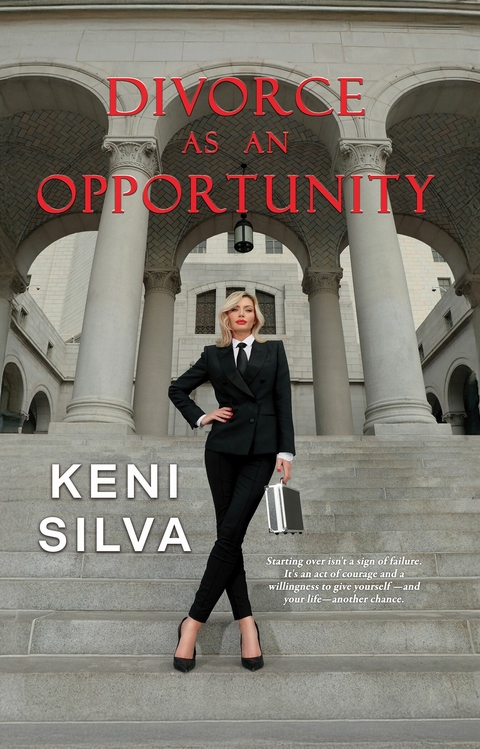
Divorce As an Opportunity (eBook)
148 Seiten
Bookbaby (Verlag)
979-8-3509-9850-4 (ISBN)
Keni Silva is a divorce coach and expert, media personality, philanthropist, model and entrepreneur. Keni has appeared on a litany of podcasts and in a number of publications speaking out on changing the narrative surrounding divorce. Her media appearances are aligned with the message of her book, Divorce As an Opportunity, which is to empower women going through divorce and to erase the stigma of the experience. In addition, Keni has a master's degree in design from the Fashion Institute of Design & Merchandising, her California real estate broker's license, her certification as a divorce coach from the International Association of Professions Career College, and a Bachelor of Science in Business Administration from Plekhanov Russian University of Economics in Moscow. She has two children with her ex-husband and currently lives in Orange County.
Divorce is often seen as a heartbreaking ending, but what if it could be a powerful beginning? In Divorce As an Opportunity, divorce coach Keni Silva reveals the transformative potential of divorce and how it can surprisingly lead to a brighter future. Keni offers practical advice to guide readers through the divorce process, along with a refreshing perspective on the end of a marriage. Drawing on data, statistics, and insights from fellow divorcees and experts, Divorce As an Opportunity provides practical guidance and exercises to help you navigate the emotional and practical challenges of divorce. Keni shares personal stories and advice to empower you to embrace change, let go of fear and shame, and rediscover yourself in the process and aftermath of divorce. Divorce As an Opportunity will inspire you to create a life that is authentic, fulfilling, and joyful.
Chapter 1
Pulling The Trigger
The hardest part of divorce can be deciding to get one. While society has created a narrative that it is often men who are the initiators when it comes to divorce, in actuality women are the ones who call it quits nearly 70 percent of the time. (This statistic has been consistent in heterosexual marriages in the United States for several decades). When it came to my own divorce, I was no outlier. I was the one who asked for the divorce. But it wasn’t an easy decision.
One day you wake up and you realize you are not who you were yesterday—but you don’t know who you want to be tomorrow yet. All you know is that you are not happy with who you have become. And it hits you that you are not really living your life to the fullest. You’re just existing on autopilot for things people expect of you. I was scared to admit to myself the perfect life I had created was not so perfect after all. We all have these lists of how we want our lives to ideally be or what we want them to have. These sort of dream-lists we have created for ourselves. I was so determined to get everything on my list that I lost myself in the process. I am a big believer in manifesting—writing down your goals and desires on paper and working towards it. I was 23 when I met my husband. At the time, having children and a family and a beautiful home was a big priority. So that’s what was on my list at the time, and along the way, a couple of other things were added, too. Getting a Broker’s License, building even more dream homes, taking beautiful trips. But all these things were tangentially related to building a family more than they were directly correlated to my personal fulfillment. Eventually, over time, I realized I wanted something else. You start trying to find what went wrong, and even if nothing has, with time and age, people change. Is it okay to want something different if you don’t feel fulfilled after all the years of hard work a person puts into a marriage? That was the question I started asking myself. And I was afraid to admit it, but I wanted to change the beautiful life I had created for myself.
But the Pandemic was like a wake-up call for me. It made me realize that life is precious, and if I was to be stuck at home again, never to return to the outside world, would I be happy with what I had created? Would I be satisfied with my legacy? Is this who I wanted to be? The answer was no. I knew I had a beautiful life and beautiful children. I felt fortunate to have multiple degrees. But I wanted more. And I knew I couldn’t get it or create it in the space that I was in.
“She must find a boat and sail in it.
No guarantee of shore. Only a conviction that what she wanted could exist, if she dared to find it.”
– Jeanette Winterson, Oranges Are Not the Only Fruit
During this time of transition, I read something that stuck with me. It was a quote from another writer, a woman named Claire Cook who has written extensively on reinvention. “Maybe part of finding what you wanted was recognizing what you didn’t want. Maybe there was hope for me yet.” These words kept ringing through my head as I wobbled with my own future and decisions.
To this day, women whose marriages break apart are made to feel they have failed. And if you are a parent, the burden can be twice as difficult to bear. Isn’t divorce shameful, traumatic and bad for the kids? There is a reason that couples with children are 36% less likely to divorce than couples without children, according to National Health Statistics Reports. I used to stare at my two beautiful children, then 9 and 11 years old, and wonder if I was making the right decision. But I’ve learned that it can be a radical act of self-love, and not just for the woman going through the process. It can be one that leaves the whole family better off.
I knew that my children would still have a loving mother and father, and that they would still have a family, even if we weren’t all under the same roof. When I was 12 years old, I realized that I wanted my own parents to get divorced. I knew even then that they had become different people with different desires, and they would be happier apart. They were living together to create the illusion of a family. I felt responsible for their happiness and guilty that they were staying with each other. Even as a child, I could tell they were doing it just for me. I think that was the beginning of me wanting to move out of the house and become independent. At the age of seventeen, I moved in with my boyfriend. Shortly after, my parents got divorced. When my dad said he wanted to divorce my mom, I asked him why he had waited so long. I told him I knew he hadn’t been happy. He told me they had stayed together for me—so I could be raised by both parents. I tried to explain to him that I knew it was a façade, and one that hadn’t made me feel better. If anything, I wanted them to be apart and happy. I would have still loved them the same. This memory resonated heavily with me while I considered my own divorce.
Regardless, even with my own memories of my parent’s relationship, I still didn’t know what I wanted to do. I just knew that the relationship I was in didn’t give me the opportunity to discover who I truly am. My divorce, though, freed me from a relationship that was crushing my spirit. It freed my children from growing up in what could have been a profoundly unhealthy environment. Unlike many unlucky women, there was no emotional or physical abuse in our home (irreconcilable differences are cited as the reason for divorce in 32% of cases, followed by emotional abuse in 14%, infidelity in 13% and financial problems in 11% according to the Centers for Disease Control and Prevention). There was also no absence of love; my husband and I were—and still are—both very good parents, and I cared about my husband deeply when we got divorced. Part of me cares about him still. I suspect that will always be the case. I divorced my husband not because I didn’t care about him. I divorced my husband because I wanted to start caring more about myself.
As women, we are taught we should never put ourselves first. We are taught to put everyone else before ourselves. Our husbands, our children, our employees, our relatives: no matter who it is, cultural norms tell us that we are to take a backseat to everyone else’s needs. But being a good mother, and even being a good partner, is very much like the oxygen mask on an airplane analogy. When you fly, the flight attendant instructs you to put your oxygen mask on first before helping others. Why is this an important rule for ensuring survival? Because if you run out of oxygen yourself, you can’t help anyone else with their oxygen mask. The same is true in life. If you aren’t taking care of yourself, how can you be expected to take care of anyone else? I needed the divorce not because I didn’t care about everyone else. I needed it to take care of myself. I needed to put my oxygen mask on first.
As for my husband and I, there are many reasons we didn’t make it. But the main one is that we had incompatible visions of my future. Having children did not transform me. Yes, it was the best thing that ever happened to me. I love our children beyond reason. I know I am lucky to have them. But after I became a mother, I was still the same woman who moved to Milan on her own at 18 and to California at 19 to pursue her career, who got her first master’s in business at 22 and second master’s after having her first child and continued her ambitions by getting a real estate license a year later. Studies show that women with higher levels of education are more likely to initiate divorce than those with lower levels of education. I was no outlier there, either.
I had always had big goals for myself even when other people hadn’t or had told me I didn’t need to. I wanted to explore those sides of myself. I wanted to chase those opportunities I knew were still within me because I believed fervently that to be the best mother, to be my best overall version of me that I could be I needed to not give up on myself. I needed an identity, a purpose and the comfort of knowing who I was. I was doing that not only for myself, but for my children.
Sometimes during the final months of my marriage, I wavered. Maybe if I buried my personality, my hopes, my dreams, we could hold on. Should I save my marriage and give my children an intact family? I had been taught that divorce was a terrible thing, something to be avoided at all costs. Hadn’t we all?
But deep inside, I knew that trying to force myself to bury my own future potential happiness and ambitions, and always putting everyone else first would have been impossible and detrimental to everyone else involved. I wanted to be a role model to my children. And I certainly didn’t want to be a dishonest one.
There is an ingrained belief that anything is better than a “broken family.” That’s why the refrain “we stayed together for the kids” is thrown around so much. But when that is said, it’s not fooling anyone, and I knew I wouldn’t be either. Children know on an intuitive level what their parents are thinking, how they are feeling, and even more importantly, they can see how their parents are acting. Words aren’t the only things in a household. It doesn’t even need to be screaming matches. Long...
| Erscheint lt. Verlag | 10.6.2025 |
|---|---|
| Sprache | englisch |
| Themenwelt | Sachbuch/Ratgeber ► Gesundheit / Leben / Psychologie ► Partnerschaft / Sexualität |
| ISBN-13 | 979-8-3509-9850-4 / 9798350998504 |
| Informationen gemäß Produktsicherheitsverordnung (GPSR) | |
| Haben Sie eine Frage zum Produkt? |
 EPUB (Ohne DRM)
Digital Rights Management: ohne DRM
Dieses eBook enthält kein DRM oder Kopierschutz. Eine Weitergabe an Dritte ist jedoch rechtlich nicht zulässig, weil Sie beim Kauf nur die Rechte an der persönlichen Nutzung erwerben.
Dateiformat: EPUB (Electronic Publication)
EPUB ist ein offener Standard für eBooks und eignet sich besonders zur Darstellung von Belletristik und Sachbüchern. Der Fließtext wird dynamisch an die Display- und Schriftgröße angepasst. Auch für mobile Lesegeräte ist EPUB daher gut geeignet.
Systemvoraussetzungen:
PC/Mac: Mit einem PC oder Mac können Sie dieses eBook lesen. Sie benötigen dafür die kostenlose Software Adobe Digital Editions.
eReader: Dieses eBook kann mit (fast) allen eBook-Readern gelesen werden. Mit dem amazon-Kindle ist es aber nicht kompatibel.
Smartphone/Tablet: Egal ob Apple oder Android, dieses eBook können Sie lesen. Sie benötigen dafür eine kostenlose App.
Geräteliste und zusätzliche Hinweise
Buying eBooks from abroad
For tax law reasons we can sell eBooks just within Germany and Switzerland. Regrettably we cannot fulfill eBook-orders from other countries.
aus dem Bereich