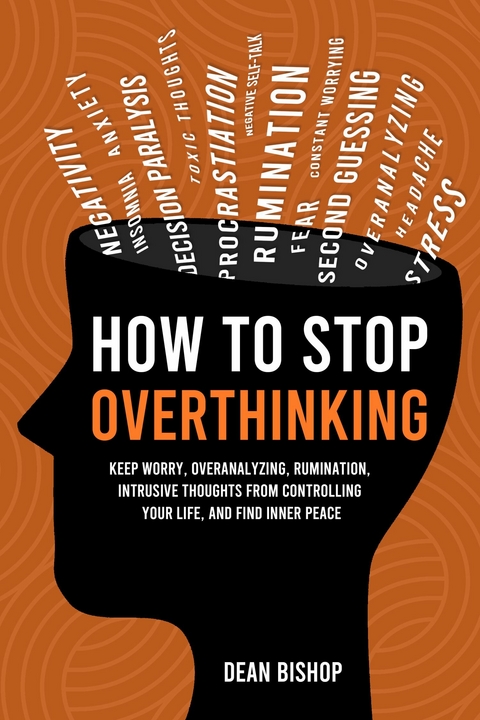
How to Stop Overthinking (eBook)
175 Seiten
Publishdrive (Verlag)
978-1-78793-855-7 (ISBN)
Have you ever wished for a pause button just to silence the relentless chatter in your mind?
Are your thoughts constantly spiraling, making it hard to focus on the present?
Do you feel like your overthinking is holding you back from truly living?
Do you find yourself trapped in a cycle of endless rumination?
Do past traumas and emotional wounds keep you up at night, replaying scenarios over and over?
I've been there. I know the weight of those thoughts, the heaviness they bring, and the yearning for peace. You're not alone in this journey.
Does any of these situations sound familiar?
- Haunted by past events, replaying them endlessly.
- Decision-making feels like navigating a maze of doubt.
- Emotional triggers set off tidal waves of anxiety.
- Pursuit of perfection leaves you fearing every judgment.
- Nights are restless, thoughts spinning without pause.
- Every conversation feels like a game of overanalysis.
- Constantly tired, but the mind won't stop racing.
- Past betrayals cast long shadows, making trust elusive.
Imagine for a second, what if you could...
- Navigate life with clarity, free from overthinking's chains.
- Embrace the present, shedding the weight of past traumas.
- Decide confidently, without the paralyzing what-ifs.
- Sleep deeply, giving your restless mind its due break.
- Engage socially with ease, no more overanalyzing.
- Heal and rebuild trust, mending emotional scars.
- Discover genuine inner peace, unlocking life's potential.
- Cultivate resilience, turning setbacks into growth.
But first, a warning...
This book isn't a magic pill. It won't instantly erase years of overthinking or heal deep-seated traumas overnight. Real change requires effort, introspection, and time. If you're searching for a quick fix, this might not be for you. But if you're genuinely committed, if you're ready to put in the work and seek lasting change, then this guide can be your beacon.
Here's just a fraction of what you'll discover inside:
- The secret to figuring out when your mind is playing tricks on you - how to conquer cognitive distortions, self-doubt, and negative thinking
- Everything you need to know about overthinking to gain a better grasp of it
- Conquering analysis paralysis - discover how to never be overwhelmed by your choices ever again
- Tips and tricks on how to tackle the number one cause (and consequence) of overthinking: stress
- The key to setting goals that don't leave any room for your mind to wander
- An essential relaxation toolkit to help you reach a calm and peaceful state of mind, whether you've got 20 minutes... or just one
- Mastering the art of decision making - trust your gut and make confident choices, be it something trivial or something really important
- Daily habits to keep your emotional equilibrium and ensure mental wellness and cognitive clarity
And so much more...
You might be thinking that nothing will work for you because your situation is beyond help, but that's just your cognitive distortions dragging you down.
Remember, as an overthinker, you can't believe everything you think.
But you can change your thoughts for the better, you can take charge of your own life, and you can be happier...
And don't let anyone - especially your mind - tell you otherwise.
Conquer your overthinking, deep clean your mind, and find the clarity, peace, and happiness you truly deserve.
Chapter 1:
Going Down the Rabbit Hole
“The easiest way to complicate things is to overthink.” ~ Sukant Ratnakar, Quantraz
When faced with an important decision, it is not unusual for us to spend a lot of time thinking about it. I remember the time when I had to decide as to whether I was going to make a career change. I spent much of my time thinking about all my options and the benefits and consequences associated with each.
Now imagine what if this amount of thinking was not reserved for decisions of major importance. What if it was your normal way of thinking, even when it involved minor things?
What Is Overthinking?
Overthinking is the rumination of thoughts; it is when we dwell on our thoughts regarding situations at the expense of taking action to improve things. Further, overthinking is not reserved for situations of major importance. Overthinking can involve minor or mundane situations as well. Stated another way, overthinking can be described as unproductive thinking. Besides being unproductive, overthinking can disrupt your life and compromise your sense of well-being.
As I write this book, I remember what it was like when I engaged in overthinking. I would think about what will happen if my plans do not work out. I would anticipate what people would say to me before I even met up with them. When I did meet up with them, I would think about what they were thinking of me!
During those years that I engaged in overthinking, I did not live in the world and experience it. Rather, I lived in my head and experienced my fearful interpretation of my life. It is for this reason that overthinking can be emotionally and physically draining. When we overthink, it makes it difficult for us to make decisions. Because we have trouble making decisions, we hold back on taking action, which then leads to anxiety. In turn, our anxiety makes it difficult to get a good night’s sleep. All of this makes it difficult for us to focus and concentrate. This, in turn, leads to more overthinking.
When we overthink, we spend all of our time in our heads, so we miss out on the present moment, including our being emotionally present when we are around others. Our focus is on ourselves, not on other people.
Overthinking can be useful at times such as when you have to deliver on an important project. In this case, overthinking can get you motivated and more aware of what you need to do. On the other hand, it becomes unhealthy when it keeps you from taking action, disrupts your daily life, or negatively impacts your sense of well-being.
Overthinking Versus Deep Thinking
There is a big difference between overthinking and deep thinking. I remember a time when I had to make an important decision that would affect the well-being of my family. There were no easy answers, and there were many factors that had to be considered. This decision monopolized my attention, and I gave it a tremendous amount of thought. Though I was preoccupied with this situation, I was becoming more and more clear as to what the right decision was. It resulted in me feeling good about the decision that I made.
On the flip side, I remember what it was like when I was younger. How I handled difficult situations was very different. I felt stressed about the situation, and I repeatedly questioned myself. I overthought the situation, which resulted in me taking minimal action toward a solution.
These examples from my life illustrate the difference between overthinking and deep thinking. When you are engaged in deep thinking, you feel like you are moving forward in your understanding of the situation. Also, your thoughts are solution oriented. You are not dwelling on what may go wrong or in self-doubt.
On the other hand, overthinking leaves you feeling stuck and you are unable to make progress. Instead of being solution-oriented, your thoughts are focused on past disappointments or doubts about the future. In other words, your attention is less solution-focused and more focused on all the things that could go wrong. Instead of feeling more encouraged, you experience more negative self-talk, which leads to feeling anxious and emotionally exhausted.
Why Do We Overthink?
There are several theories on why we overthink. Some experts believe that overthinking is a strategy that we use to feel more in control and confident about a situation (Witmer, 2023). In our attempts to reduce anxiety, our brains go through all the possible scenarios and predict their outcomes.
Though overthinking may reduce stress in the short term, it usually creates greater stress for us in the future. The reason for this is that when overthinking, we are less likely to take action to address our situation.
There is also the theory that overthinking may be caused by past experiences. Children with overcontrolling parents are more susceptible to developing passive personalities, leading to overthinking. Also, those who experienced traumatic or stressful events in the past are more likely to demonstrate overthinking (Eng, 2020).
Lastly, there is the theory that overthinking may be a response from the primitive part of the brain. Overthinking, along with anxiety and depression, may be associated with the primitive part of our brain where survival instincts originate.
We retain a part of the brain structure that was found in early man and animals. For them, survival was the main concern. When there is a threat from a predator, there is no time for rational or optimistic thinking. Rather, there is a need for hyper-vigilance to survive.
Though we have evolved from our primitive past, and though we do not have to worry about being preyed upon by predators, that primitive part of our brain remains. Instead of predators, this part of the brain reacts to the threats posed by modern society, such as being able to pay our bills or relationship problems. Those who overthink may be caught in the fight-or-flight mode that is a response from the primitive brain.
Regardless of the reason why we overthink, that is not nearly as important as why we maintain this habit. The following are reasons why we may continue to do so:
Illusions of Certainty and Control: Despite all the disadvantages that come with overthinking, it does provide a benefit, though it is illusionary in nature. It is human nature for us to not want to feel uncertain; we need to feel that we are in control. Most of us need to feel that we are in control even in situations where things are out of our control. Ruminating thoughts and worrying may make us feel like we have a level of certainty and control although it is just an illusion.
The way of getting out of this trap is to learn to accept that there are times when there is nothing that you can do about a situation and to come to terms with that reality. It is beneficial to learn to live with uncertainty.
Perfectionism: Perfectionism is a personality trait; it is not a personality disorder. Those with this type of personality are ruled by their feelings. Intellectually, they know that nothing can ever be perfect. However, on the feeling level, they have difficulty moving forward because they feel like more needs to be done on what they are working on.
Those who are perfectionists often overthink a problem. They do this because they have a low tolerance for leaving a task that they feel could be improved upon. Overthinking distracts them from feelings that they are not good enough. For such individuals, it is important to learn to tolerate feelings of inadequacy so one can move forward.
Secondary Gain: The only reason why we repeat a behavior is because we perceive that there is a benefit to doing it. That benefit is a change in how we feel. While thoughts are not behaviors, our behaviors are often born from our thoughts. As we saw with perfectionism, overthinking can distract from feelings of inadequacy.
In the same way, overthinking can lead to other feelings that we find rewarding, even though it can lead to many negative effects in the long term. However, feeling good in the short-term is more impactful to the mind than the future long-term consequences, which remain abstract to the mind. By focusing on the long-term consequences of overthinking, you can train your mind to realize that short-term gain is not worth it.
Overgeneralizing: As previously mentioned, there is a difference between overthinking and deep thinking. Without recognizing that there is a difference, we may think that overthinking is a good thing. It should be clear by now that overthinking leads to more negatives than benefits.
However, even deep thinking can have its faults if it is overgeneralized. Just because deep thinking is useful in some cases, it does not mean it is useful in all cases. It is completely appropriate to spend time deep thinking when you want to figure out how to improve your relationships. However, deep thinking about whether you should exercise today or not just provides an excuse for not doing it.
You can avoid this situation by making a list of areas in your life where the only thing that is needed is to decide if you are going to do it or not rather than spending your time thinking about it.
Conflict Avoidance: We tend to avoid conflict. Most of us become fearful or anxious when a conflict arises. As a result, most of us have not learned how to deal with conflict effectively. Instead, we may engage in overthinking. The problem is that conflict is part of life. As long as we avoid conflict, we will just create more of it.
For this reason, use conflict as a learning tool for how you can...
| Erscheint lt. Verlag | 6.6.2025 |
|---|---|
| Sprache | englisch |
| Themenwelt | Sachbuch/Ratgeber ► Gesundheit / Leben / Psychologie ► Familie / Erziehung |
| Sachbuch/Ratgeber ► Gesundheit / Leben / Psychologie ► Psychologie | |
| Schlagworte | anxiety management daily mental detox plan • decision making clarity mindfulness practice • emotional regulation techniques for overthinkers • negative thought patterns cognitive reframing • perfectionism anxiety self-doubt mental habits • repetitive thoughts inner calm stress relief • self-awareness emotional triggers mindset shift |
| ISBN-10 | 1-78793-855-7 / 1787938557 |
| ISBN-13 | 978-1-78793-855-7 / 9781787938557 |
| Informationen gemäß Produktsicherheitsverordnung (GPSR) | |
| Haben Sie eine Frage zum Produkt? |
 EPUB (Ohne DRM)
Digital Rights Management: ohne DRM
Dieses eBook enthält kein DRM oder Kopierschutz. Eine Weitergabe an Dritte ist jedoch rechtlich nicht zulässig, weil Sie beim Kauf nur die Rechte an der persönlichen Nutzung erwerben.
Dateiformat: EPUB (Electronic Publication)
EPUB ist ein offener Standard für eBooks und eignet sich besonders zur Darstellung von Belletristik und Sachbüchern. Der Fließtext wird dynamisch an die Display- und Schriftgröße angepasst. Auch für mobile Lesegeräte ist EPUB daher gut geeignet.
Systemvoraussetzungen:
PC/Mac: Mit einem PC oder Mac können Sie dieses eBook lesen. Sie benötigen dafür die kostenlose Software Adobe Digital Editions.
eReader: Dieses eBook kann mit (fast) allen eBook-Readern gelesen werden. Mit dem amazon-Kindle ist es aber nicht kompatibel.
Smartphone/Tablet: Egal ob Apple oder Android, dieses eBook können Sie lesen. Sie benötigen dafür eine kostenlose App.
Geräteliste und zusätzliche Hinweise
Buying eBooks from abroad
For tax law reasons we can sell eBooks just within Germany and Switzerland. Regrettably we cannot fulfill eBook-orders from other countries.
aus dem Bereich