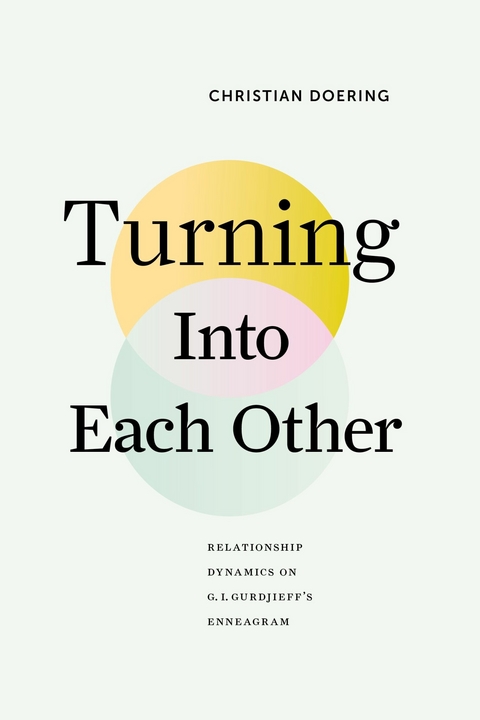
Turning Into Each Other (eBook)
232 Seiten
Bookbaby (Verlag)
979-8-3178-0698-9 (ISBN)
Among the many things Christian Doering has been during his 75 years on Earth: husband (twice); father; writer; musician; student at The International Academy for Continuous Education, where he was introduced to G. I. Gurdjieff's Enneagram of self-renewing processes by J. G. Bennett; survivor of prostate cancer. Christian is currently living with metastatic liver cancer in northern California, thanks to the love and support of his wife Lis, his family, and the Guitar Circle.
As the poet once asked: "e;What is Love?"e;Interestingly, this book is not so much about Love as about loving, with emphasis on the "e;ing"e; part so, it is an action, a process. Turning into Each Other explores the evolving nature of love and relationships, emphasizing that real Love is a process rather than a feeling. This process is that of relationships, and, from my experience, it works equally well as a guide for couple relationships and group relationships (I've used the book as a guide for both). Many people believe that commitment to a partner or a project will naturally lead to happiness, but the book argues that love requires effort, self-awareness, and adaptation. The book asserts that lasting love requires transcending personal limitations, embracing change, and recognizing love as a shared journey rather than a fixed state. Through challenges, couples and/or work groups can transform their relationship into something more profound, moving beyond romantic idealism or functional efficiency and "e;spiritual"e; self-deception into a partnership built on mutual understanding and continuous evolution. Reading this book to me felt like having a conversation with a wise friend one who's been around the block a few times and wants to help you navigate your own path. The insights here aren't sugar-coated, but they're real, grown from personal experience and work, and that's very much the point. Leonardo Requejo, Ph.D. Cuernavaca, MexicoMarch 2025
The Enneagram of Relationships
To everything there is a season, and a time to every purpose under the heaven: a time to be born and a time to die; a time to plant, and a time to pluck up that which is planted; a time to kill, and a time to heal; a time to break down, and a time to build up; a time to weep, and a time to laugh; a time to mourn and a time to dance; a time to cast away stones, and a time to gather stones together; a time to embrace, and a time to refrain from embracing; a time to get, and a time to lose; a time to keep, and a time to cast away; a time to rend, and a time to sew; a time to keep silence, and a time to speak; a time to love, and a time to hate; a time of war, and a time of peace.
— Ecclesiastes 3:1-8
Are there any similarities between cooking and eating a meal and living a relationship? Perhaps not at first glance, but look deeper and surprising similarities emerge. We all know that the honeymoon doesn’t last forever, we all know that most of the people we know who are in committed relationships find them very difficult, and if we’re lucky we have met a few couples who seem to have found or created a special joy and peace in a long-lasting relationship. But how those lucky couples found or made a way into their Garden through the process of relationship remains a mystery, perhaps even to those who have lived the experience.
This could be because we don’t have a working model of relationships as a process of growth and change. The relationship of two people has certain definite stages as it progresses through time. The differences between the formative, developmental and fulfillment stages of a relationship are as profound as those between the preparation, cooking, and serving of a meal. No wonder the experience of the two people inside the relationship changes dramatically at each of those stages.
Knowing that relationships pass through different stages is not the same as understanding why this must be so. If we don’t fully recognize and appreciate the dynamic nature of relationship, we can’t anticipate the inevitable changes in the way we experience the process. This makes it more difficult to accept and handle the challenges of the particular stage in which we find ourselves.
Building and sustaining a committed relationship is not easy–everyone needs help at some point. But we may not accept that help is needed, or know what the right kind of help is at the stage we’re in, or what forms that help might take. When things change without warning, or when the relationship gets stuck, we usually blame our partner, and later perhaps ourselves. One thing the Enneagram can show us is that the relationship must inevitably pass through crossroads, turning points, intervals when it needs something that the couple cannot provide on their own. This is true even when the partners are compatible types according to astrology, Enneagram personality typologies or other type systems. The partners may have all the right stuff, all the proper ingredients, within themselves, but still be unable to move the process forward without help.
One consequence of those misunderstandings is that about 40 to 50% (depending on who’s compiling the statistics) of formalized marriages end in divorce. Some of us never commit to any relationship, becoming “hopeless romantics” who fall in and out of love over and over again. Or we might find time in our lives to explore more deeply, through two or more committed relationships that fall into difficulty, get “stuck in the middle with you,” and then, having failed to find a path forward to fulfillment, fall apart. The way forward may be hard to see and even harder to take, but the way out is often available, thanks to the economic and social freedoms of the developed world. So we fail to form commitments, or else we break them and, after a grieving period, go back to the beginning by starting a new relationship.
Some would argue that this is normal, that no one should expect to spend an adult lifetime with the same partner. Starting but never finishing relationships may be ordinary, but it is not normal. This is too bad for all of us, because our world needs all the love that can be made, and it especially needs deep, abiding, unconditional love, and it especially needs it right now at this critical moment in Earth’s evolution. “Someday after we have mastered the winds, the waves, the tides and gravity, we shall harness… the energies of love,” Pierre Teilhard de Chardin once wrote. “Then for the second time in the history of the world, man will have discovered fire.” We cannot wait any longer to bring our capacity to love and to understand into balance with our power to make and to destroy. In the nuclear age, in the age of genomic engineering via CRISPR, in an era where super-mechanized memory and computation gives the appearance of mentality, humanity’s power to create and destroy is close to absolute: we need to restore the balance between our physical power and our capacity to love and to understand each other, and all the creatures with whom we share this extremely rare, beautiful and fragile planet.
Loving relationships are the process by which that kind of all-embracing, all-conquering love is brought into being. I wish and hope that I might be able to make some of that kind of love before I die, and I wish and hope the same for you. The Enneagram is a powerful tool that can help us understand what is required for a relationship to grow, for the partners to grow within it, and for the love within the relationship to become stronger and wiser, deeper and wider. Of course, as Morpheus says in The Matrix, “there’s a difference between knowing the path, and walking the path.” I can’t walk your path. All I can do is write about mine as honestly as I am able. I hope that by doing so I can help you find your own way into and through at least one authentic relationship.
Relationship and relationships
The mirror-scalèd serpent is multiplicity,
But all that run in couples, on earth, in flood or air, share God that is but three,
And could beget or bear themselves could they but love as He.
— William Butler Yeats, Ribh Denounces Patrick
Everything in the Universe exists in varying degrees of relationship to everything else. A butterfly beats its wings in Ghana and four weeks later a hurricane lashes the coast of North Carolina. A week after that, on a beach in New Jersey, I breathe in the scents of salt spray and pine resin, and go off into a reverie about my childhood summers in Maine. I get a beautiful smile from the person who makes my morning latte, and I pass my version of that smile on to everyone I meet at work that morning. Like the mythological object Indra’s Web, each of us reflects in miniature everything existing, from invisible cellular organisms to the invisible light of stars and galaxies too far away in space and time to see, yet whose photonic energy permeates our atmosphere nonetheless.
In the ideal world of myth, each pearl comprising Indra’s Web is identical, every reflection is perfect and all-encompassing. In reality, each of our personal reflections of the totality of everything existing is unique, individual, incomplete, flawed, partial. These reflections are also dynamic, changing through time, striving toward completion but never reaching it. They are our experiences, brief and fragile epiphenomena built of billions of nerve synapses firing in complex shifting patterns, each event shaped by a vast matrix of prior experiences that the event itself shifts. The matrix we call our identity changes slowly but inevitably in response to the events taking place within it. We grow and die, evolve and devolve, expand and contract with each moment, each infinitesimal spark in the process of consciousness.
I occasionally think of myself as one piece in an infinitely complex jigsaw puzzle. I’ve been dumped out of the box along with all the others, but somehow it is up to me to find the one spot in the Universe where I fit perfectly. So I jump, drift, fly and am blown around within the chaos of loose pieces, searching for colors that match, for holes that accept my rough edges, bulges that fill my gaps. Every other piece is doing the same thing, and we are all shaped and reshaped, constantly changed by the process of living, growing and dying. The space I seek is always elusive, always changing. Perfect flexibility seems to be the key, yet that also eludes me: there is a core that I need to express, to which I must be true, like it or not. I carry my shifting reflection of Reality, my individual truth, with me, tentatively expressing it to see where it can be useful, where it can help someone else’s reflection grow, become more flexible, fit better into their own stochastic process of living.
My personal reflection of the light from the Big Bang may be invisible to me and to everyone else. But my reflections of the people I encounter daily are vivid and multi-dimensional. Like all my experience, they are incomplete, partial, biased and imperfect, sometimes larger than life, sometimes much smaller. These are the relationships that occupy most of my attention, most of my time: family, co-workers, friends, lovers. In this complex dance without steps, to an inaudible music, an infinitely complex rhythm of breaths and heartbeats, thoughts and feelings, I may briefly encounter something extraordinary. Sometimes it seems as though I can see through the reflection presented by someone else, and they can see through me, and we recognize each other’s truth, God’s truth, in each other.
These...
| Erscheint lt. Verlag | 5.6.2025 |
|---|---|
| Sprache | englisch |
| Themenwelt | Sachbuch/Ratgeber ► Gesundheit / Leben / Psychologie ► Partnerschaft / Sexualität |
| ISBN-13 | 979-8-3178-0698-9 / 9798317806989 |
| Informationen gemäß Produktsicherheitsverordnung (GPSR) | |
| Haben Sie eine Frage zum Produkt? |
 EPUB (Ohne DRM)
Größe: 4,4 MB
Digital Rights Management: ohne DRM
Dieses eBook enthält kein DRM oder Kopierschutz. Eine Weitergabe an Dritte ist jedoch rechtlich nicht zulässig, weil Sie beim Kauf nur die Rechte an der persönlichen Nutzung erwerben.
Dateiformat: EPUB (Electronic Publication)
EPUB ist ein offener Standard für eBooks und eignet sich besonders zur Darstellung von Belletristik und Sachbüchern. Der Fließtext wird dynamisch an die Display- und Schriftgröße angepasst. Auch für mobile Lesegeräte ist EPUB daher gut geeignet.
Systemvoraussetzungen:
PC/Mac: Mit einem PC oder Mac können Sie dieses eBook lesen. Sie benötigen dafür die kostenlose Software Adobe Digital Editions.
eReader: Dieses eBook kann mit (fast) allen eBook-Readern gelesen werden. Mit dem amazon-Kindle ist es aber nicht kompatibel.
Smartphone/Tablet: Egal ob Apple oder Android, dieses eBook können Sie lesen. Sie benötigen dafür eine kostenlose App.
Geräteliste und zusätzliche Hinweise
Buying eBooks from abroad
For tax law reasons we can sell eBooks just within Germany and Switzerland. Regrettably we cannot fulfill eBook-orders from other countries.
aus dem Bereich