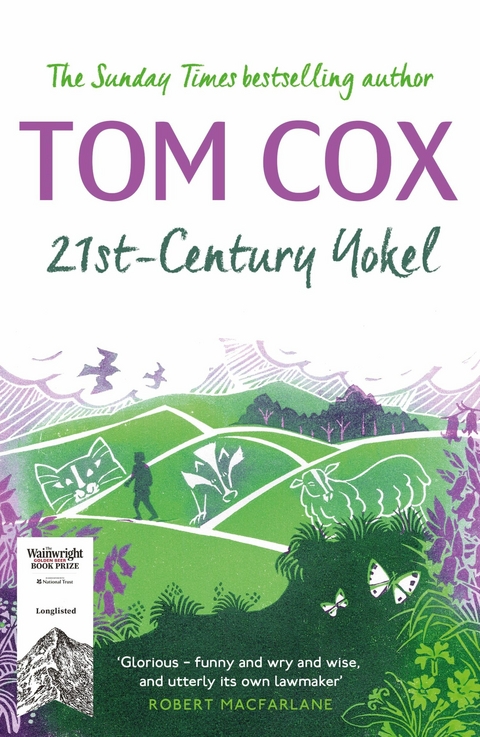
21st-Century Yokel (eBook)
416 Seiten
Swift Press (Verlag)
978-1-80075-600-7 (ISBN)
Tom Cox was born in Nottinghamshire in 1975 and now lives in Devon. His fifteen books include Villager, 1983, the Sunday Times top ten bestseller The Good, The Bad And The Furry, the Wainwright Prize-longlisted 21st-Century Yokel and Help The Witch, which won a Shirley Jackson Horror Writing award. You can subscribe to his Substack page at tomcox.substack.com
Thick with owls and badgers, oak trees and wood piles, scarecrows and ghosts, and Tom Cox's loud and excitable dad, this book is full of the folklore of several counties the ancient kind and the everyday variety as well as wild places, mystical spots and curious objects. Emerging from this focus on the detail are themes that are broader and bigger and more important than ever. Tom's writing treads a new path, one that has a lot in common with a rambling country walk; it's bewitched by fresh air and big skies, intrepid in minor ways, haunted by weather and old stories and the spooky edges of the outdoors, restless and prone to a few detours, but it always reaches its destination in the end.
1
WITCHES’ KNICKERS
January. Haldon Hill, the border hill. Such a long, high wall in the sky as you approach it from the north-east, so thick with trees, always a tiny bit surprising that a few minutes later you can be on top of it in a car. Also surprising, perhaps, to my car itself, which lets out a harassed groan as I change gear for the final ascent. My ears pop hard as I reach the brow. It happens every time. When I’ve told hardy natives of the South West Peninsula the same thing, they have sometimes claimed I’m being overdramatic but I’m honestly not. Maybe it’s because my sensitive eustachian tubes spent too many years living closer to sea level, in a more recumbent landscape, but the altitude is too much for them. ‘Ppppop!’ they go, as always, maybe even a bit louder than usual today. What that noise signifies to me is that I have entered the unofficial country that I call home, comprising Cornwall and the western two thirds of Devon.
Haldon rises, dividing the land, around six miles south-west of Exeter, which has always struck me as the most sarcastically named of small cities: a place that, when you’re attempting to get out of it at rush hour, appears to have no exit at all. If you look at it another way, though, the name is apt. When you reside on the west side of Haldon Hill, as I do, Exeter feels like your exit to the rest of Britain: the beginning of that place which, when you’ve lived down here for any time at all, you start to think of as Everywhere Else. Draw a line directly south from Haldon’s summit and you reach the exact point where the cliffs change colour – soft sandy red giving way to gnashing dark grey. Haldon seems like a barrier and must have seemed an even bigger one before it was tarmacked over with dual carriageway. Evidence of several sunken medieval lanes ascending the hill has been found on its east side, but almost none on its western slopes. Weary fourteenth-century travellers from the east would arrive at Lidwell Chapel near the eastern base of Haldon and receive offers of hot food and a bed for the night from Robert de Middlecote, the monk who lived there. Middlecote would then drug them, cut their throats and dump their bodies in the well in the chapel’s garden – allegedly bottomless, like so much still water in folklore. ‘Ooh, bloody hell, I’m not going over that,’ you can imagine similarly weary Romans exclaiming, thirteen hundred years or so earlier, as Haldon came into view. ‘We’ve done enough conquering, anyway. Let’s just leave whoever lives over there to carry on cuddling boulders and worshipping trees, or whatever it is they do.’ The Deep South West was its own country then and remains so now. Making a home in it is still a commitment to a certain kind of life, with more potential to be a self-contained part of its own immediate surroundings. Pass over that long brow and the land begins to steepen and get more intimate with itself, employment becomes more scarce, communities become more scattered and the idea of a day trip to the middle of the country becomes more fatigue-inducing.
As often as not, you drive up to the top of Haldon in one kind of weather and descend in another. In Exeter today there’s been squally showers and the lingering grey of a collective tetchy mood, but as I come down the opposite side, the sun switches on its spotlight function and illuminates the valley. Dartmoor streaks away in front of me on the right, unearthly and moody and promising and electric. They say in Devon that if you can’t see the moor, it means it’s raining, and if you can see it, it means it’s about to rain. That’s a comic exaggeration, of course, but not a huge one. Today the moor looks like a giant outdoor factory where witches make weather. There are countless small bright gaps in the sky, like holes stabbed in a tent roof to let the light in, then longer, bigger, more jagged gaps, as if the person in the tent has lost patience and gone at it with a bread knife. Some hills are enigmatically yellow in a way that doesn’t seem to correspond with the cloud above them, others a dark green verging on black that’s no less confusing. I can’t get nonchalant about this view, and it’s become even more fascinating to me as I’ve become more intimate with the moor. I will glance across and try to work out which shape or shade might denote a patch where I’ve walked. Is that where the farm is that I walked past that time with the huge ball of wire outside with the variety of animal skulls placed in it? I will think. No. Perhaps that’s a couple of miles further north. Maybe it’s the wildflower meadow I was pursued across last April by a small, determined pig.
I press on past Heaven and Hell Junction, Heaven being the moor and Hell staring it down from across the tarmac in the form of Trago Mills, the vast, grotesque shopping and leisure park whose toxic-waste-dumping, UKIP-supporting, wildlife-shooting owners the Robertson family once printed adverts calling for the castration of gay men. Up another big hill, past Ashburton Junction One and Ashburton Junction Two – the one which looks like my junction, that I take by mistake when I’m tired – and I’m home, or as good as, heading seawards on the smaller road where home begins in the most graspable sense: a zigzagging one, full of roller-coaster dips and climbs. To the right of the road is the River Dart and, because the road attempts to use the river as its guide, it is at the constant mercy of its indecision. All the Dartmoor rivers are capricious, but none that race down from the moor prevaricate about their route more often than the Dart. The hills here are not like those in Somerset or east Devon, which have wide valleys and plains between them; they are a community, bunching together as if nervously fearing solitude. The Dart finds the tight rare spaces between them and curls around them at flamboyant length, making its scenic way to the ocean.
Just two of the hills in this post-moor, pre-coast landscape rise up in a more noticeable, individual way. Unlike most of their less spellbinding neighbours, both of them are known locally by name. The bulkier of the two is called Hood Ball Hill, a corpulent sovereign of a hill topped with a copse somewhat resembling a mullet haircut. Its lankier neighbour, around a mile away, is called Yarner Beacon, although it was initially introduced to me as the Dragon’s Hoof, a name that became even more appealing upon my failure to substantiate it using any historical or electronic source.
At Hood Ball Hill’s foot, as well as the river and the bridge where the road crosses to the water’s eastern bank, is the track belonging to the Buckfastleigh to Totnes tourist railway. The steam from the trains that run along this enhance the hill’s mystic quality like dry ice around the ankles of a wizard. Talk to the more shamanistically inclined around here and they might tell you that Hood Ball Hill is the Atlantean Temple of the Moon, to which people have been known to travel many miles in order to face their shadow, or at least that a ley line passes directly through its centre, carrying mellow vibes down from Glastonbury, eighty miles to the north-east. In the late seventies an annual hippy fayre was held on its slopes. I met a carpenter called Brendan in the pub at Staverton, one of the two villages Hood Ball Hill overlooks, who attended the fayre regularly as a child and remembers it as an event where people often dressed in sackcloth and there were always ‘lots of dogs running loose and having a go at one another’.
Nowadays Hood Ball Hill has no footpath and is strictly, even a tad angrily, sectioned off from the public. I know this because I have checked out the situation assiduously from every angle. I have, however, climbed Yarner Beacon several times, both after the advent of the new permissive path leading to its peak and prior to that as a wide-eyed trespasser. For weeks before I made my maiden ascent, the beacon would call to me. Every time I saw it I could think about nothing but getting up into the comb of trees at its peak. This hill fetish was new to me and I did not understand what it meant or what I hoped to achieve through it, but if anything that made it all the more powerful. I had moved here from one of the flattest counties in England, Norfolk, where I once had a neighbour who spoke longingly of ‘living in a house on a hill’. It was quite a big deal to him since they only have about six of them there. I lived for a long spell after that on what I thought was a hill but now realise was only a tussock with ideas above its station. People visiting me from Devon said they liked the place but asked how I coped with the flatness. I didn’t understand what they meant. It was merely a topographical characteristic, surely, not a malady? But as a resident of Devon’s South Hams region I soon began to get it. Flat landscapes have a subtle enchantment of their own, but a landscape dense with hills makes everything more of a fascinating puzzle. Voices and revelations tend to flood the head on a good country walk, as if imparted by well-meaning unseen sprites hiding in the countryside itself. These voices and revelations are imbued with a different magic when emerging from the secret folds and crevices that hills create. Being accustomed to that magic, then visiting a place where it appears to have been steamrollered and rendered ostensibly more prosaic, must come as a shock.
I like to climb Yarner Beacon on a clear day, gaze several miles into the distance towards the sea and try to...
| Erscheint lt. Verlag | 19.6.2025 |
|---|---|
| Sprache | englisch |
| Themenwelt | Sachbuch/Ratgeber ► Natur / Technik ► Natur / Ökologie |
| Sozialwissenschaften ► Politik / Verwaltung | |
| Sozialwissenschaften ► Soziologie | |
| Schlagworte | bewitching • country walk • Curiosity • David Sedaris • english folklore • Essays • family memoir • Folklore • Funny • Humour • Mystical • Nature writing • Sunday Times bestselling author • Wainwright Golden Beer Book Prize • Walking |
| ISBN-10 | 1-80075-600-3 / 1800756003 |
| ISBN-13 | 978-1-80075-600-7 / 9781800756007 |
| Informationen gemäß Produktsicherheitsverordnung (GPSR) | |
| Haben Sie eine Frage zum Produkt? |
 EPUB (Wasserzeichen)
DRM: Digitales Wasserzeichen
Dieses eBook enthält ein digitales Wasserzeichen und ist damit für Sie personalisiert. Bei einer missbräuchlichen Weitergabe des eBooks an Dritte ist eine Rückverfolgung an die Quelle möglich.
Dateiformat: EPUB (Electronic Publication)
EPUB ist ein offener Standard für eBooks und eignet sich besonders zur Darstellung von Belletristik und Sachbüchern. Der Fließtext wird dynamisch an die Display- und Schriftgröße angepasst. Auch für mobile Lesegeräte ist EPUB daher gut geeignet.
Systemvoraussetzungen:
PC/Mac: Mit einem PC oder Mac können Sie dieses eBook lesen. Sie benötigen dafür die kostenlose Software Adobe Digital Editions.
eReader: Dieses eBook kann mit (fast) allen eBook-Readern gelesen werden. Mit dem amazon-Kindle ist es aber nicht kompatibel.
Smartphone/Tablet: Egal ob Apple oder Android, dieses eBook können Sie lesen. Sie benötigen dafür eine kostenlose App.
Geräteliste und zusätzliche Hinweise
Buying eBooks from abroad
For tax law reasons we can sell eBooks just within Germany and Switzerland. Regrettably we cannot fulfill eBook-orders from other countries.
aus dem Bereich