


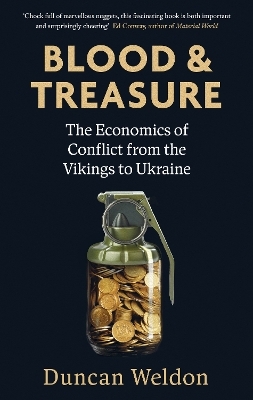
Blood and Treasure
The Economics of Conflict from the Vikings to Ukraine
Seiten
2026
Abacus (Verlag)
978-0-349-14541-9 (ISBN)
Abacus (Verlag)
978-0-349-14541-9 (ISBN)
- Noch nicht erschienen (ca. Juni 2026)
- Portofrei ab CHF 40
- Auch auf Rechnung
- Artikel merken
How war and violence have shaped institutions, told by the author of Two Hundred Years of Muddling Through
Blood and Treasure is the story of the economics of conflict from the Viking Age to the war in Ukraine.
'Absolutely fascinating and totally absorbing' JAMES HOLLAND
'A brilliant book' MARTIN WOLF, FINANCIAL TIMES CHIEF ECONOMICS EDITOR
'Chock full of marvellous nuggets, this fascinating book is both important and surprisingly cheering' ED CONWAY
'A delightfully quirky approach to military history' SPECTATOR
Wars are expensive, both in human terms and monetary ones. But while warfare might be costly it has also, at times, been an important driver of economic change and progress. Over the long span of history nothing has shaped human institutions - and thus the process of economic development - as much as war and violence.
Blood and Treasure looks at the history and economics of warfare from the Viking Age to the war in Ukraine, examining how incentives and institutions have changed over time. Along the way it asks whether Genghis Khan should be regarded as the father of globalisation, explains how New World gold and silver kept Spain poor, asks if handing out medals hurt the Luftwaffe in the Second World War and assesses if economic theories helped to create a tragedy in Vietnam.
Blood and Treasure is the story of the economics of conflict from the Viking Age to the war in Ukraine.
'Absolutely fascinating and totally absorbing' JAMES HOLLAND
'A brilliant book' MARTIN WOLF, FINANCIAL TIMES CHIEF ECONOMICS EDITOR
'Chock full of marvellous nuggets, this fascinating book is both important and surprisingly cheering' ED CONWAY
'A delightfully quirky approach to military history' SPECTATOR
Wars are expensive, both in human terms and monetary ones. But while warfare might be costly it has also, at times, been an important driver of economic change and progress. Over the long span of history nothing has shaped human institutions - and thus the process of economic development - as much as war and violence.
Blood and Treasure looks at the history and economics of warfare from the Viking Age to the war in Ukraine, examining how incentives and institutions have changed over time. Along the way it asks whether Genghis Khan should be regarded as the father of globalisation, explains how New World gold and silver kept Spain poor, asks if handing out medals hurt the Luftwaffe in the Second World War and assesses if economic theories helped to create a tragedy in Vietnam.
Duncan Weldon is a writer and broadcaster. As a journalist he has previously covered the British and global economies at The Economist and the BBC as well as writing and presenting radio documentaries. An economist by background, he began his career at the Bank of England, before working in asset management and public policy. He is a member of the advisory board of the Centre for the Analysis of Comparative Advantage in the Global Economy at Warwick University. He is also a regular commentator on television and radio and writes for a variety of publications. His first book, Two Hundred Years of Muddling Through, was published in 2021.
| Erscheint lt. Verlag | 4.6.2026 |
|---|---|
| Verlagsort | London |
| Sprache | englisch |
| Maße | 126 x 198 mm |
| Themenwelt | Sachbuch/Ratgeber ► Beruf / Finanzen / Recht / Wirtschaft ► Wirtschaft |
| ISBN-10 | 0-349-14541-5 / 0349145415 |
| ISBN-13 | 978-0-349-14541-9 / 9780349145419 |
| Zustand | Neuware |
| Informationen gemäß Produktsicherheitsverordnung (GPSR) | |
| Haben Sie eine Frage zum Produkt? |
Mehr entdecken
aus dem Bereich
aus dem Bereich
warum wir vor den Tech-Milliardären noch nicht einmal auf dem Mars …
Buch | Softcover (2025)
Suhrkamp (Verlag)
CHF 30,80
zum Stand der Dinge (des Alltags)
Buch | Softcover (2025)
Suhrkamp (Verlag)
CHF 30,80


