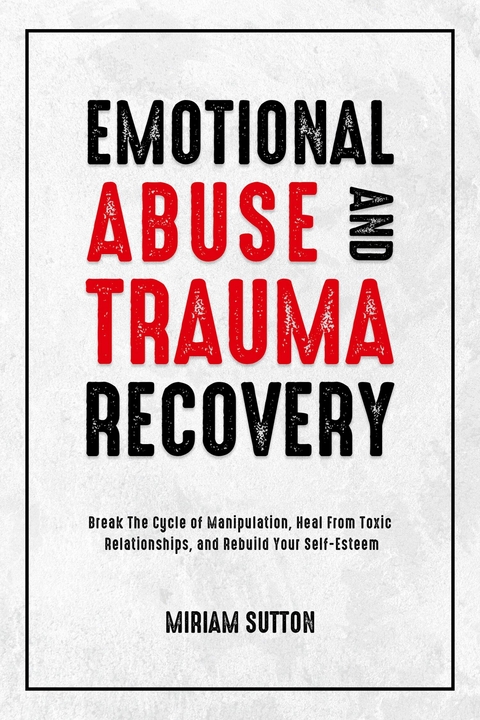
Emotional Abuse and Trauma Recovery (eBook)
116 Seiten
Publishdrive (Verlag)
978-1-78793-814-4 (ISBN)
Are you trapped in a relationship that drains your energy, warps your reality, and leaves you feeling like a shell of yourself?
Whether it's a romantic partner, a parent, or a close friend, emotional abuse can be devastating-and invisible. It erodes your self-worth, isolates you from support, and creates trauma bonds that feel impossible to break.
Inside You'll Discover:
- How emotional abuse manifests through gaslighting, negging, guilt-tripping, and triangulation
- The hidden damage of trauma bonding-and why it keeps you stuck
- Signs you're in a toxic dynamic (even if it sometimes feels 'normal')
- How to safely exit a manipulative relationship and build an effective exit plan
- Why abusers target your insecurities-and how to take that power back
- The psychological and physical toll emotional abuse takes over time
What You'll Learn to Heal:
- Techniques to regulate anxiety, panic, and emotional flashbacks
- Self-care practices that restore nervous system balance
- How to rebuild your self-worth and trust your intuition again
- Journaling prompts and reflection questions to reconnect with your true self
- How to set, express, and enforce healthy boundaries with confidence
- Ways to manage guilt, grief, and the fear of abandonment after abuse
- How to trust others-and yourself-without repeating past patterns
Real Tools for Real Transformation
This book isn't just about identifying abuse-it's about healing and thriving after it. With a trauma-informed, deeply empathetic approach, you'll be guided through every phase of recovery:
✔ Breaking trauma bonds
✔ Managing PTSD-like symptoms
✔ Rebuilding your support system
✔ Cultivating emotional resilience
✔ Creating a life that reflects your values-not your pain
You'll also learn how to challenge the voice of your inner critic, develop positive self-talk, and stop the cycle of self-blame that abuse often leaves behind.
You Are Not Alone
This book combines powerful personal storytelling with psychological insight to remind you that your story is valid, your pain is real, and your healing is possible.
If you've ever asked yourself:
'Why do I keep going back?'
'Why does it still hurt after I've left?'
'Will I ever trust again?'
This book has answers.
Are you trapped in a relationship that drains your energy, warps your reality, and leaves you feeling like a shell of yourself?Whether it's a romantic partner, a parent, or a close friend, emotional abuse can be devastating and invisible. It erodes your self-worth, isolates you from support, and creates trauma bonds that feel impossible to break.Inside You ll Discover:- How emotional abuse manifests through gaslighting, negging, guilt-tripping, and triangulation- The hidden damage of trauma bonding and why it keeps you stuck- Signs you re in a toxic dynamic (even if it sometimes feels normal )- How to safely exit a manipulative relationship and build an effective exit plan- Why abusers target your insecurities and how to take that power back- The psychological and physical toll emotional abuse takes over timeWhat You ll Learn to Heal:- Techniques to regulate anxiety, panic, and emotional flashbacks- Self-care practices that restore nervous system balance- How to rebuild your self-worth and trust your intuition again- Journaling prompts and reflection questions to reconnect with your true self- How to set, express, and enforce healthy boundaries with confidence- Ways to manage guilt, grief, and the fear of abandonment after abuse- How to trust others and yourself without repeating past patternsReal Tools for Real TransformationThis book isn t just about identifying abuse it s about healing and thriving after it. With a trauma-informed, deeply empathetic approach, you ll be guided through every phase of recovery:? Breaking trauma bonds? Managing PTSD-like symptoms? Rebuilding your support system? Cultivating emotional resilience? Creating a life that reflects your values not your painYou ll also learn how to challenge the voice of your inner critic, develop positive self-talk, and stop the cycle of self-blame that abuse often leaves behind.You Are Not AloneThis book combines powerful personal storytelling with psychological insight to remind you that your story is valid, your pain is real, and your healing is possible.If you ve ever asked yourself: Why do I keep going back? Why does it still hurt after I ve left? Will I ever trust again? This book has answers.
Chapter 1:
Recognizing Emotional Abuse
“You are so beautiful, just look at you.”
I am standing in my boyfriend’s bedroom in my underwear, holding his slinky Siamese cat in my arms.
“You are gorgeous.”
I am blushing a little bit now. No one has ever called me gorgeous (apart from men in vans driving past with crude wolf whistles).
“You are a 10. Or you would be if you got your tits done.”
I still remember that moment very vividly. I felt very beautiful and very seen for a split second, and then it all came crashing down. The aftermath? I was still drawn to my partner. Maybe more so than before. After all, he thought I was beautiful. But I was left feeling self-conscious, crossing my arms over my flat chest.
It did not stop there. He knew I had grown up with an eating disorder, and every so often, he would sprinkle backhanded compliments about my weight or size into the conversation.
“Look at those arms! Getting a little chunky.”
“Woah, those shorts are a little tight, right? What a cute belly.”
The comments were not just about my appearance either. My (amazing) impression of a Star Wars character was met with a side glance and a frown.
“You are a bit weird.” And no, he did not mean that in a good way. It went on. I was too quiet. Too loud. Too closed off. Too clingy. Too independent.
Soon, I did not know myself anymore.
What Is Emotional Abuse?
Emotional abuse is a method whereby individuals try to undermine a person’s self-esteem and independence to be able to control and manipulate them to their advantage. It can come in many shapes and forms, such as the following:
Name-Calling and Demeaning Comments: The manipulator frequently uses derogatory language and insults to belittle and demean the victim. They may call them names, and make cruel remarks about their appearance, intelligence, or character, aiming to undermine their self-esteem and assert dominance. These often focus on the manipulator’s knowledge of the victim’s weak spots and insecurities.
Negging or Patronizing: The manipulator employs a tactic known as "negging," which involves giving backhanded compliments or making condescending remarks to make the victim feel insecure. They may disguise insults as compliments, highlighting supposed flaws or weaknesses in a way that undermines the victim's confidence.
False Accusations: The manipulator frequently makes baseless accusations against the victim, often without any evidence. They may accuse the victim of cheating, lying, or other wrongdoing to create doubt. Through this, the victim feels more compelled to defend themselves or to try harder, to be better for the abuser. This is often a deflection or projection of the abuser’s own negative behavior.
Controlling Behavior: The manipulator exercises control over various aspects of the victim's life, such as monitoring their daily activities and tracking their movements, dictating their choices about clothing or activities, or otherwise limiting their freedom. Although a victim might not initially allow for this controlling behavior, they are gradually worn down over time, their self-esteem so impacted that they begin to become eager to please the abuser and do whatever they can to keep the relationship level.
Gaslighting: Gaslighting is a manipulative technique where the manipulator distorts the victim's perception of reality (which we will cover more of in the next chapter). They may deny or minimize their harmful actions, twist facts, and make the victim doubt their memory or sanity. Gaslighting creates confusion and makes the victim feel as if they cannot trust their own judgment, leaving them overly reliant on the person instigating the gaslighting.
Isolating: The manipulator deliberately isolates the victim from their support system, such as friends and family, to gain more control. They may discourage or prevent the victim from spending time with loved ones, telling them that their friends or family dislike them or talk about them behind their back. The end result is that the victim feels dependent on the manipulator for social interaction and emotional support, and has no one else to turn to.
Withholding Affection: The manipulator may withhold love, affection, or intimacy as a form of punishment or control. They may intentionally create emotional distance, giving the victim the silent treatment or withdrawing affection to make them feel unloved and desperate for their attention. The key here is that the affection is here in the first place; manipulators are often experts at giving flattery and affection to give a false sense of security, only to retract it later. This often leaves the victim feeling confused and helpless, as their relationship is sometimes okay. Sometimes more than okay. Sometimes, their partner makes them feel on top of the world. The highs are so good, they begin to forget the lows.
Constantly Starting Arguments: The manipulator instigates frequent arguments over trivial matters, seeking to provoke the victim and keep them on edge. The victim starts feeling like they need to walk on eggshells or repress certain parts of themselves to avoid conflict. They also begin to avoid bringing up areas where they feel unheard or dissatisfied out of fear of starting a huge argument (in which they often end up on the receiving end of blame).
Silent Treatment: The manipulator employs the silent treatment as a passive-aggressive tactic to exert control and punish the victim when they are dissatisfied with them or want to force them to engage in some way. They intentionally ignore the victim, refusing to communicate or respond to their attempts at resolution, leaving the victim feeling anxious, frustrated, and desperate for their attention.
Why Do People Emotionally Abuse Others?
We enter into relationships hoping to find a life partner who will lift us and support us through good times and bad. Why then do some people actively engage in emotionally abusive behaviors? Why do they want to hurt others?
Unfortunately, life is not all sunshine and rainbows. Some individuals enter into relationships with the conscious aim of controlling their partner. This feeling of being in control gives them immense pleasure.
Additionally, children who grew up in households where they were the victim of emotional abuse sometimes grow up feeling the need to exploit others and gain control over those around them as adults, as this is what they were exposed to in their youth. Children who come from unstable households may seek out the instability of an emotionally abusive partner or try to instigate emotional abuse themselves as a way to regain that sense of familiarity.
Am I a Victim of Emotional Abuse?
Whilst individuals who experience a degree of trauma are more prone to entering into emotionally abusive relationships, this is not a one-size-fits-all scenario. You might be sitting there wondering if you were really a victim of emotional abuse since your childhood was perfect and your partner never physically hurts you.
At points, your relationship is perfectly fine. It is pleasant, even. Your partner can be charming to you and those around you. You sometimes wonder if you are housing a Jekyll and Hyde. If that is the case, please do not feel disheartened. Your experience is completely valid.
Some people are however more prone to falling victim to emotionally abusive relationships. In the same way that some partners are more prone to becoming the abuser, others can be more susceptible to falling victim to that abuse.
Factors such as childhood trauma, negative self-worth, mental health issues, or parental influence can leave some people more likely to engage and tolerate a partner who actively hurts them.
Signs of Emotional Abuse
Abusers are often very good at warping our sense of reality through methods such as gaslighting, which we will explore in depth in the next chapter.
Right now, you might well be questioning whether you are actually a victim of abuse, if it is really as bad as it sometimes feels, or if you are just exaggerating things in your head. You see stories about domestic violence or physical abuse and think, my situation is not so bad after all. Maybe I am just being dramatic.
I have thought about this myself on many occasions. The truth is that we lose a lot of ourselves in emotionally abusive relationships when many of us had little sense of self to begin with. If the following red flags resonate with you, chances are you are a victim of emotional abuse.
Understanding these red flags can help you to identify when you are being abused, when to leave a relationship, and how to reach out and get the support that you need.
It is important to note that the presence of one of these red flags is not a clearcut indicator of emotional abuse. However, noticing these types of behaviors continuing to flare up and repeat in your relationship is highly indicative of it.
- You feel the need to avoid wearing certain types of clothing choices that might anger your partner.
- Your partner monitors all your messages, social media accounts, or emails.
- Your partner discourages or prevents you from spending time with friends and family, telling you that your social circle dislikes you and that your partner needs more of your attention.
- Your partner frequently makes you feel guilty about things, saying that you lead them to act in certain ways.
- Your partner is excessively jealous and possessive of you, constantly questioning your loyalty or accusing you of cheating or being...
| Erscheint lt. Verlag | 30.5.2025 |
|---|---|
| Sprache | englisch |
| Themenwelt | Sachbuch/Ratgeber ► Gesundheit / Leben / Psychologie ► Familie / Erziehung |
| Schlagworte | gaslighting recovery for women and men • how to end a codependent relationship • how to set healthy boundaries with ex • narcissistic personality traits in partners • psychological abuse effects on the brain • rebuild trust after emotional betrayal • signs of gaslighting in a relationship |
| ISBN-10 | 1-78793-814-X / 178793814X |
| ISBN-13 | 978-1-78793-814-4 / 9781787938144 |
| Informationen gemäß Produktsicherheitsverordnung (GPSR) | |
| Haben Sie eine Frage zum Produkt? |
 EPUB (Ohne DRM)
Digital Rights Management: ohne DRM
Dieses eBook enthält kein DRM oder Kopierschutz. Eine Weitergabe an Dritte ist jedoch rechtlich nicht zulässig, weil Sie beim Kauf nur die Rechte an der persönlichen Nutzung erwerben.
Dateiformat: EPUB (Electronic Publication)
EPUB ist ein offener Standard für eBooks und eignet sich besonders zur Darstellung von Belletristik und Sachbüchern. Der Fließtext wird dynamisch an die Display- und Schriftgröße angepasst. Auch für mobile Lesegeräte ist EPUB daher gut geeignet.
Systemvoraussetzungen:
PC/Mac: Mit einem PC oder Mac können Sie dieses eBook lesen. Sie benötigen dafür die kostenlose Software Adobe Digital Editions.
eReader: Dieses eBook kann mit (fast) allen eBook-Readern gelesen werden. Mit dem amazon-Kindle ist es aber nicht kompatibel.
Smartphone/Tablet: Egal ob Apple oder Android, dieses eBook können Sie lesen. Sie benötigen dafür eine kostenlose App.
Geräteliste und zusätzliche Hinweise
Buying eBooks from abroad
For tax law reasons we can sell eBooks just within Germany and Switzerland. Regrettably we cannot fulfill eBook-orders from other countries.
aus dem Bereich