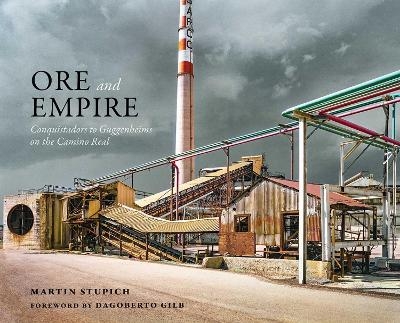
Ore and Empire
University of New Mexico Press (Verlag)
978-0-8263-6860-7 (ISBN)
- Noch nicht erschienen (ca. Februar 2026)
- Versandkostenfrei
- Auch auf Rechnung
- Artikel merken
For centuries the Spanish Empire’s conscripted laborers extracted silver from hand-dug tunnels and shafts deep beneath the mountain spine of the Americas. By the late nineteenth century, mining engineers in the United States and in Mexico were refining not just silver ores but also lead, gold, and copper.
Copper was especially crucial to the looming industrial century. Not since the days when Spanish treasure galleons carried off the New World’s silver had anyone seen the sort of vast mineral wealth amassed by the “copper kings” of the Gilded Age. First among them was the Guggenheim family, whose American Smelting and Refining Company (ASARCO) controlled more than 80 percent of the world’s supply of silver, copper, and lead by the early twentieth century.
Like the Spanish conquistadors before them, the ASARCO empire extended over 1,500 miles, from Central Mexico to Colorado. Its epicenter straddled the Mexico–Texas borderlands where the Rio Grande and the ancient Camino Real de Tierra Adentro converge at El Paso, the home of one of America’s largest smelters—and the centerpiece of Martin Stupich’s photographic journey. The hundred-acre ASARCO site was, until its 2013 demolition, more than a gritty industrial tract. For a century the company was central to El Paso’s vitality, even as Mexican American workers’ families in Smeltertown, the company barrio, died slowly under its toxic plume.
Ore and Empire documents this storied landscape in words and images. Original color photographs are complemented with essays by three renowned scholars, adding depth to an already sweeping historic panorama. Created over some fifteen years in the field, Stupich’s monumental work serves as an homage to the unnamed thousands who lived and toiled here.
Martin Stupich is an internationally recognized photographer of industry and landscape. His photography books include Red Desert: History of a Place, with Annie Proulx, and his work is extensively covered in Through the Lens of the City: NEA Photography Surveys of the 1970s by Mark Rice and The Altered Landscape: Photographs of a Changing Environment, edited by Ann M. Wolfe, and in numerous critical essays and exhibition catalogs over his forty-year career. Dagoberto Gilb is the author of three books from UNM Press, The Magic of Blood, winner of the PEN/Hemingway Award and a finalist for the PEN/Faulkner Award, the anthology Hecho en Tejas, winner of the PEN/Southwest Book Award, and A Passing West: Essays from the Borderlands, winner of the 2025 PEN/Diamonstein/Spielvogel Award for the Art of the Essay. His fiction and nonfiction have appeared in both the New Yorker and Harper’s, and his work has been featured in Best American Essays and O. Henry Prize Stories.
| Erscheint lt. Verlag | 17.2.2026 |
|---|---|
| Vorwort | Dagoberto Gilb |
| Verlagsort | Albuquerque, NM |
| Sprache | englisch |
| Maße | 267 x 216 mm |
| Gewicht | 700 g |
| Themenwelt | Kunst / Musik / Theater ► Fotokunst |
| Sachbuch/Ratgeber ► Freizeit / Hobby ► Fotografieren / Filmen | |
| Technik ► Architektur | |
| ISBN-10 | 0-8263-6860-3 / 0826368603 |
| ISBN-13 | 978-0-8263-6860-7 / 9780826368607 |
| Zustand | Neuware |
| Informationen gemäß Produktsicherheitsverordnung (GPSR) | |
| Haben Sie eine Frage zum Produkt? |
aus dem Bereich