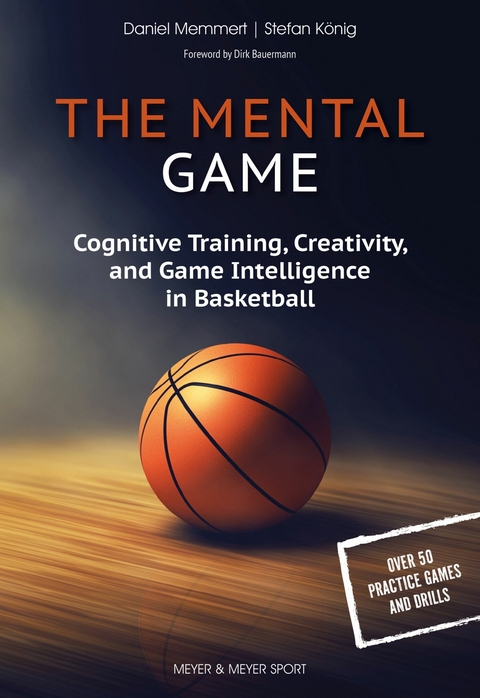
Mental Game (eBook)
208 Seiten
Meyer & Meyer Fachverlag und Buchhandel GmbH
978-1-78255-550-6 (ISBN)
Prof. Dr. Daniel Memmert is executive head of the Institute of Exercise Training and Sport Informatics at the German Sports University Cologne. His main research areas are movement science, sport psychology, and sport informatics. He holds trainer licenses in soccer, snowboarding, and alpine skiing, and he is the author of books on modern sport training. In addition, he cooperates with national and international professional clubs, the German national team, and DAX companies. He organized the first international master's degree in Game Analysis. Prof. Dr. Stefan König is a professor at the Sports Center as well as director of the Research Center for Secondary Education at the Weingarten University of Education. His scientific work focuses on training science (effects of training processes in school, recreational, and health sports); school sports research (effects of physical education, school sports concepts, sports teacher research); sports game research (mediation concepts, tactics, leadership behavior); and research methodology (mixed methods research).
World-class basketball players like Nikola Jokic and Caitlin Clark seem to effortlessly conjure not only unusual but also masterful technical and tactical plays on the court. Coaches of elite players know that to be able to play at such a top level requires fast thinking and sharp game intelligence. This book offers a theoretical framework in which anticipation, perception, attention, and memory processes play a big role in training. Diagnostic tools and useful examples for training cognitive abilities are provided to help the coach and player understand the science behind training mental speed. To round out training, the authors also include more than 50 game activities which can be incorporated into practice to train players' cognitive skills and improve their mental game. Dominate on the court by training cognitive creativity and mental speed with The Mental Game!
4DIAGNOSTICS OF COGNITIONS
In recent literature, an almost unmanageable flood of cognitive tests exists. They range from scientifically proven to pure software products that do not meet scientific criteria. In the following, no general overview is given. However, selected methods, which were developed in recent years at the Institute for Training Science and Sports Informatics and were used in studies and practice are presented. Four laboratory tests and four court tests are also presented as examples.
4.1Laboratory Tests
In the following, four cognitive test procedures are presented, which have been developed and used in various projects at the Institute for Training Science and Sports Informatics. After the testing, the athletes received a summary of their test results compared to different sport-specific test subject groups (see figure 10).
Figure 10 Presentation of the results for all four elementary cognitions of an exemplary athlete combined with the group mean values of individual other samples (sport discipline, age, expertise).4.1.1Attention Window Test
Figure 11 Representation of the attention window test (AWT; Hüttermann et al., 2013). The task is to perceive two stimuli peripherally at the same time. The maximum, still-perceptible distance between the stimuli in horizontal, vertical, and diagonal directions is measured and a maximum attention window is determined.The attention window test by Hüttermann et al. (2013) can be used to assess the individual’s range of attention. During each test phase, players are instructed to focus on a central point and try to detect a grey triangle within circle and square distractors. For several attempts, the target will appear in different distances from the focused point (10, 20, and 30 degrees), along with one of eight equally distributed radial lines from a square in the center of the display (45-degree distance) (see figure 12). This random display is shown for 12 ms, followed by a colored mask (100 ms). After the masking, the players are asked to indicate how many grey triangles they have just seen in the different locations, depending on the orientation of the objects. The participants must complete 180 attempts. This task measures how well people can handle objects far from focused points (Hüttermann et al., 2014). The dependent variable is the point distribution of the diagonal attention window and the division of the total value by the number of dimensions (i.e., three).
4.1.2Working Memory Span Test
The established working memory test of Conway et al. (2005) measures the athlete’s ability to draw attention to the task without being distracted by other thoughts. The processing task is to count certain forms among other distractors and then remember this number for later memory recall. Each task contains randomly arranged dark blue circles, green circles, and dark blue squares (see figure 12). The task is to count out loud the dark blue circles and then announce the total number of circles at the end. After two to six tasks, a reminder screen appears in which the players have to fill in their memorized totals precisely in the same order as they were displayed (see Kane et al. 2004, for a detailed description). The simplicity of this counting task permits it to be performed with almost any player. The margin score is a subtotal (see Conway et al., 2005) that represents the sum of all successfully recovered items—where a correctly retrieved item from a set of two items gets 2 points, and a correctly retrieved item from a set of six items gets 6 points—divided by the maximum possible score. The test consists of 15 attempts. The dependent variable is the evaluation of the percentage of correctly memorized objects.
Figure 12 Representation of a display of the working memory test by Conway et al. (2005). The player has to count out loud all dark blue circles between the distractors (green circles and dark blue squares) and then memorize the totals for a later memory recall.4.1.3Perceptual Load Test
The perceptual load test by Beck and Lavie (2005) is an instrument for measuring cognitive inhibition since it determines the extent to which players are distracted by stimuli that are entirely irrelevant to their task. The players perform the soccer-specific perceptual load task (Furley et al., 2013) which starts with two example blocks (a high and a low cognitive distraction load), followed by eight experimental blocks that alternate between low and high load blocks (figure 13). All players start with one block carrying high load. Before each measurement, a mark for 1,000 ms is displayed in the middle of the screen, followed by the task display with the soccer-specific arrangement and the distraction maneuver. The task instructions are displayed for 100 ms. Players are instructed to ignore the distraction and indicate as quickly and accurately as possible which player is in possession of the ball. The distraction maneuver is always shown at a fixed point (Beck & Lavie, 2005). The participants react to the target stimuli by pressing a key. A new task is triggered by the player’s reaction or omissions within 2 seconds. After each attempt, feedback on the quality of the answers or omissions is given by means of a computer sound. After each block, the participants are reminded of the critical assignment. The test consists of 160 attempts. The dependent variable is the reaction time due to perceptual stress related to the state of low and high distraction.
Figure 13 Representation of a display of the basketball-specific perceptual load task by Furley et al. (2013). The players are assigned to ignore the distraction (X in the paint) and indicate as quickly and as accurately as possible which player is in possession of the ball (0 = defense or X = offense).4.1.4Multiple Object Tracking Test
The multiple object tracking test for movement tracking measures the velocity at which players are still able to track multiple relevant moving objects (Alvarez & Franconeri, 2005). Three-dimensional multiple object tracking training has positive effects on making decisions (Romeas et al., 2016), but no significant transfer effects on other visual or executive functions (Scharfen & Memmert, 2021).
The players observe the positions of a series of moving circles on a computer monitor. The display initially contains four green and three blue circles. After 3 seconds in a static state, the blue items turn green and are identical to the targets (green circles), and all circles begin to move as players try to track the positions of the initially green items. The test is adaptable so that the speed changes and the number of attempts depends on the abilities of the players. After 8 seconds, the circles stop and players must mark the three formerly blue circles. Performance is defined by the number of correctly tracked and marked circles. This task shows individual differences in the ability to divide and maintain attention on several independently moving objects (see figure 14c) but no significant transfer effects on other visual or executive functions (Scharfen & Memmert, 2021).
Figure 14 Illustration of the multiple object tracking test (Cavanagh & Alvarez, 2005). The task consists of tracking and perceiving several a) still images for identification and b) moving objects simultaneously in order to c) identify them at the end of the test.4.2Court Tests
Elementary cognitions are also known as basic tactics in sports games (Memmert, 2004a). As already described in the chapter on game intelligence, these are basic competences that are of particular importance in many sport games, and form the foundation for later sport-specific (here basketball) tactics.
Game test situations can assess both tactical creativity (Memmert, 2010a, b; Memmert & Roth, 2007) and game intelligence (best solutions) in basic tactical tasks (cf. Memmert, 2010b; Memmert & Roth, 2003; Memmert, 2013). The resulting convergent performance indicators can be used for talent diagnostics in clubs or for grading in physical education classes. In the club, it may be useful to use a video camera to record children’s behavior and then use a video and scale to assess tactical behavior. At school, the teacher can also use the developed scale to assess directly. As an example, four standardized game test situations with corresponding scales for the evaluation of convergent tactical performance are presented below. They were comprehensively tested with regard to the quality criteria (Memmert, 2004a, b). These diagnostic options use the basic module labels from Memmert (2004a). As these are almost identical in content to the basic modules of Roth and Kröger (2011), they are also listed. Game test situations with the scales for evaluating divergent tactical performances can be read about in Memmert (2010a, b) as well as in Memmert and Roth (2007).
4.2.1Game Test Situation: Moving the Ball Towards the Goal
In the basic tactic of moving the ball towards the goal (i.e., creating a majority), the players should play the ball in the direction of the goal area. For this purpose, it must be assessed whether the player currently in possession of the ball—if it makes sense—has played the ball in a particular direction of the goal area, and if the most considerable possible distance has been bridged (first evaluation criterion). Furthermore, the decisions of the children should be...
| Erscheint lt. Verlag | 1.6.2025 |
|---|---|
| Sprache | englisch |
| Themenwelt | Sport ► Ballsport ► Basketball |
| ISBN-10 | 1-78255-550-1 / 1782555501 |
| ISBN-13 | 978-1-78255-550-6 / 9781782555506 |
| Informationen gemäß Produktsicherheitsverordnung (GPSR) | |
| Haben Sie eine Frage zum Produkt? |
 EPUB (Adobe DRM)
Kopierschutz: Adobe-DRM
Adobe-DRM ist ein Kopierschutz, der das eBook vor Mißbrauch schützen soll. Dabei wird das eBook bereits beim Download auf Ihre persönliche Adobe-ID autorisiert. Lesen können Sie das eBook dann nur auf den Geräten, welche ebenfalls auf Ihre Adobe-ID registriert sind.
Details zum Adobe-DRM
Dateiformat: EPUB (Electronic Publication)
EPUB ist ein offener Standard für eBooks und eignet sich besonders zur Darstellung von Belletristik und Sachbüchern. Der Fließtext wird dynamisch an die Display- und Schriftgröße angepasst. Auch für mobile Lesegeräte ist EPUB daher gut geeignet.
Systemvoraussetzungen:
PC/Mac: Mit einem PC oder Mac können Sie dieses eBook lesen. Sie benötigen eine
eReader: Dieses eBook kann mit (fast) allen eBook-Readern gelesen werden. Mit dem amazon-Kindle ist es aber nicht kompatibel.
Smartphone/Tablet: Egal ob Apple oder Android, dieses eBook können Sie lesen. Sie benötigen eine
Geräteliste und zusätzliche Hinweise
Buying eBooks from abroad
For tax law reasons we can sell eBooks just within Germany and Switzerland. Regrettably we cannot fulfill eBook-orders from other countries.
aus dem Bereich