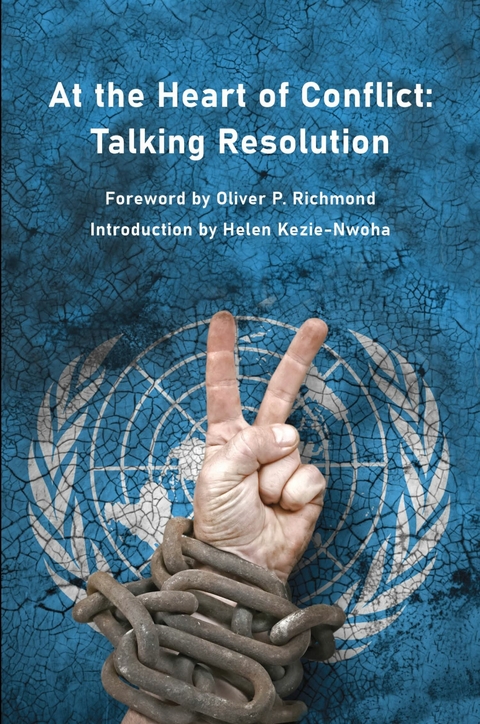
At the Heart of Conflict (eBook)
296 Seiten
Supernova Books (Verlag)
978-1-913641-43-6 (ISBN)
A ground-breaking new book that dares to bridge the divide between peacemakers and military strategists.
As the world reels from an unprecedented surge in destructive wars and international crises, a new and critically important book challenges conventional wisdom and asks: Can peace be built by dialogue alone? When is the use of force necessary? Is there cause for hope? With 20 unflinching first-person accounts, the book uniquely gives voice to both sides of the conflict resolution debate from seasoned UN negotiators and grassroots peacebuilders to intelligence experts and military veterans.
This book is an essential read for those studying conflict resolution, international relations, or working in the field, looking to know more about the lived experiences of UN officials, translators, ambassadors, NGOs and military personnel.
edited and compiled by Cheryl Robson
Foreword by Oliver P Richmond
Introduction by Helen Kezie-Nwoha
Afterword by Jonathan Cohen
Reviews:
'At the Heart of Conflict: Talking Resolution is a profoundly hopeful book. In these pages, we hear directly from practitioners who have not only witnessed conflict but have actively worked to transform it. Their voices bring a rare depth and texture to our understanding of mediation and peacebuilding - grappling with the political conditions on the ground and reflecting on how those moments fit into larger historical arcs. These accounts offer more than technical and political insight - they remind us that in the midst of violence and fragility, there are always individuals building bridges, nurturing resilience, and creating space for hope.'
- Dr Christine Cheng, War Studies, King's College London
'A fascinating insight into the challenging world of conflict resolution that is likely to be as relevant tomorrow as it is today.'
-York Membery, writer and journalist, Sunday Times.
About the authors:
Helen Kezie-Nwoha is a feminist scholar, peace-builder, and human rights advocate. She is the Founder and Lead Researcher at Researchers Without Borders and former Executive Director of the Women's International Peace Centre. Her work spans Africa and beyond, providing strategic policy advice to regional institutions such as the African Union, on the implementation of the Women, Peace and Security agenda.
Professor Oliver Richmond is the founder of the MA in Peace and Conflict Studies at the University of Manchester. He received the 2019 Eminent Scholar Award from the International Studies Association. He has worked closely with international organizations, including the UN, and civil society groups. His publications include The Grand Design: Peace in the 21st Century (Oxford University Press) and Peace in International Relations (Routledge)
Jonathan Cohen is Executive Director of Conciliation Resources, where he has supported dialogue and peacebuilding initiatives in contexts including the South Caucasus, Kashmir, the Philippines, Colombia, Ethiopia, and Papua New Guinea.
Previously he served as Deputy Director of the Foundation on Inter-Ethnic Relations in The Hague, and is an Associate of the Institute for the Public Understanding of War and Conflict at the Imperial War Museum.
Cheryl Robson is a writer, editor and filmmaker who was awarded a Special Jury Prize for peace for publishing 'The Arab-Israeli Cookbook' by Robin Soans and Claudia Roden. She has edited over 100 books and won many awards but is best-known for leading the campaign to erect a statue of Virginia Woolf on Richmond Riverside in England.
Victor Ângelo
Could you share some highlights of your 32-year career with the work at the un?
Certainly, I had the privilege of working with the United Nations for an extended period, though it is essential to note that prior to this, I served with the Portuguese Government in the National Statistics Institute. This was during the first Election Commission following the 25 April 1974, which oversaw the preparations for the first free elections after the fall of the dictatorship. I was quite young at the time, around 24 years of age. One of my responsibilities at the Institute was to represent Portugal in meetings in Paris with the Organisation for Economic Co-operation and Development (oecd).
It was during those meetings that I encountered individuals from various oecd countries, as well as representatives from international organizations, including from the un in New York. Through these contacts, in 1978, I was invited by the un to assist in establishing a planning and statistics system in São Tomé and Príncipe. The assignment was initially intended to last for one year, with the aim of conducting a census, rebuilding the national statistics system – which had been dismantled following the departure of the Portuguese – and implementing a system of economic planning.
Ultimately, I remained in São Tomé and Príncipe for two and a half years. After that, the un offered me a more permanent position in Mozambique. From 1980, I became deeply involved in family planning, demography, and the protection of women and children, not only within Mozambique but across Southern Africa. This was a large-scale initiative that also encompassed Angola, São Tomé and Príncipe, and Equatorial Guinea, all of which were Portuguese or Spanish-speaking countries.
My work then transitioned towards development, and in 1985, I was appointed as the United Nations Development Programme (undp) representative to the Central African Republic. At that time, the Central African Republic was a largely unknown and underdeveloped nation. When New York offered me the opportunity, I had to consult a map to identify its location. The un presented me with two options: to work on development in the Central African Republic or to remain focused on demography and population issues, with a posting in Rio de Janeiro. I chose the Central African Republic, believing it would offer both a more rewarding challenge and greater career advancement, given that it was a country few were willing to work in and where the need for development was urgent.
I spent four years there, assisting the government in establishing basic governance structures. My role was broad, addressing a variety of national needs rather than focusing on a specific sector.
Following this, I was assigned as the un representative to The Gambia, a country that was attracting attention for its status as one of the few democratic nations in Africa at the time. In 1989, The Gambia sought to become a leader in the fight against poverty, and I was tasked with leading the development and implementation of an integrated poverty reduction plan. I spent nearly five years in The Gambia, overseeing the creation of the plan and mobilising resources from the international community.
Due to the success of my work in The Gambia, the un subsequently appointed me to Tanzania, a country of great significance in Africa at the time. I went to Tanzania with two purposes: to support the transition from a Marxist-Leninist economy to a market-driven one and to manage the influx of refugees fleeing the Rwandan massacre. I arrived in Tanzania during the height of the Tutsi genocide and remained there for almost four years. During my tenure, I organised the first free elections in Tanzania and played a pivotal role in resolving the conflict between Tanzania and Zanzibar, which was then under a dictatorial regime.
Following my time in Tanzania, I returned to New York, where I served for three years as Director of Operations for the development of Africa.
When did you work as Special Representative of the U.N. Secretary-General (Peacekeeping Operations)?
I left New York for East Timor right after the referendum of 1999, which declared the country independent from Indonesia. There, I prepared the political presence for peace operations to come in. I also mediated the armed conflict in the Philippines between the Muslim population of Mindanao and the central government.
What did your day-to-day work involve in that role?
Within this role, I pursued two principal objectives: de-escalating tensions between conflicting parties and organizing an electoral process that was both credible and widely acceptable. Achieving the former required preventing armed confrontations and engaging in negotiations to secure the release of hostages. The latter involved carefully balancing the demands of the general population with those of opposing group leaders.
Shifting to another politically charged context, I was assigned to Zimbabwe during the period when Robert Mugabe initiated the controversial occupation of white-owned farmlands. My primary goal was to negotiate an agricultural reform process that ensured access to land for the indigenous population while preserving the capacity of white farmers to sustain commercial agriculture, a fundamental practice for Zimbabwe’s economic stability.
This created enormous and widespread conflicts. It encompassed external invasions, armed clashes between factions, and escalating tensions between Zimbabwe and the international community, particularly the United Kingdom.
My role was to mediate negotiations and reach for an agreement that would guide the redistribution of land ownership. This was one of the most challenging tasks, as Mugabe’s government was both ruthless and deeply hostile toward the white minority. Violent attacks on white-owned properties and individuals were frequent, and the response from the white community was often armed too.
After this, I joined the Peace Operation in Sierra Leone. The primary focus of this mission was the reintegration of former soldiers who had perpetrated heinous acts of violence during the civil war, into the national armed forces and police. Part of this reintegration process required fostering acceptance of democratic governance among the ex-combatants and in turn, persuading the government of Sierra Leone to accept their inclusion.
I spent three and a half years working on the peace process in Sierra Leone, engaged in efforts to rebuild a country that was divided and fractured by civil war and exacerbated by profound ethnic divisions between northern and southern tribes. As I organized the nation’s first free and credible elections, I faced attempts from both sides to manipulate and falsify the results. This included interference from highly influential government figures with great international reputations.
The government ended up losing the elections. This marked the first instance in Africa where a government in power was defeated in a democratic election. One of my critical responsibilities was ensuring the government accepted the results. To that end, I had to discreetly protect the president of the Supreme Court of Justice, giving him the time and space to announce an impartial declaration of the results, free from government intervention.
Following my time in Sierra Leone, I went to the Sahel region to address a complex web of conflicts. These included disputes between the governments of Chad and Sudan, and a rebellion zone in the Central African Republic. My mission was to negotiate peace agreements aimed at fostering a good ‘neighbourly’ relationship between Chad and Sudan, creating a foundation for peaceful coexistence.
In addition to addressing the conflicts, I worked on two other critical issues. The first was managing massive refugee movements. Thousands of Sudanese refugees had sought shelter in Chad, while many Chadians went to the Central African Republic. My role involved protecting these populations and ensuring the safety of humanitarian workers amidst ongoing hostilities. The second concern was the rampant poaching of wildlife in Chad and the Central African Republic. Poached animals were sold to finance the purchase of weapons, perpetuating the cycle of violence.
To address these challenges, we had 6,000 soldiers, a police force of 2,000, and numerous ngos to safeguard vulnerable populations and counteract the destructive consequences of poaching.
Of all the conflicts you worked on, was there one that was particularly challenging? Why?
Each conflict I worked on presented its own unique challenges, as they all differed in nature and had distinct characteristics. I will give you a few examples.
The conflict between the rebels in Chad and the military stands out for its sheer intensity and the brutal conditions in which it unfolded. Both sides were primarily composed of people from the northern regions of the country, accustomed to the harsh desert environment. For those of us intervening, it wasn’t something we were used to. Our soldiers were not equipped to survive, let alone fight, for weeks in the desert. Only the individuals who had been born and raised there were able to fight and win in those conditions.
Fighting in the desert and the most arid areas was a nearly impossible challenge for us not only because of the conditions, but also because most of the un soldiers had limitations imposed by their governments that prevented them from going to areas of the desert that had worse living...
| Erscheint lt. Verlag | 4.9.2025 |
|---|---|
| Einführung | Helen Kezie-nwoha |
| Mitarbeit |
Sonstige Mitarbeit: Gershon Baskin, Nurcan Baysal, Anjan Sundaram, Victor Angelo, Caroline Brooks, Corey Levine |
| Sprache | englisch |
| Themenwelt | Sachbuch/Ratgeber ► Geschichte / Politik ► Politik / Gesellschaft |
| Sozialwissenschaften ► Politik / Verwaltung | |
| Schlagworte | afghan women • Conflict Resolution • Gaza • Geopolitical Conflict • Geopolitics • inclusive global peacemaker • International Relations • Peacebuilding • Peace Building • Peace negotiation • Peace studies • Sahel • War Studies |
| ISBN-10 | 1-913641-43-0 / 1913641430 |
| ISBN-13 | 978-1-913641-43-6 / 9781913641436 |
| Informationen gemäß Produktsicherheitsverordnung (GPSR) | |
| Haben Sie eine Frage zum Produkt? |
 EPUB (Ohne DRM)
Digital Rights Management: ohne DRM
Dieses eBook enthält kein DRM oder Kopierschutz. Eine Weitergabe an Dritte ist jedoch rechtlich nicht zulässig, weil Sie beim Kauf nur die Rechte an der persönlichen Nutzung erwerben.
Dateiformat: EPUB (Electronic Publication)
EPUB ist ein offener Standard für eBooks und eignet sich besonders zur Darstellung von Belletristik und Sachbüchern. Der Fließtext wird dynamisch an die Display- und Schriftgröße angepasst. Auch für mobile Lesegeräte ist EPUB daher gut geeignet.
Systemvoraussetzungen:
PC/Mac: Mit einem PC oder Mac können Sie dieses eBook lesen. Sie benötigen dafür die kostenlose Software Adobe Digital Editions.
eReader: Dieses eBook kann mit (fast) allen eBook-Readern gelesen werden. Mit dem amazon-Kindle ist es aber nicht kompatibel.
Smartphone/Tablet: Egal ob Apple oder Android, dieses eBook können Sie lesen. Sie benötigen dafür eine kostenlose App.
Geräteliste und zusätzliche Hinweise
Buying eBooks from abroad
For tax law reasons we can sell eBooks just within Germany and Switzerland. Regrettably we cannot fulfill eBook-orders from other countries.
aus dem Bereich